Technological progress has meant LED bulbs are cheaper, more efficient, and work well in the cold outdoors conditions.
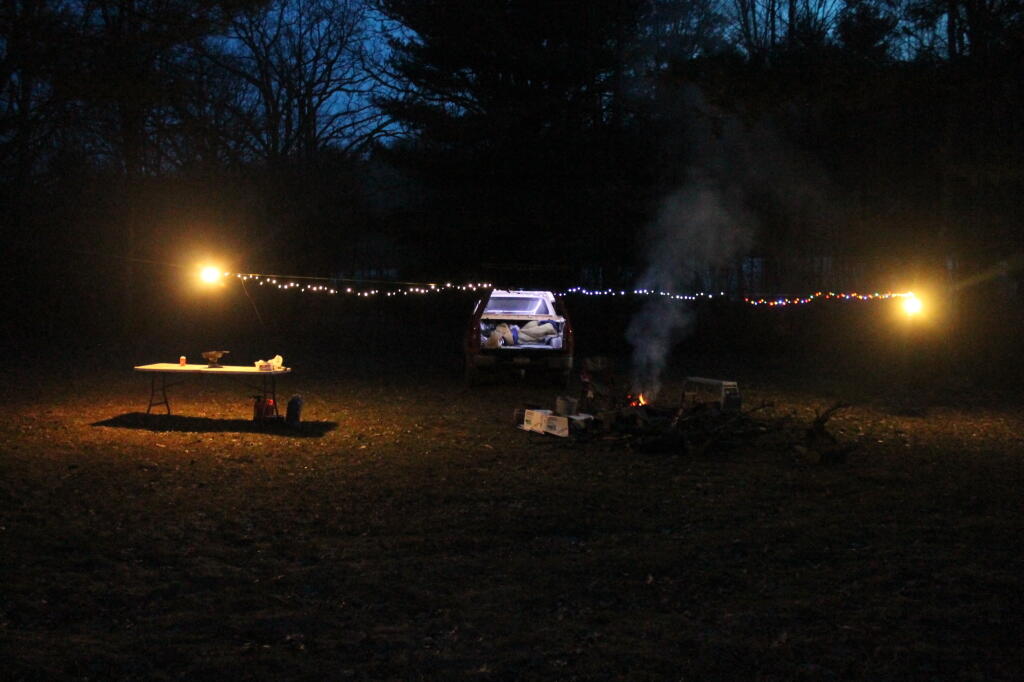
Right now, my primary source of camp lighting is a set of two 100-watt equivalent florescent bulbs, hooked to my truck’s inverter. Due to the nature of camping, and because things often get wet or dropped, they really do not last very long, and frequently need replacing.
When they don’t get broken, I usually bring them home, and save them to the some day in the future when I return them for recycling. When they break — I don’t freak out — I usually just chuck them in the campfire, and pack out the glass and unburnt debris in the morning. I don’t really freak out about the mercury. But for environmental reasons, I would like to get away from mercury-based lighting, despite the relatively tiny amount of mercury in each bulb.
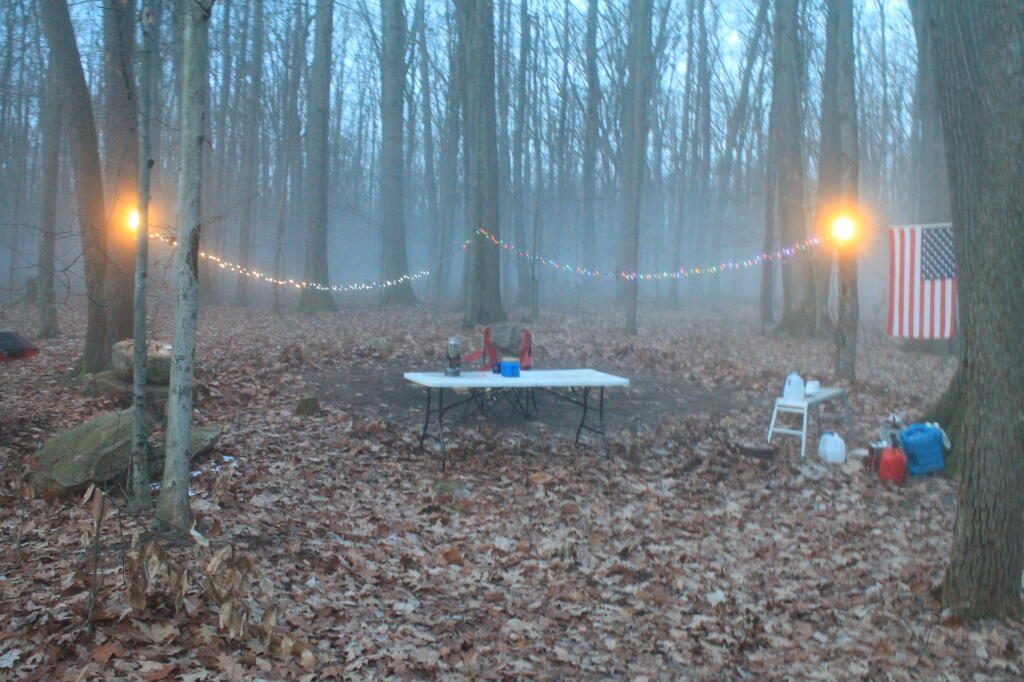
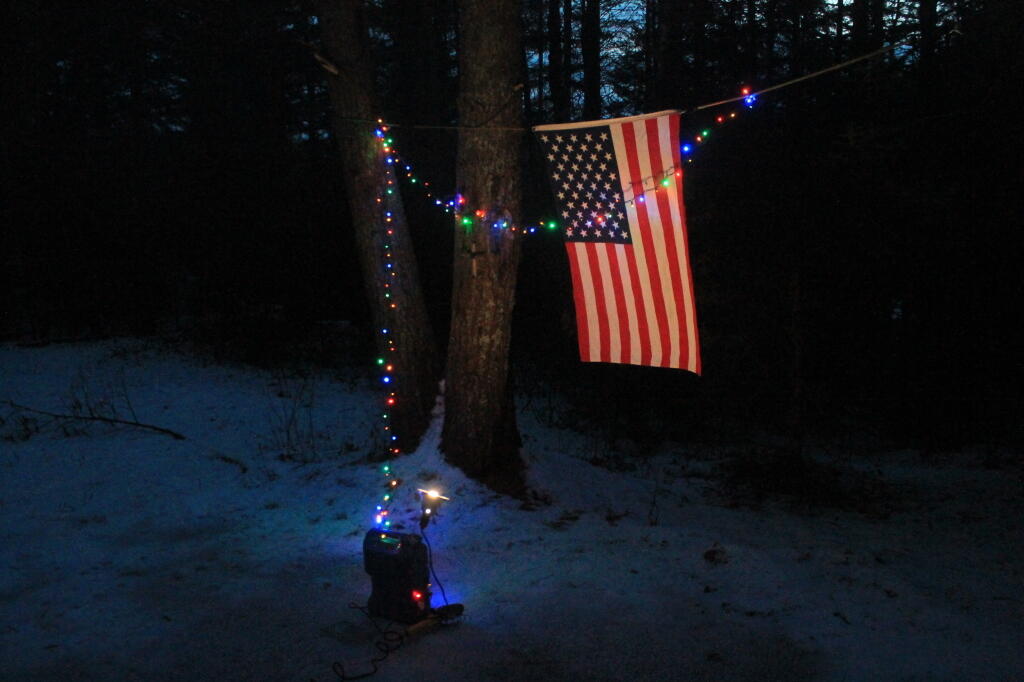
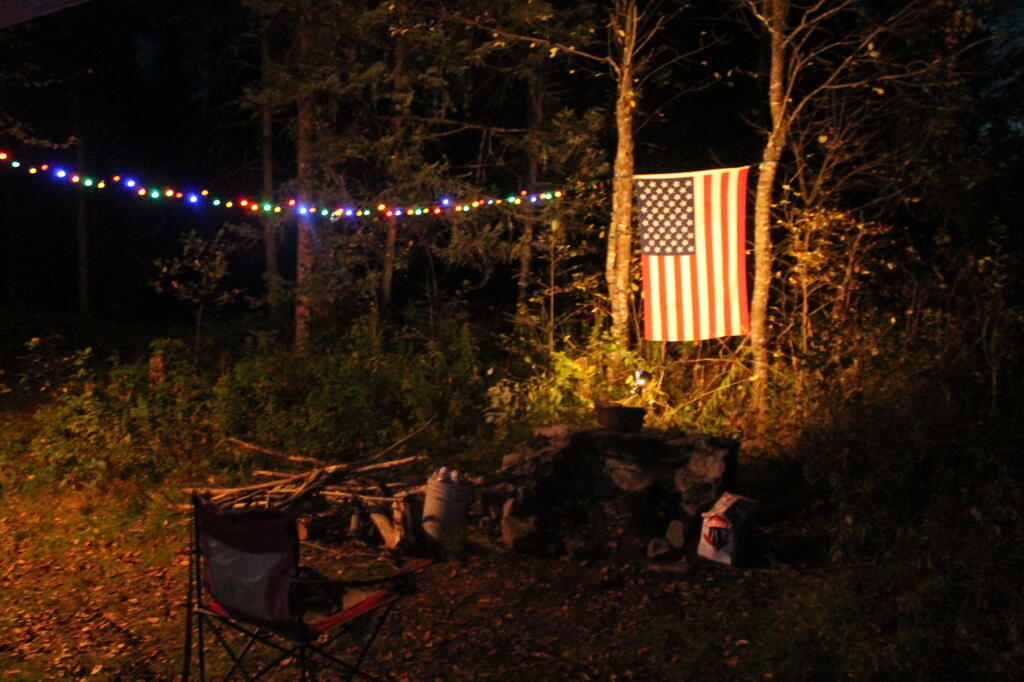
In recent years, I’ve been slow moving away florescent lighting whenever I can for camping. An early purchase of mine was LED Christmas light strings. The purpose of the Christmas lights was not so much for decoration — even though they’re pretty — but to provide a small amount of backlight to the campsite, so I don’t trip on things. A string of LED Christmas lights uses a fraction of the energy, even a smallish compact florescent uses.
This past year, I noticed that LED light bulbs have finally come down enough in price to reasonably affordable. I bought my first one this past July, a 40-watt equivalent bulb that uses only 7-watts of electricity, for a bright warm white lighting of my American flag. It not only seems quite durable and efficient, it always bright regardless of the temperature. It keeps the flag lit regardless of the weather.
With prices coming down even further, I bought a second LED bulb this fall for $10. It’s a 60-watt equivalent that uses only 10 watts of electricity. Best of all, even during the cold winter months, it works quite well. I wasn’t crazy about the heat shielding on the model I bought, but many of the newer ones lack the ugly heat shielding over the glass. Despite 15 degree temperatures, the 10 watt LED bulb kept things bright all night long.
LED lighting is the future. Fluorescent lighting not only contains mercury, it also uses more power and dims dramatically even under modest temperature drops. Florescent lighting is fine indoors, in relatively warm rooms. But it doesn’t work well outside, especially when camping, when air temperatures can 50 degrees or even lower in the even lower. Common fluorescent lamps dim in the cold, while LEDs shine their brightness, regardless of the cold.
Two years ago, when I bought my truck cap, I bought a series of LED strip lights to light up the cap. At the time, I had the choice between warm-color LEDs and cool-color LEDs. I bought the cool colored ones, as I thought they would look more neat in the truck cap. I’ve been thoroughly impressed with them since purchasing, and would consider having them as part of a future off-the-grid home.
What’s nice about LEDs is they are natively 12-volts, so they work well with batteries, solar-panels, and most renewable sources of energy. The onces I bought for my truck, required no transformer or adapter, as they worked on natively at that voltage. It’s also relatively easy to step down 120 volt AC power and run it through a diode to create 12 volts DC to run LED lamps. Most LED lights are natively dimmable with common thysor-based dimmers and require no ballast.
A decade ago, I toured an off-the-grid house in Clinton County. It was a neat home, and one of it’s best features was the use of 12-volt wiring for lighting. Rather then step up the voltage from the solar panels and batteries for lighting purposes, they chose to efficiently just use 12-volt DC lamps, mainly the relatively new LED bulbs and some halogens. They also had a large inverter to power 120-volt AC appliances and select number of florescent light bulbs.
I think LEDs are the future. I am sure after spending $10 a bulb to buy a third or fourth camp light, prices will come down even further, and I will look back and think what a waste of money.
United States oil consumption in 2012 will be about 4.7 million barrels a day, or 20%, lower than it would have been, if the pre-2005 trend in oil consumption growth of 1.5% per year had continued. This drop in consumption is no doubt related to a rise in oil prices starting about 2004.
The scene: a Manhattan art-house theater. The cause: a campaign against the gas drilling process known as fracking that’s being led by more than 100 celebrities, including Yoko Ono, Sean Lennon, Robert Redford, Mario Batali and Sullivan County resident Mark Ruffalo.
Outside, demonstrators in hazmat suits circle the theater. Inside, actress Scarlett Johansson attends a benefit screening of “Gasland,” the documentary film that has become the movement’s manifesto. Johansson tells The Associated Press that her “Avengers” co-star Ruffalo introduced her to the cause and that she found “Gasland” “incredibly shocking.”
Most people don’t understand the difference between energy conservation and energy efficiency. Yet, it’s an important concept to understand.
For the sake of this example, let’s take a 100 watt incandescent light bulb. You plan on leaving it on for an hour, which will consume 100 watts over the hour or 0.10 kW/h. Giving it some thought about the electricity you will use, you decide to reduce your energy consumption by either conservation or improving the efficiency of the light bulb.
Energy Efficiency.
You decide to swap the 100 watt incandescent light bulb for a compact florescent bulb, which uses only 26 watts over an hour. The 26-watt CFL is as bright as the 100 watt incadescent bulb, so you don’t end up losing anything.
When you choose energy efficiency you don’t lose anything by switching over to the more efficient technology. Indeed, with modern compact florescent technology, the electronic ballasts are flicker and lamp color resembles a regular bulb. The bulb doesn’t get hot and lasts longer. You always win with efficiency!
Government can easily set efficiency standards. Through laws and regulations, the US Energy Department can tell manufacturers that they must limit the amount of energy required to complete a desired task. That does not mean giving up features, or shutting off the light bulb. Yet, without government efficiency standards, it can often be difficult to find more efficent appliances, because manufacturers are lazy and do not feel the need to innovate.
Energy Conservation.
You decide to keep the 100 watt incandescence bulb and turn off the light after 15 minutes, so you sit in darkness for the rest of the hour. You only use 25 watts over the hour.
When you choose conservation, you save money, but give up utility in response. If their is enough day light, you can turn off a light bulb, and use the day light to read by. You choose to buy a smaller car or television set to conserve energy. It’s a personal choice, or as Dick Cheney famously said, “Conservation is a personal virtue”.
Government can not normally force people to engage in conservation. Unless fuel is rationed or they send a cop to your door to tell you to turn off that 100 watt bulb, you can choose to use as little or as much energy as you want as long as you pay for it. People can be educated on virtues of conservation.
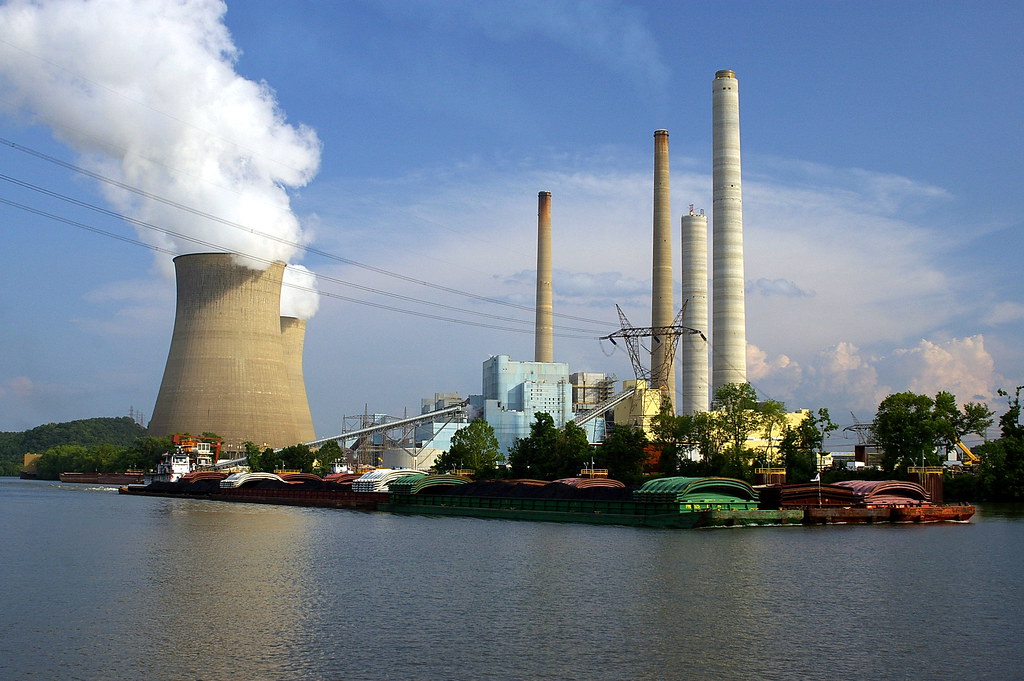
I was looking at the coal company advertisements that the “Quit Coal” project put up. Basically, those advertisements criticize “aggressive” regulations put forward by the government, and policies pursued by Congress to control air pollution. Not surprisingly, the folks that worked in corporations did not want to be told how to run their business, much less do something that would put uncertainty in their business.
Some will say that coal companies were actively spreading lies and falsehoods. Or did they actually believe in what they were advertising — a statement of belief of reality as it appeared to a coal power plant operator? Certainly many of the pollution control technologies of early 1970s were not to the point where well tested or even scaled up. A coal power plant operator, who always operated their plant one way, did not want to deal with the risk of changing operating methods and technologies.
Some will claim that coal-fired power plant operators were mostly motivated by greed. Yet, if you look at historically, did the clean air equipment on power plants actually cost that much — especially compared to existing revenue? Most upgrades to power plants were covered by small increases in electric rates, granted by public service commissions. If anything, more pollution controls meant more employees, and more opportunities for companies to profit because now operated more complex power plants in a regulated market that fixed their profit above cost.
In retrospect, the coal power industry is run by people who believe their mission — to provide inexpensive electricity, using proven technologies. These people who are resistant to change, because they don’t always understand what it will mean in the future.
The lessons of coal advertising is three fold:
Most people don’t actively lie due to moral conscience, nor do the corporations that represent the aggregation of people lie due to threat to litigation
People and corporations that make them up are highly resistant to change, because they fear the unknown and potential costs of unknown, even if the costs really don’t prove to be significant over the long run.
Government has an important role in setting emissions and efficiency standards, to force corporations, which represent large aggregations of people, to take calculated risks to improve their environmental preformance.
Often when people talk about “Climate Change Adaption”, they open discuss mega-projects that prevent theorical stresses that face our cities and urbanized areas. They often discuss large flood walls and other reduncency that would not exist if not for climate modeling.
Yet, there is a more sensible alternative. It’s the minor project and tweaks that can help societies adapt to climate change, that cost far less. Rather then looking at the worst case scenario, planners and engineers can consider likely threats using climate models, and when building new infrastrucuture make tweaks to make them more resilant to weather and flooding that might not have existed even a generation before.
A lot of climate change adaption will happen quietly without much public notice. Simply said, engineers are already that taking notice of recent events, and have to consider future models. Many of the changes, such as bridges designed for greater stream flow, are occuring quietly, without much public consideration.
As get we farther down the path of the changing climate, more infrastructure will fail. Settlement patterns will quietly change, as will land use. But there will be no press release or global stragety. People will adapt to what is right for them, just as infrastructure quietly adapts to a changing climate.