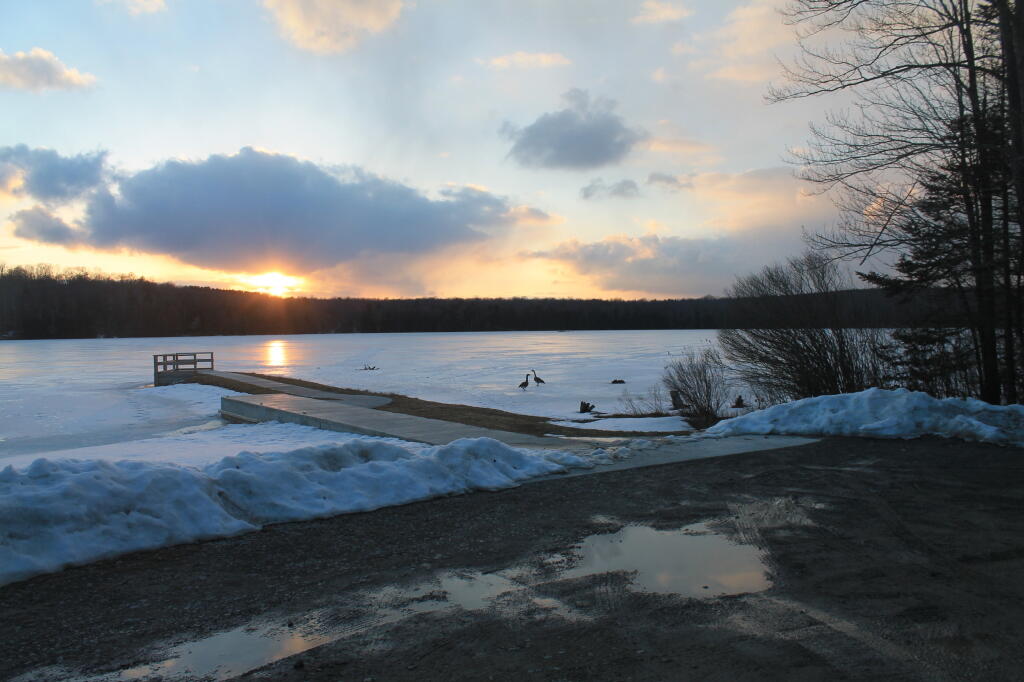
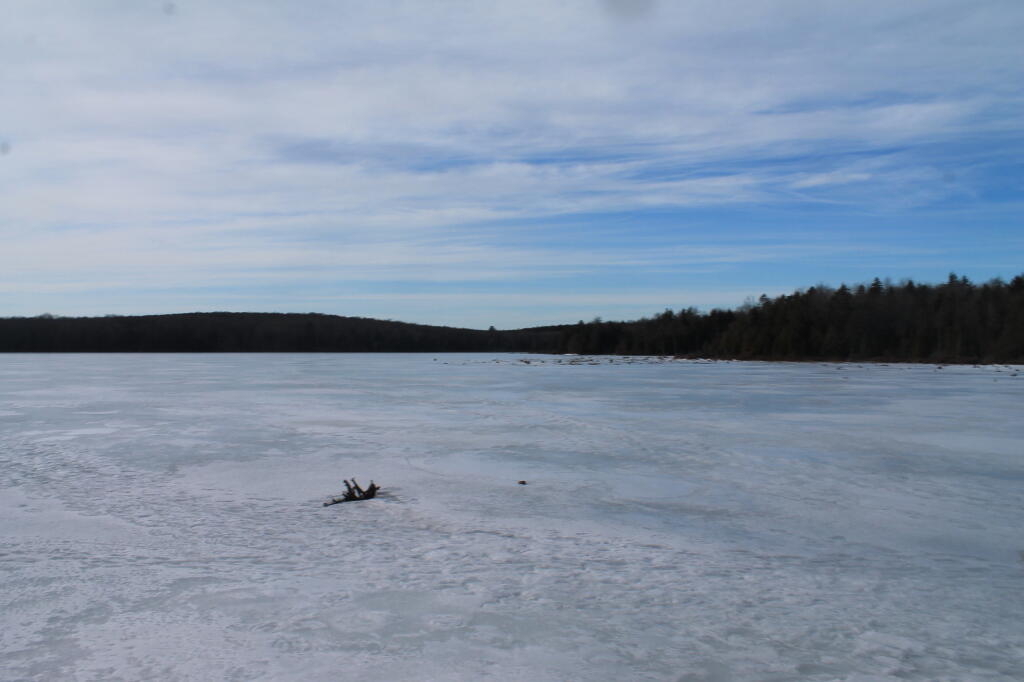
Balsam Swamp is a sprawling state forest that stretches almost 5.5 miles east-west across 4 towns. The area is very rural, and the landscape surrounding the State Forest is predominantly forested. Balsam Swamp State Forest is comprised of a mix of native hardwood forests, hemlock swamps, and conifer plantations. There are no designated recreational trails on the forest, but there is ample opportunity for self-guided day hikes to explore the diversity of habitats represented on this State Forest. Additionally, the western section of Balsam Swamp State Forest is adjacent to Five Streams State Forest to the south.
The main attraction of this forest is Balsam Pond. The impoundment is approximately 152 acres and is a popular destination for fishing and paddle boat sports. Balsam Pond is a warm water fishery that contains a mix of largemouth bass, smallmouth bass, chain pickerel, yellow perch, brown bullhead and sunfish. Tiger muskellunge have been stocked in the past with the last stocking occurring in 1995. However, there have been very few reports of anglers catching any of the adult tiger muskies. A shallow gravel boat launch is suitable for launching small fishing boats.
A small rustic camp ground is also located at Balsam Pond. Camping spaces are available at no cost on a first-come, first-serve basis and there is no running water or electricity. A fire ring, outhouse, and picnic table are provided for each camping space. A sign on Balsam-Tyler Road in Pharsalia designates the entrance to the boat launch and camping facility. This is a carry-in carry-out facility. Please do not litter.
The other day when I was walking up Ravine Road I passed that off grid homestead where they live in a trailer… 🏡
Well actually a mobile home is the proper term for these low cost, usually low income form of housing commonly seen in rural communities. They are kind of looked down upon, kind of seen as a home for people who can’t afford better. Most have very little residual value, much of their value isn’t the trailer but the land they reside upon.
So what exactly is a mobile home?
Typically it’s a prefabricated structure with a rectangular steel steel base where wheels are initially mountained on for towing, with 2×6 wooden floor joists and 2×4 wall joists. The walls are typically insulated with fiberglass insulation like most houses, although often thinner than code requires for modern houses.
The outside is weatherized with a plastic vapor barrier and then protected from the elements by thin aluminum sheeting that is nailed onto the beams and caulked to prevent water intrusion. The inside typically uses thin sheets of lightweight and thin pressed board made of wood chips and a binder material, some of which is covered by plastic resin to improve its waterproof nature. Appliances and plumbing are typically lighter weight to reduce the weight when towing onto the site and compensate for the smaller footprint of the building.
The problems that mobile homes face is multi-fold. One is the structure is lightweight and it can be difficult to upgrade to heavier materials like sheet rock or hardwood flooring can poses excessive weight on the floor joists, requiring extensive bracing to the ground. Insulation is another issue, as the thin beams don’t allow for the thicker insulation called for in the building codes for more modern buildings.
Why would I consider it?
Money is a big reason and what properties are available. I’d rather have more land and less house. 40 acres and a junk trailer beats 2 acres and a fancy suburbanite house. An off grid cabin, made from wood or more durable material would be better but sometimes that’s not an option. A junkey old trailer could be demolished with useful parts salvaged for other purposes.
Why might I not consider it?
Getting rid of a nasty old structure can be a lot of work. Even if you can burn a lot of the debris, scrap the metal pieces, your still left with a lot of junk that doesn’t burn that has to hauled off to the landfill or used as back fill on your property. Moreover, some of that rubber and plastic stuff used in mobile homes is really nasty to burn even if you are in a fairly unregulated area that let’s you burn what you want after notifying the fire department. It might seem like a good deal on paper but how good of a deal really is it?
Honestly though…
The videos on YouTube are quite fascinating to watch on this topic. While I certainly grew up in rural area where a lot of people lived in trailers I didn’t know much about the structures and the tear downs, repairs and demolitions on YouTube are fascinating – along with learning how all the different materials go together are used and interact in the structures.
I am working on a map of how many New York State’s land mass you can fit into other states land mass. I will post later in the week. But in the mean time…
You can fit 12.1 states with the land area of New York in Alaska, 5.5 in Texas, 3.09 in Montana, 1.69 in Minnesota, 1.46 in Minnesota.
Aspartame is now as cancerous as drinking beer and wine. It’s big news, especially in natural health circles. Of course, alcohol is terribly unhealthy even in moderation – a lot of the people who defend drinking alcohol are a lot like those who defend eating dark chocolate and bacon. All good things, but be honest they are not healthy and should be considered an unhealthy treat only engaged in very sparingly.
Americans have long had this fear of science and technology. Some of it is justified – the history books are full of stories about advances like DDT, asbestos, leaded products whose uses seemed like a good idea at the time but ended up with tragic long term consequences. But those are mostly unknown risks.
People have been suspicious of artificial sweeteners since the 1960s. Cyclamate was banned in 1970 in the United States based on dubious science and lobbying by the sugar beets growing farmers in the Midwest which didn’t like the competition, despite the rest of the world viewing it as largely safe. Aspartame has been viewed with suspicion ever since. A lot of money and time has gone into studying the safety of aspartame and the results are mixed at best though it seems that in general the risks of aspartame consumption are relatively low.
A bigger concern with artificial sweeteners and food additives like MSG isn’t their health concerns but what they are masking underneath. Artificial sweeteners and food additives are often added to junk food loaded with calories, salt, sugar and fat – and have very little nutrient value or stomach filling protein and fiber which encourages overeating. There is this desire by Americans to blame the chemicals they are eating and not the underlying crappy food that the chemicals are masking.
If you mix aspartame at home with non fat unflavored Greek yogurt and frozen strawberries, what you are still eating is quite healthy. If you put MSG on kale and brown rice, you are eating good healthy food. But the same aspartame used in sugar free ice cream or MSG used on Dorritos is junk food. Chemistry can be good or bad depending on how it’s used – to enhance flavor or mask flavors of junk foods.
President Donald Trump has many times suggested that people should move from Upstate New York to places where there are more jobs. In his quote to the Wall Street Journal about two years ago:
“You’re going to need people to work in these massive plants,” Trump told the newspaper. “I’m going to start explaining to people: When you have an area that just isn’t working like upper New York state, where people are getting very badly hurt, and then you’ll have another area 500 miles away where you can’t get people, I’m going to explain, you can leave. It’s OK. Don’t worry about your house.”
This is pretty solid economic advice – people should consider moving to places where there are better jobs – so they have more choices in employment, more possibilities to make more money.
But I’m sure the President is aware there is more to relocating than just selling your home, renting a trailer to tow behind your pickup and moving to a different part of the country. It’s hard to leave your family and friends to move from your hometown to a place where there are more jobs.
Moreover, nowhere are sustainable, long term jobs popping up in the rural countryside or small towns, all of the action in American capitalism is happening in the big cities and metropolitan regions. Like New York City or Los Angeles. You can’t expect to move from rural or small town New York to somewhere in the south or Midwest and instantly have a better life. Part of the price of living in farm country or the mountains is lower wages and less economic opportunities.
Simply said automation and mechanization has eliminated a great deal of rural and small town jobs. Almost all Americans economic activity occurs in large Metropolitan Areas and their suburbs. Most rural areas and small cities are almost entirely dependent on government jobs and welfare, such as school teachers, highway workers, and social security payments even if the legacy industries like agriculture and manufacturing which employee few are highlighted by the politicians. While living in the country is cheaper – you can meet your basic needs more on farm or on the homestead, you still are giving up economic gain by not moving to a big city.
Now to be sure there are political reasons to consider moving to another state – gun laws, restrictions on fireworks, open burning, or cannabis – for example. Rural freedom is better in red states for sure, where the government is closer in sync with the needs of farm families and other rural residents. Or you just want to pay less in taxes in exchange for less services. Rural states lack the costly infrastructure and legacy needs of big states Those are valid reasons for going red state for country living. But not necessarily alone in the search for a better job when most of America outside of metropolitan areas is struggling.