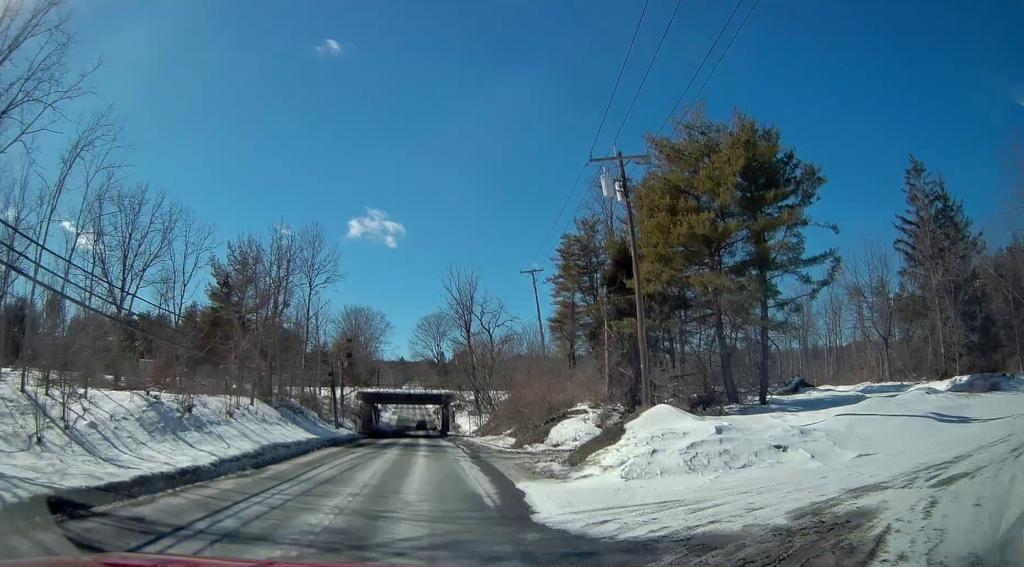
Which is good because it’s mad cold, and actually it took longer then expected so catching the bus back home would have been a challenge or required me to bring wet wash back home. Got a good machine load full heaping over the bike, plenty of clothes for the rest of week.
The clothes rode on the bike just fine, 👖 I was able to load them on the bike. I was originally going to do the bus, but yeah the bike saved a buck thirty and was good. I had a full small load but I could have actually a strapped a somewhat larger bag on my bike. I was though annoyed that I left my headphones 🎧 home when I was down at the laundromat, but I listened to YouTube quietly, and there wasn’t a lot of people at laudromat. I would have ridden home while the wash was going if it wasn’t so cold and dark. I am glad I did it last night and not this surprisingly awful cold late February morning.
I slept well last night but still feel a bit of a haze, as it was bitterly cold once I woke up this morning. I thought we done with the real cold of winter, but it was a hard reminder when I got up and heard the wind howling around, and the mercury in the mid-teens. I don’t know why I was tired, granted I was in bed by 8 PM but not asleep until 9:30 AM and half-awake by around 4 AM though I didn’t get out of bed until closer to 5:30 AM. Nice how much sunlight there is in the morning, it will kind of suck in three weeks, but rm
Honestly, I’m actually back on the train of maybe a MiniZilla would be a better fit, as some people say they get better fuel economy compared to GodZilla while others are kind of a mash. I still think the 7.3 and TorqueFright is better then 6.8 and TorqueFright-G or whatever they call it, is a more reliable option, but will it even make a difference? And while I was thinking the FX4 package was essential, those skid plates and the hill descent control, while cool and marketable for resale, really is kind of silly because I’m not going to be rock-crawling an gianmous SuperDuty. 💭 But on the other hand, if I’m paying so much money, who cares about a a few thousand more to get the truck I truly want. 💰 The upfitter switches, bigger alternator, extended long bed seem like far higher priorities in my mind, though the 6 3/4 foot bed I guess isn’t that much shorter then 8 foot. But that’s where I camp, so I should go for the long bed.I don’t know, next week when I test drive one and look up close, I’ll have more direction in my mind. Especially when I get actual out-the-door prices, as 100% of listings is bull shit and imaginary.
After test driving next week, 🚘 I will have a better idea 💡 what I actually want, and start getting in some real proposed prices, rather then the made up ones I keep seeing on dealership websites that don’t include fees and taxes. Truth is the trucks I am looking at are within my budget even if I add in 10% for taxes and fees, but I know that is seriously overpaying for the truck, so I need to negotiate. ⚖️ I’d rather not have to play the finance game with a dealership, study a loan agreement and have to cut two or three checks and wait for the title in the mail, ✉️ but whatever. I guess all this study on negotiation and dealership practices just has my nervous. Each day now I check roughly 10 local dealership websites to see prices and inventory, along with the Ford site, to see what dealers are proposing to charge, just so I can see what trends are happening in the industry.
Truth is it keeps me busy and my mind active during the doldrums of winter 🧠 figuring out what my next rig should look like and how I want to build it out, much like two years ago when I was studying buying a house and homestead or maybe building that off-grid cabin. 🏡 It was an interesting thing to learn about, and maybe ultimately I don’t end up getting a truck. It’s fine to walk away. That house to my parents house was fine, and interesting to tour, and it would have been inexpensive even after fixing it up, but it wasn’t right for me, and I didn’t want to have to drive to work every day. I am not opposed to moving back out to country when I retire, 👴🏻 but right now I kind of like living in city.
Reality will be a third scenario: paced obsolescence and growth. Productivity is always positive for society, but it doesn’t change things overnight. Like the concept of creative destruction introduced by Joseph Schumpeter, new technology starts at the high end, where it is economically feasible (AI for coding and customer service today) and then works its way down over decades, seeping into the economy sector by sector. But this time it’s different, we hear. Yeah, right
Investing $500 per month from August 2000 through April 2013 involves 153 monthly contributions, totaling a principal investment of $76,500. Depending on the chosen investment vehicle, the final amount varies significantly. Notably, this period includes two major market crashes: the Dot-com bubble (2000-2002) and the Global Financial Crisis (2008).
Investment Scenarios
S&P 500 (Dividends Reinvested): Your balance would have grown to approximately $112,000. Despite starting at the peak of the dot-com bubble and enduring the 2008 crash, consistent monthly contributions (Dollar Cost Averaging) allowed you to buy more shares when prices were low, leading to a total return of roughly 46% over the principal.
High-Yield Savings/CDs: Based on historical interest rates which averaged around 1.5% – 2.5% for much of the 2000s before dropping below 1% after 2009, your balance would have reached approximately $88,000 – $92,000.
Cash (No Interest): Simply saving the money without any growth would result in exactly your principal: $76,500.
Key Data & Context
Market Volatility: The S&P 500 began this period around 1,460 (August 2000) and ended near 1,590 (April 2013). While the price index only grew marginally, reinvesting dividends was critical for growth.
Inflation Impact: $1,000 in 2000 had the same purchasing power as approximately $1,352 in 2013 due to a cumulative inflation rate of 35.3%. This means your $76,500 in total contributions was worth significantly more in terms of “buying power” when you started than when you finished.
The “Lost Decade”: This specific timeframe is often cited as a difficult period for investors because the market effectively went “nowhere” for 13 years if dividends were ignored; however, monthly investing turned this stagnation into a gain.
Compared to another tougher time period
The 1970s were tougher times though due to inflation. Politicians of both parties play too carelessly with inflation, it’s by far the single most destructive thing a politician can do to a country.
Investing $50 a month from January 1968 to December 1982 (a 15-year period) into an S&P 500 index fund with dividends reinvested would have resulted in a total contribution of $9,000, growing to an estimated end balance of roughly $15,000 to $17,000 by the end of 1982.
During this 15-year window, the U.S. experienced “Great Inflation,” with the Consumer Price Index (CPI) rising by approximately 177%. Because your end balance (~$16,000) was less than the inflation-adjusted value of your contributions (~$25,000), your investment actually had a negative real return. In 1982 dollars, you effectively had less “buying power” than the total money you had tucked away over those 15 years.
Investing $50 a month in a standard passbook savings account from 1968 to 1982 would have been significantly worse than the stock market, primarily due to government-imposed interest rate caps known as Regulation Q. Under Regulation Q, banks were legally prohibited from paying more than about 5% to 5.5% on savings accounts for most of this period. Even when inflation hit 13.5% in 1980, your bank was often stuck paying you only 5.25%. Because inflation was much higher than the interest rate cap, savers essentially paid a “tax” on their purchasing power. By 1979, the real return on these accounts reached a low of -5.8%.

 I was able to load them on the bike. I was originally going to do the bus, but yeah the bike saved a buck thirty and was good. I had a full small load but I could have actually a strapped a somewhat larger bag on my bike. I was though annoyed that I left my headphones 🎧 home when I was down at the laundromat, but I listened to YouTube quietly, and there wasn’t a lot of people at laudromat. I would have ridden home while the wash was going if it wasn’t so cold and dark. I am glad I did it last night and not this surprisingly awful cold late February morning.
  I thought we done with the real cold of winter, but it was a hard reminder when I got up and heard the wind howling around, and the mercury in the mid-teens.
  I don’t know why I was tired, granted I was in bed
  by 8 PM but not asleep until 9:30 AM and half-awake by around 4 AM though I didn’t get out of bed until closer to 5:30 AM. Nice how much sunlight there is in the morning, it will kind of suck in three weeks, but rm
 as some people say they get better fuel economy compared to GodZilla while others are kind of a mash. I still think the 7.3 and TorqueFright is better then 6.8 and TorqueFright-G or whatever they call it, is a more reliable option, but will it even make a difference? And while I was thinking the FX4 package was essential, those skid plates and the hill descent control, while cool and marketable for resale, really is kind of silly because I’m not going to be rock-crawling an gianmous SuperDuty. 💭 But on the other hand, if I’m paying so much money, who cares about a a few thousand more to get the truck I truly want. 💰 The upfitter switches, bigger alternator, extended long bed seem like far higher priorities in my mind, though the 6 3/4 foot bed I guess isn’t that much shorter then 8 foot. But that’s where I camp, so I should go for the long bed.I don’t know, next week when I test drive one and look up close, I’ll have more direction in my mind. Especially when I get actual out-the-door prices, as 100% of listings is bull shit and imaginary.
 just so I can see what trends are happening in the industry.