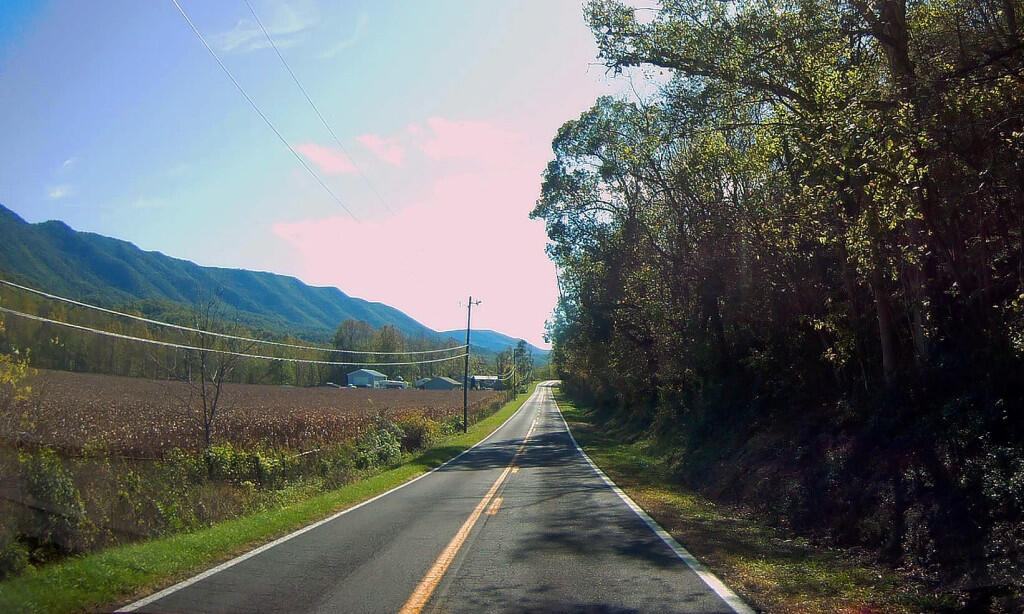
The Rattlesnake Hill Wildlife Management Area is a 5,100 acre upland tract, situated approximately eight miles west of Dansville, New York. Roughly two-thirds of the area lies in southern Livingston County, while the remaining third lies in northern Allegany County. The tract was purchased in the 1930’s under the Federal Resettlement Administration and is one of several such areas turned over to DEC for development as a wildlife management area.
The area is appropriately named after the Timber Rattlesnake, which may be occasionally found in the more remote sections of the “Hill”.
The area offers an interesting blend of upland habitats such as mature woodland, overgrown fields, conifer plantations, old growth apple orchards and open meadows.
The area is inhabited by a variety of game species and is open to public hunting. The white-tailed deer, wild turkey, ruffed grouse, grey squirrel, cottontail rabbit and woodcock are found on the area. An occasional snowshoe hare may be observed adjacent to thick creek bottom brush or conifer plantation habitats.
A number of small marsh units have been developed and provide limited hunting for waterfowl. Some of the area’s furbearing species such as mink, beaver and raccoon may be occasionally viewed at these marsh units.
Here are some key points in John Boyd Thacher State Park’s history:
Early 20th Century: The park was established in 1914 and originally named the Helderberg State Park. It was created to provide the people of Albany and the surrounding region with a natural recreational area.
John Boyd Thacher: In 1938, the park was renamed John Boyd Thacher State Park in honor of John Boyd Thacher II, the Mayor of Albany from 1886 to 1887 and a prominent local figure. He was an avid naturalist and conservationist who played a significant role in preserving the Helderberg escarpment.
Civilian Conservation Corps (CCC): During the Great Depression, the CCC was active in the park. CCC workers built many of the park’s facilities, including trails, picnic areas, and the famous Indian Ladder Trail.
Indian Ladder Trail: This trail is one of the park’s main attractions, taking visitors along the Helderberg Escarpment, offering stunning views of the Hudson Valley. It is named after the original wooden ladders that were used to navigate the steep cliffs.
Geological Significance: The park is known for its unique geological formations, such as limestone caves and fossils dating back hundreds of millions of years. The Indian Ladder Trail provides an opportunity to explore these geological wonders.
Today: John Boyd Thacher State Park continues to be a popular destination for hiking, picnicking, birdwatching, and enjoying nature. It offers a variety of recreational activities and scenic vistas, making it a beloved spot for both locals and tourists.
The park’s history is intertwined with the conservation efforts of John Boyd Thacher II and the contributions of the CCC, and it remains a testament to the natural beauty of the Helderberg Mountains.
1) Television Stations – Nothing gets people watching more television then parents grieving over dead children. More viewers means more advertising revenue. People who feel sad are more likely to go out and buy things to be happy. Billions of dollars in marketing possibilities.
2) Police Officers – Over-time means they take home more money. Moreover, they are able to get make the case to the public that they deserve the latest equipment and toys, and that they should be allowed to expand their forces and obtain higher wages and enhanced pension benefits.
3) Retired Police Officers – Many school districts and public places like malls are hiring retired law enforcement as security consultants.
4) District Attorneys – D.A. are able to make their case for re-election by showing they are taking steps to be tough on crime, they are given opportunities to speak and raise their public profile, which helps as they seek higher office with more power and increased pay.
5) Politicians – Politicians have the ability to champion new laws that can play to their base. They can push gun control or take a tough on crime posture, even if their proposals are either meaningless or even harmful to law abiding citizens.
6) Security/Defense Contractors – While mass-shootings are an extremely rare, very low-risk event, businesses, governments, and schools feel public pressure to invest billions in completely needless upgrades to “harden” buildings from attacks.
7) School Employees – Even school employees benefit from mass-shootings, as it’s an excuse to take taxpayer-funded junkets to learn about the how they can improve safety at their school. Who doesn’t mind spending a few hours in a lecture hall to discuss grim topics with consultants if it’s taxpayer-financed junket to Las Vegas or the Atlantic City (with meals and lodging paid for at taxpayer expense)?
Still pretty dark out but the sun is rising. It should be interesting to see how large the hole is next to my apartment when the landlord decided to dig up where my kayak is normally stored to fix a broken waterline as part of the renovations. He did pressure wash some of the mold off the building and looks like he is fixing some of rot around my door which is good I guess.
I was actually surprised 🤨 to see them working into late into the evening, especially now when I would think Mr. Preska would be bailing hay and chopping silage but maybe not yet. 🐮 I just wonder when the project will ever be done and when I’ll get new neighbors or face the inevitable eviction notice.
Yesterday was surprisingly quiet, 🖥 though I keep volunteering for more work and making my data processing work more complicated then ever was done in the process. But I want to do it right, provide value added services to my employer so they can maximize the value of the data they have. 🍬 I don’t normally eat candy or processed sugar, but those M&Ms, fudge bars and diet soda at campaign committee were pretty damn good. 😋
The way I look at it is I’m becoming a damn good R Statistical Language programmer, 🤓 good at manipulating and processing data for what it’s worth. I know that and a buck fifty will get you on bus, and that R Statistical Language isn’t a real programming language, especially if you aren’t using it for scientific purposes. But it’s damn good for processing and manipulating reasonable-sized data like the state voter file broken down by Assembly distirict. Or spatial data and GIS processing. I know Python and Pandas is more popular and probably somewhat faster but on the whole I think R is a better tool.
The left channel of my ear buds broke again 🎧 but I was looking online at what Walmart and saw that now they have low-cost ear buds that aren’t wired between the ears, that won’t have the issue of the broken cables, or any cable for that matter running between the ears. 👂 Wasn’t all that long ago when headphones were simply just wired. I have to admit I’m not the most up on technology, but I like listening to music at work and when I’m home. 🏡
Tomorrow I might take the Nature Bus 🚍 to Thacher Park for a while before the rain starts, especially if they are continuing to dig and work on the apartment on Saturday. Going to rain in the afternoon, ☔ which will be a good opportunity to read and look at various properties on Zillow.
Off to work shortly, 🏢 one more busy day in the office before the moratorium sets in and then I can focus on more long-time projects for next year. Plus maybe work remote sometimes on Fridays and even Mondays when it’s quiet so I can do so from camp or the library. 🖥
Shifting gears on a mountain bike is essential for maintaining a comfortable and efficient ride on varying terrains. Here are some tips for shifting on a mountain bike:
Anticipate Terrain Changes: Try to anticipate changes in terrain, such as uphill climbs, downhill descents, or flat sections, in advance. This will help you prepare for the right gear changes.
Use Both Shifters: Mountain bikes typically have front and rear derailleurs, each with multiple gears. Use both shifters in combination to find the right gear ratio for your current situation.
Avoid Cross-Chaining: Cross-chaining occurs when you’re in a big chainring (front) and a big cog (rear) or a small chainring (front) and a small cog (rear). This can strain your drivetrain and reduce efficiency. Try to avoid extreme cross-chaining.
Shift Before It’s Too Late: Shift gears before you reach a steep climb or descent. Shifting under heavy load can damage your drivetrain and make shifting less smooth.
Light Pedal Pressure: Lightly pedal when shifting to ease the transition between gears. Don’t push too hard on the pedals while shifting.
Listen and Feel: Pay attention to the sound and feel of your bike. When you shift, you should hear a clean and crisp transition. If it’s noisy or feels rough, consider adjusting your gears or having your bike serviced.
Practice: Shifting effectively takes practice. Spend time on different trails to get a feel for how your bike behaves in various conditions.
Fine-Tune Your Gears: If your bike has barrel adjusters, you can fine-tune your gears’ indexing. This can help ensure precise shifting.
Maintain Your Bike: Regularly clean and lubricate your drivetrain to keep it in good working condition. Dirty or poorly maintained components can affect shifting performance.
Seek Professional Help: If you’re unsure about adjusting your bike’s gears, consider visiting a local bike shop for a professional tune-up or advice.
Remember that the right gear choice depends on the specific terrain and your personal fitness level, so experiment to find what works best for you on different trails.
When I was young, being a computer geek or a nerd was spending countless hours in front of a computer screen eating hot pockets for endless hours, being super brilliant writing the next great code that would somehow change the world. That’s what the movies and popular culture said.
I was told there was basically three paths one could take with computers – become a system administrator providing tech support, write the next Microsoft Word, or maybe become a game developer. I guess you could throw in web designer too. Chances were that as a boy from the sticks probably the best hope was to become a system administrator, baby sit servers and provide tech support for Microsoft Windows and reset passwords when people got locked out of their computers.
Being a geek in those days was a lonely miserable life, or so we were regularly told in popular culture. It was a life locked inside a windowless server room or a cubicle bull pen, a life working in a large suburb, driving from one’s tacky suburban home through a web of dead end streets in a Honda Civic to a massive parking lot in a suburban office campus of UniCorp Global to spend another day running job control lists from the List of Lists books. I actually had a job like that in college. I understand why people go postal.
Computer geeks weren’t allowed to have friends or go outside. They’re wasn’t time for playing in the woods, go hunting or fishing, you couldn’t live out in the country, have livestock or guns. Computer geeks were only allowed to have computers and live in the suburbs and work for UniCorp. Don’t you know the rules.
Computer science was about math and more abstract math. Calculus and endless integrals and imaginary numbers. Writing complicated and tedious code, spending endless hours debugging thinking about complicated code, impossible for mere mortals could understand. Written all by hand, by typing endless meaningless sentences that made no sense except to computers. No APIs or libraries to assist you, everything had to be done by hand.
Of course, things start to look different when you think about computers not as all encompassing but just as a tool. Not an ends, but something you use to better accomplish other parts of your life or business. Very rarely with computers do you use Assembly language or machine code anymore, and there are rich libraries, APIs and even drag and drop interface designers that do much of the hard work behind the scenes. Unless you are writing a compiler or a device driver, it’s rare to write low level, tedious pages and pages of code.
For some of the stuff I do I will do basic trigonometry although most of the knowledge I gleen is from examples on the internet. For things like understanding electricity and alternating current, some calculus is required but it’s not an everyday thing with programming. The precalcus and chemistry classes I flunked my way through really had no bearing on skills needed for writing code.
But I’ve also learned that being able to program and be fluent in many computer languages doesn’t mean giving up your friends, your hobbies and interests. And in most businesses, computers aren’t programmed for the sake of programming but to serve a business interest. You write code to support a farm’s record keeping, an insurance business claims or understanding a politicians election results. You don’t have to live in a big suburb to be a coder.
I’ve learned that learning technology and how to code actually saves time in the long run and makes you more effective in what you do. But technology is just a tool, it doesn’t have to be self consuming or dominate who you are. You can utilize technology to save time and learn without it dominating your life. You can have a life beyond programming.
Tobler’s Law, often summarized as “Everything is related to everything else, but near things are more related than distant things,” is a fundamental principle in geography and spatial analysis. It suggests that the degree of interaction or similarity between two locations decreases as the distance between them increases.
In other words, geographic proximity tends to influence the level of connections and relationships between places. This concept is widely used in various fields like urban planning, economics, and social sciences to understand spatial patterns and relationships.
Tobler’s Law of Geography and the concept of an inverse distance relationship are closely related. Both ideas emphasize the importance of distance when considering spatial relationships.
Tobler’s Law states that proximity matters: things that are closer together are more related than things that are farther apart. This aligns with the concept of an inverse distance relationship. In an inverse distance relationship, the strength of a relationship between two variables decreases as the distance between them increases. Mathematically, this relationship can often be described by an equation where the effect or influence of one variable on another diminishes as the distance between them grows.
In geographic terms, the inverse distance relationship supports Tobler’s Law by providing a quantitative framework to explain how spatial interactions, similarities, or influences decrease as distance increases. Both ideas underscore the significance of distance as a key factor shaping spatial patterns and relationships.
West Virginia is one of many charming states with a lot of good rural land to explore. I’ve certainly enjoyed my road trips down there, and I will probably go back there this autumn. There is are two off-grid living channel I follow on the Youtube, and it’s wild and wonderful down there.
But I’m not sure I would choose the state to live in. For one, the summers are brutally hot even in the mountains and the winters are cold and icy. The roads are often steep, twisty and narrow which makes vacation fun, but probably not so fun when they are covered with ice and snow and you have to get other places.
The politics are strange in the state, while the people are friendly some of the laws are not. I am no fan of the idiotic boosterism for coal energy, that is literally tearing apart the land and leaving it with massive heaps of coal waste, ruining trout streams, and fouling with air with emissions — to say nothing of accelerating the harm of climate chgnage. Scrubbers help, but even the most basic of controls are often resisted at local levels, because coal is so uneconomic at this point compared to other generating plants and renewables.
West Virginia gun laws are good, but in many rural parts of state shopping opportunities are quite limited with even Walmart a distant trip away. Hunting and fishing opportunities are pretty good, especially in the mountain area around the National Forest are great. Restrictions on trash burning, and mandatory trash pick up go against my desire to live as close to zero-waste and zero-landfill as possible, reducing and managing the remaining waste by composting, reuse and burning on my own land.
Most people who live in West Virginia, especially rural West Virginia will tell you, they would never want to leave it — as it is truly is almost heaven. But the truth is, opportunities to make a decent living, outside of the dwindling jobs in the coal industry, is pretty darn hard.