For the longest time, since the implement of the burn ban in 2009, I have seriously thought about leaving New York State. I’ve watched in frustration as do-gooders continue to lock down our public lands in the name of wilderness preservation, demanding more restrictions on our gun rights from the SAFE Act to SAFE Act 2.0 that made it illegal to purchase ammunition without a background check, or even a simple .22 “semi-auto” rifle for hunting squirrels without a pistol permit like I bought before SAFE Act 2.0 for $150 a few years back. Or the games people and towns go through to register and ride ATVs on private trail systems, because state politics is forever hijacked by the environmentalists. Or how well-meaning, but the still problematic drive to decarbonize the state is leading to thousands of acres of farmland and open space to be developed, at the same time electricity prices continue their spiral upwards.
My complaints about the state are well known to anybody who regularly reads the blog. They are pretty obvious to anybody who lives in Upstate, especially in rural areas. It’s not hard to see who often gets the raw end of the stick in New York, when more then 2 out of 3 New Yorkers live in the metropolitan region, where the state’s liberal policies may be idealistic but come back to bite those who don’t live in the city or suburbs. It kind of sucks to live in Upstate New York. But at least for me, it’s a Faustian bargain. Or as Dan Halloran said to then-Senate Democratic Leader Malcolm Smith, when he tried to buy a spot on NYC Mayor’s ballot — “It’s All About the F-ing Money.”
That’s how I’ve felt about New York for many years. I stay because I make pretty good money, especially nowadays. Maybe I feel like I’m still a bit underpaid, but I do make good money. To leave New York would be to leave my job and leave the money behind. And nowadays, as the Data Services Director, I would not only be leaving behind the money, but a job that I actually really kind of like that challenges my mind, involves working with code and scripting, and being able to work with smart programmers and computer system administrators. I get paid to write SQL queries, export databases, clean data and work with a great team. It’s the kind of career of wanted for a long time, but didn’t have an easy way to transition into, as my college degree was in Political Science, as I found the advanced theoretical math required for Computer Science to be difficult. Plus I’ve always had these anti-technology bent, in part learning how toxic these devices we call computers are both from the hazardous materials they are made out of and how they warp our brains and our politics.
At this point it’s just too hard to walk away. I told myself for years I’ll move out of state the first possible minute that I can reasonably afford to — be it once I have enough money saved up, once my parents pass away, or once I retire. The date just kept getting pushed further and further into the future. And while the news headlines about what state government was doing to make the lives of Upstate New Yorkers worse and worse really grinds at me, one of the best way to avoid it, is to just turn it off. Don’t follow the news very carefully. Most of the most objectionable things that the do-gooders are trying to force our throats, are actually quite unpopular and as such aren’t vigorously enforced despite the stern warnings of the politicians. Watch what is happening in reality, on the ground by real people, and not what the media and politicians are saying.
I am quite fortunate to have a great career, good pay, and a life that has been fun over the past 17 years since I graduated from college. I have enjoyed the travel, camping, hiking, spending time in the woods and having fires. And as much as I have romantic visions of moving to a rural, free state like Missouri, South Dakota, Idaho, or West Virginia, the truth is things aren’t all wine and roses there either. Nearly every state has bad laws, stupid politicians who egos trample on your freedoms. And the Faustian bargain is real — no place I could move would have the career opportunity or make the money that I am currently making. It’s not like I object to my work, I’ve had the chance to work with many great clients over the years, and even when I don’t agree on all issues, I do agree with them on many things, and New York has excellent consumer protections and those for renters. After all, I am a liberal Democrat, maybe of a wilder breed. And it’s not like we shouldn’t be doing something to address to climate crisis, even if I think some of state’s actions by the urban politicians are a bit misguided.
Faust in the bible made the mistake of not only selling his soul for twenty-four years of supreme knowledge, but squandering his gift. Faust didn’t maximize his gift, use it for good though he sold his soul to get it. I have been a careful steward of money over the years, living frugally and carefully saving and investing for a better tomorrow — namely that off-grid cabin that I wanted in a free state. While I am realizing that the second half of the dream may not be possible if I want to keep up that part of the Faustian bargain, it’s not necessarily to say much of the first half of the dream isn’t possible to largely make into a reality, duly noting the constraints of state building code, the various laws as implemented as rules in reality, and the long unpleasant commute that will involve to get far enough away from cities for at least some freedom. The thing is I could wait and save even more — but cost of land and building is no longer the major constraint — but number of years I can practically expect in my second half of my life. Old age, time, is cruelest joke as you get deeper into your forties.
I don’t like all the compromises, but maybe it’s a way to live with myself, and a live a life closer to what I want without walking away from the money.
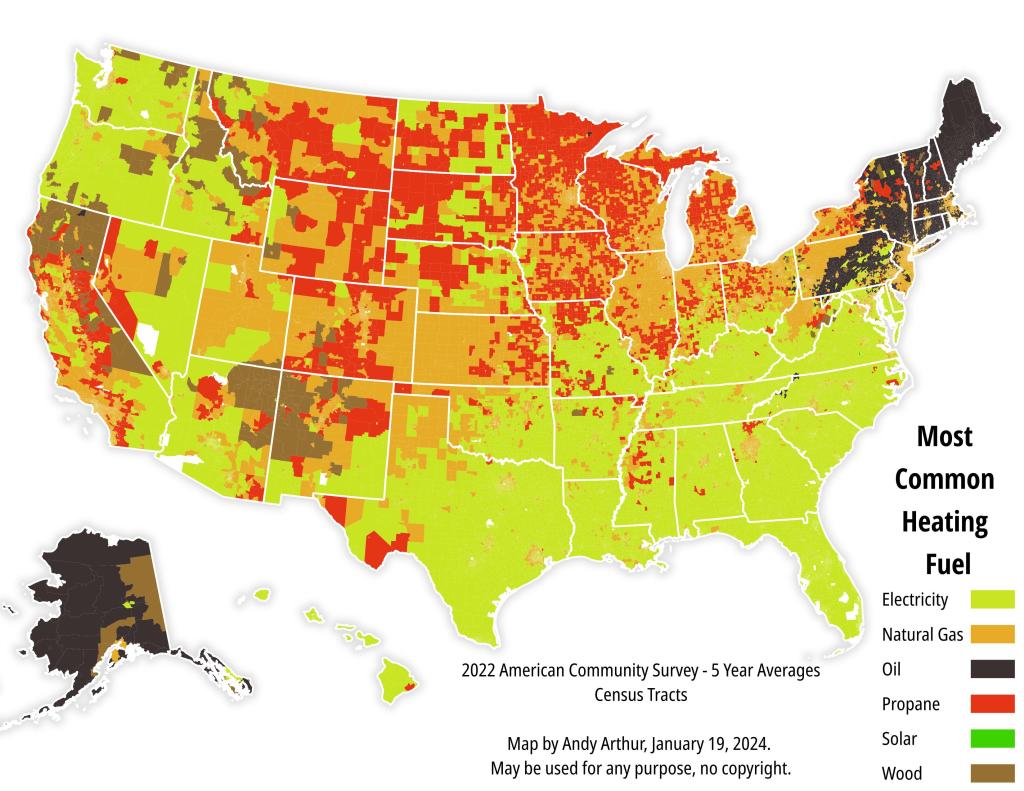
This map is based on a very popular Washington Post map of a few years back. Basically for all 84,000 or so US Census Tracts, it compares the method most common for heating.
As New Yorkers, we might think it's odd that electric heating is the most popular way to heat houses in great parts of country, and it's not just in warm climate south -- electricity is popular where electricity is cheap, like in the Northwest and much of Appalachia.
Oil is odd fuel, not widely used outside of the rural areas in the Northeast and Alaska. Propane dominates the rural Midwest, where it is cheap due to farms using to dry corn.
Heating with fuel oil, which is essentially dyed diesel, seems like an odd choice. Oil is expensive, but also is electricity in the Northeast.
In the 1940s through the 1970s, there was a big push to retire both coal power plants and coal heating for reasons of pollution and convenience, and oil seemed like a good drop in replacement, when oil was cheap. But the northeast relying on oil so heavily for power generation, caused electricity to spike in 1970s, which ironically caused some people to swap out electricity for fuel oil. Natural gas supply has traditionally been constrained in New England, which is another reason why the Northeast likes oil so much.
That and they are promising a dire emergency winter snowstorm super homeland disaster emergency. Or whatever the colored television is calling it these days. Mom got another remote for her television, and I pushed more buttons and it changed the channel on her SmartyPaints television and got to the next channel about ICE burning immigrant babies in Minnesota and how to lard up your dinner menu with more fat, salt and sugar. Or whatever they’re trashing your mind and stomach with these days.
Even with the two plus feet of snow coming, ☃️ it’s actually a nice calm morning. Still cold and in the single digits, but without the breeze it feels much warmer. 🚲 I want to get some carrots 🥕, bananas 🍌 and oatmeal so I might ride out to Price Chopper this morning, mostly because I want the exercise. I doubt I’ll be doing much riding on Monday, and probably Tuesday will be difficult to ride to work. I was looking at my credit card bill, and noticing how much I’m saving not having a vehicle, as I tend to buy less groceries due to needing to haul on bike and not having an easy way to take trash to transfer station. 🗑️ It’s so much easier in the summer when you have a fire every few days or weeks. 🔥 I haven’t bought any Greek yogurt or fake sugar-free syrup since I retired Red, in part because of the problem of getting rid of containers, as we all know especially No 5 plastic doesn’t get recycled even if you toss it in the designated bin. ⛽ And while I don’t drive much in the winter, haven’t had any gas bills since I fueled Red up at the end of year. And got $275 back from my insurance, which brought my bank emergency savings account back up to balance. 💳
Yesterday, Dad picked me up and I went out to visit the folks. 👨👨👦 It was nice to visit for a while, they made up riggis and had a little party for my 43rd birthday. 🎂 It seems like only yesterday, I was doing some camping and skiing up at Rensselearville State Forest for my birthday. How fast time comes and goes. It feels good though at this point, being in much better shape, 🫃🏻 eating healthy food 🍏, riding my bike to work much of the year, 🚲 and watching as my savings and investment grow, as I inch closer – year by year – towards retirement and owning that off-grid homestead. Going past the house next door that I toured a few years ago, the people who moved in had a rip-roaring bonfire 🔥 going yesterday before the snow. It could have been mind, but it was a werid parcel with only 5 acres, no wood stove and limited wood lot, right on the main road with another residential in holding, so not only would I have been careful what I burnt, there would be the road noise, risk of livestock getting on the road, though it did have a nice barn for pigs and goats and outdoor sink for butchering. 🐐 🗡️ But it looks like the new owners are enjoying it, and I still have the cash that would have gone into it. And honestly, I like living in city, especially now without a vehicle. ☃️ No snow to shovel or cars to clean off for me.
This morning, I am heading out to Price Chopper in a bit. 🚴 Not because I have any essentials to pick up, but I want the ride for the exercise before the snow starts to pick up. It’s cold but I want the exercise as once snow comes, it’s going to be deep and likely stick around for a while based on the forecast. 🌨️ Going to be Corning Hill for the bike ride in, and probably delayed buses on Tuesday and maybe Wednesday until the snow emergency and they get Delaware Avenue cleaned to the point where the buses aren’t blocked by cars parked way out in the middle of the road. 📚 Then I need to get some books out of the Libby or Hoopla to read, and most studying up on car buying strageties and Ford SuperDuty trucks. I don’t want to call the truck I’m buying an F-250 or F-350, as for my purposes the difference doesn’t matter much as I’m not planning to buy such a heavy trailer that I need a one-ton truck axle but if that’s what’s available in the package and price I want over the 3/4-ton truck axle, there is no difference besides a stiffer ride, as all other equipment is generally the same.
One of the areas I’ve been watching a lot of is videos of real people negogating 📺 car buys with hidden recorders, and what makes an effective deal 🤝 literally saving thousands of dollars 💵 while getting the vehicle you want. And now I’ve started to study window stickers more, and under what the various trim and features packages really mean. With those HD trucks so you have so many different configurations as people use them for everything from hauling cattle to plowing and towing trailers to the oil fields. What do I really need and want? How much do I care about appearance? How do the various features work on the modern Fords? All questions I am trying to answer. 🙋 Like while I had heard the the hill descent feature is fantastic on extremely icy roads, I had no idea how it worked. The manual lockers and hubs are great, and while I had some idea how they worked on Ford I learned a lot more watching YouTube. What tires do I want? While they’re a consumable item and OEM tires are crap even if they are AT, it’s something to consider as they’ll likely be what I’m driving on for the first four or five years of the truck’s life.
We live in a society that embraces change, especially technological change and the consumeristic possibilities that it makes possible for corporations to dove tail on and sell us things. To be anything but one who embraces change, is often seen as backwards, a luddite of sorts.
Change can be good and bad. We often describe change as progress, but is it not always the case. Sometimes a step forward really is two steps backwards. We should weigh both sides, realize that change has costs but also benefits. Change often involves the unknown. That, can be scary and threatening to one’s position and way of doing things.
Life would be boring if nothing would ever change. There would no opportunity for growth or progress. But I often get caught up in loss aversion, fearing what change means. I often over emphasize the negatives of change while ignoring the benefits. I can be a perfectionist, and when change doesn’t bring only the best be solely down on change. I’ll complain about all change brings and is below my expectations.
I don’t mean to be an eeyore, always complaining about how things are going to hell as the world changes not always for the better. Yet still, I can’t bring myself to always be looking out the happy window, embracing only the good while being blissfully ignorant of all that is lost with the change. But I do need to try to find some more balance in life, overcome my loss aversion while accepting both the good and bad of change.
That is what is in the news today, citing the rising cost transformers, equipment and maintence of the grid. After decades of fairly stagnent electricity growth, it seems like the past few years since the pandemic, electricity demand has surged as the demand for ever growing computer power, electric cars, heat pumps and other technologies have increased the amount of demand on both local and regional grids.
At some point, we all knew electricity demand would increase. Efficency gains, often unpredicted offset the increase demand from servers and other technologies in the 1990s through the 2010s. And none of us can know for sure what brilliant energy saving solutions inventors supported by government investment will come up with. But suddenly in a world of electrification of automobiles, buses, and heat pumps, it seems like demand is only going to go up.
It doesn’t help that Washington is putting all of it’s chips in on fossil fuels. While I always thought the goals of 100% renewable energy by 2035 was laughable, we shouldn’t be moving away from renewables when demand is surging, and we need to diversify. At some point the fracking revolution is going to peter out and the impacts on climate change are only increasing. Too many renewables, too quickly can push up the price of electricity – but not adding enough and investing in innovation also will push up the price of electricity.
Truth is future demand is quite unpredictable. Is the AI Boom going to bust? How much more data processing capacity does the world need? Seriously, I can’t figure out much of a use for AI beyond cute parlor tricks like shitty canned text writing and meme generation. AI is pretty bad at what it does. Electric cars and heat pumps require more electricity, but they also will become more efficent over time, as will buildings as their upgraded and insulated better. Nobody knows how much industry there will be in in ten years from now, how many jobs, or how much growth will be. With all the baby boomers retiring, it’s possible energy demand will actually fall when they’re not consuming nearly as many services or products. We don’t know.
Another possibility is that more and more people will start generating and storing electricity on site. People make fun of solar, describing it as woke technology. But those modern hybrid inverters and solar panels are remarkably inexpensive now and simple to install and set up. Battery capacity with lithium ion phosphate technology gets cheaper, safer and simpler to use every year. Off-grid is no longer just for remote cabins and homesteads, and it’s quite possible that within a few years residential grid usage – and even commercial usage may fall if more facilities create and store their own energy on site. We just don’t know.