Here are some great pictures of the Latham Circle both before and after the bypass was built. Ironically, with the Adirondack Northway well underway and largely built probably a lot of traffic already was bypassing the circle.
Good technology
It would be mistake to say that I am opposed to technology but I do oppose highly commercial, glittery, closed source technology that is the hallmark of suburbanite lifestyle. I like simple technology that I can understand, is durable and hackable for my own uses. Technology that doesn’t focus on entertainment but better understanding my own life and the world around me.
I’ve long said that I will never have a television or internet at home. Don’t get me wrong, I like my smartphone and I do go down to the public library to use the internet for uploading or downloading large files. But it’s different than watching bright flashing pictures and for hours on end for canned entertainment purposes.
Even when I own my own home I can’t imagine having internet or television. I would want my very inexpensive smartphone and cell service with the basic data package, but nothing more than that. I probably wouldn’t totally forgo having electricity but it would be a very small and simple solar system for lighting, charging phones and maybe pumping water. Good technology is simple and understandable, and easy to understand and close to nature.

Indian Summer
“Indian Summer” is a term used to describe a period of unseasonably warm, dry, and sunny weather that occurs in late autumn, typically during September and October in North America. During an Indian Summer, temperatures rise above the normal range for the season, and the days often feel more like summer than fall.
The origin of the term is somewhat debated, but it likely has its roots in early American settlers’ observations of Native American weather patterns. Indian Summers are characterized by clear skies, warm temperatures during the day, cool and crisp nights, and a lack of precipitation. This weather phenomenon can be quite pleasant and is often associated with a final burst of outdoor activities before the onset of colder winter weather.
Listening to Garth this morning 🤠
And Brooks and Dunn. Maybe I’m somewhat sentimental for the days were back when I was in college. Not that I would want to go back to those days, but the world in some ways was simpler — and I was much more ignorant kid of the sticks finding my way in the city, but won’t we all?
Apparently the internet marketers have decided I am interested in meal services, and are now serving up a series of advertisements in my social media feeds and even when I open up the browser
Apparently the internet marketers have decided I am interested in meal services, and are now serving up a series of advertisements in my social media feeds and even when I open up the browser. Probably because I often blog about going to the grocery store, if only because that’s just something that is regularly on my to-do list for once a week, like going to the laundromat or washing Big Red.
I should become a better cook, and make healthier food but my kitchen is small and rundown, and I’m busy. When I own my own land, I probably get more into cooking so I can harvest more of my own food from my animals and plants. But I can’t imagine paying money for an overpriced meal service, one that comes in styrofoam and tons of packaging — even if I lived out in the country and had a burn barrel to burn up the packaging. I always buy bulk in store, and try to minimize packaging — so I have less to bring to transfer station. I don’t do TV dinners or anything excessively packaged — why pay for something your going to have buried in landfill or burn on up?
It just seems like so many things these days are over-packaged and waste — trying to get you to part with your money to throw it away. 🍌 👉 🗑
Farming and the Natural Landscape.
Farmers they say live off the fat of the earth.
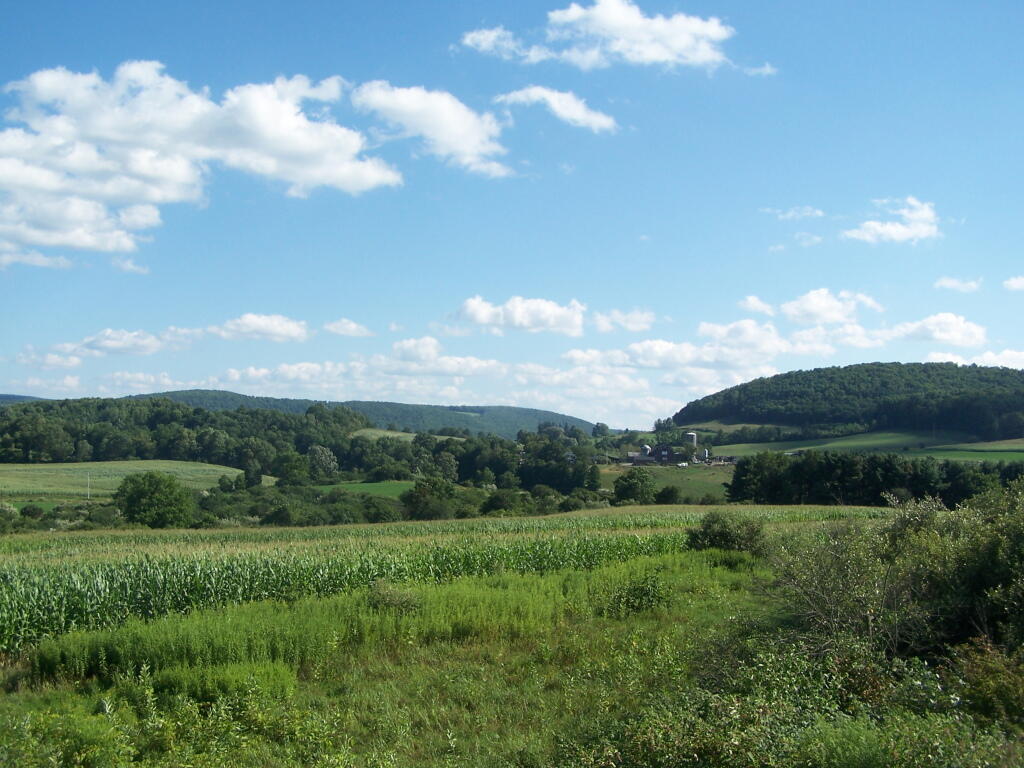
In other words, they plant, they raise, the grow food and fiber in the dirt which they either sell or feed to livestock. The same could be said of ranchers, or for that matter loggers — both who generally use and manage natural resources both for today and tomorrow. They work the land in ways that tries to tie down and maximize nuetriant uptake in plants, use science to produce more product with less impact and fewer inputs.
Farms by their very nature are quite adaptable land-use pattern. A farm can become a housing development, a forest or wilderness area, a commerical plaza, an industrial area or a highway. Or it can continue to be agriculture. For one, farms are generally large properties, with one owner. Many farms are hundreds of acres, in some parts of country that are flatter and less agriculturally productive, farms can be thousands of acres managed by a single family. That makes land transfers and wide-spread development or conservation much easier.
Farm land is generally lightly developed, as most fields are dirt that could quickly grow back up to forest if abandoned. Or paved or built over. Farming in many ways is a temporary land use, much more so then when a farm land is paved-over, subdivided, or used for other non-natural purposes. Developed land is often in many hands, and contains buildings, infrastructure, and other things that can be costly to remove. Farm land also is more productive to wildlife, often the home of many species of birds, deer, coyotes and other wildlife. It absorbs carbon dioxide, and is part of a healthy landscape.
Chances are you are already using Artificial Intelligence already… 🤖
Artificial intelligence sounds scary but chances are if you are living a modern life, like anyone reading this blog, you are benefiting from this technology.
- Chatbots and Virtual Assistants: AI-powered chatbots and virtual assistants are employed for customer support, answering queries, and automating tasks.
- Recommendation Systems: AI algorithms are used by platforms like Netflix and Amazon to suggest content or products based on user preferences.
- Natural Language Processing (NLP): NLP is used in sentiment analysis, language translation, and speech recognition, enabling applications like Google Translate and voice assistants like Siri and Alexa.
- Healthcare: AI assists in disease diagnosis, drug discovery, and patient care by analyzing medical data and images.
- Autonomous Vehicles: AI powers self-driving cars, enhancing safety and efficiency in transportation.
- Finance: AI is used for fraud detection, algorithmic trading, and credit risk assessment.
- Manufacturing: Robots and AI systems automate production lines, quality control, and predictive maintenance.
- Education: AI-powered tools aid personalized learning, adapt curriculum, and assess student performance.
- Gaming: AI is used to create realistic non-player characters (NPCs) and adapt game difficulty based on player skills.
- Energy Management: AI optimizes energy consumption in buildings and power grids.
- Marketing and Advertising: AI-driven analytics and ad targeting help businesses reach their target audiences effectively.
- Agriculture: AI helps optimize crop management, predict crop diseases, and enhance yields.
- Security: Facial recognition, behavior analysis, and anomaly detection systems enhance security in various contexts.
- Human Resources: AI aids in resume screening, candidate matching, and employee engagement analysis.
- Environmental Monitoring: AI is used to analyze data from satellites and sensors for climate and environmental research.