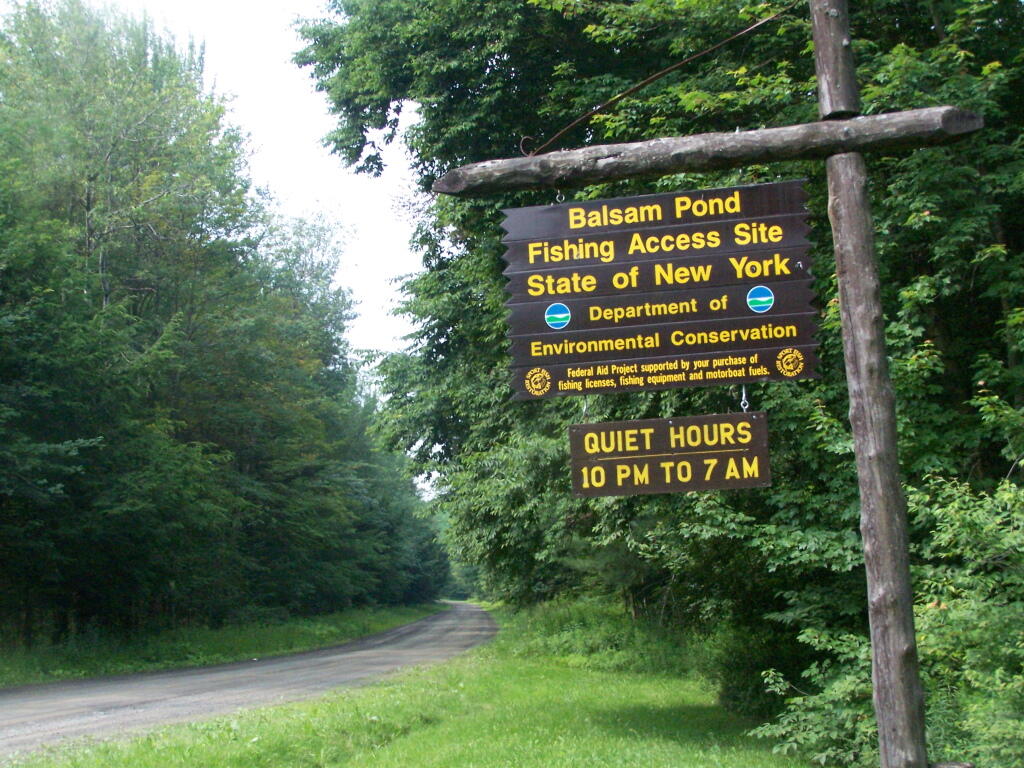
Balsam Swamp is a sprawling state forest that stretches almost 5.5 miles east-west across 4 towns. The area is very rural, and the landscape surrounding the State Forest is predominantly forested. Balsam Swamp State Forest is comprised of a mix of native hardwood forests, hemlock swamps, and conifer plantations. There are no designated recreational trails on the forest, but there is ample opportunity for self-guided day hikes to explore the diversity of habitats represented on this State Forest. Additionally, the western section of Balsam Swamp State Forest is adjacent to Five Streams State Forest to the south.
The main attraction of this forest is Balsam Pond. The impoundment is approximately 152 acres and is a popular destination for fishing and paddle boat sports. Balsam Pond is a warm water fishery that contains a mix of largemouth bass, smallmouth bass, chain pickerel, yellow perch, brown bullhead and sunfish. Tiger muskellunge have been stocked in the past with the last stocking occurring in 1995. However, there have been very few reports of anglers catching any of the adult tiger muskies. A shallow gravel boat launch is suitable for launching small fishing boats.
A small rustic camp ground is also located at Balsam Pond. Camping spaces are available at no cost on a first-come, first-serve basis and there is no running water or electricity. A fire ring, outhouse, and picnic table are provided for each camping space. A sign on Balsam-Tyler Road in Pharsalia designates the entrance to the boat launch and camping facility. This is a carry-in carry-out facility. Please do not litter.
I am no fan of pets – dogs, cats, ferrets, snakes, you name it that people have solely for purposes of companionship. It seems awful lonely and deprived to depend on an animal to keep one as a companion. There are fellow humans to do that, community events to be involved in rather than relying on an animal that prays on your emotions for food and shelter.
There is a whole industry that has sprung up around animal rights that claim that dogs and cats are something that need special protection. Right wing politicians that want to cut food and health care to needy children are usually the most vocal advocates for animal rights. But dogs and cats just seek their biological needs met, they don’t have feelings or emotions. They do pray on our own emotions but they’re not thinking beings with complex emotions beyond what is learned to better meet their biological instincts.
To be sure, animals have biological needs to healthy. Domesticated animals have significant needs that only humans can provide to the thanks to breeding. Domestic animals have specific diets, shelter requirements and even a need for human attention to productive healthy animals.
Often the law views food animals and those hunted differently. It puts a higher burden on humans to be humane compared to nature. And it certainly puts a much higher level of care towards animals then other man made products like motors, electronics and other non living equipment not made out of renewable resources.
I think we would be a lot better off if we viewed pets more like livestock and the renewable resources they are. Don’t abuse them, meet their biological needs but don’t worship them – they can always be recreated and replaced. Dog breeding is a a big business. It should be fine to discard a pet should the cost of surgery or health care is too high and just get another one. Badly behaved and trained animals should be replaced.
I have no need for a pet now but I could some day envision having a dog or cat for practical purposes. A cat could control rats and mice in the barnyard, a use of waste milk. A dog might be useful for hunting or to guard a barnyard against predators. But I can’t imagine having any emotional connection beyond servicing the land.
Ultimately what I care about is the land and a healthy ecosystem. I am always a bit alarmed about the number of birds attacked by domestic cats and I can’t imagine having a dog in a city and carrying around a bag of dog crap to throw in the trash and send to the landfill. I’m fine with shoveling and spreading manure from herbivores in support of the land and producing food to eat or fur to sell but I just don’t like the idea of having a dog or cat solely because one is lonely.
I think my dream house or cabin would be as small as possible. As a single guy, I don’t need a lot of space, just room enough for a small table, a place to put a futon-style bed, a dresser, some room to hang clothes, have a stove and sink, a small propane heated shower, and a toilet or shitter bucket to take out to the outhouse.
I don’t really want or need a lot of space, because the more space you have, the more you need to clean. More space means more need for heating, more need for lighting and more room for stuff that will break. Fewer things, mean fewer things to fail and break and a simpler world to live in.
I look at horror with marble countertops and fancy carpets. So many things to break and fail. So many things I don’t think add much value to life. I don’t like complicated wiring or all that technology – especially nowadays when you can do almost everything on your laptop. I do like the big screen and a standalone keyboard but those aren’t something that take a lot of room. I doubt I’ll ever want internet at home, except maybe through my Smartphone.
That’s the song that Brooks and Dunn made famous about 20 years ago. And that’s the advice of my counselor to help me find more order and contentment on my life. It’s actually not a bad plan. I have to say I agree with a lot of his idea.
I can go alone for the rest of my life with the freedom to do whatever I want whenever I want. I do like my freedom. But there is a lot of benefit to living together with someone and having a relationship and shared responsibilities. Stools are more steady with more than one legs.
The truth is my off-grid dream or owning a homestead really isn’t super practical to do it all alone. It is nice to have money and invest it, with a dream but it’s hard to make it a reality alone. Plus it seems like all my friends are settling down, buying houses and starting families. While I doubt I’d ever want to have kids except maybe young meat or dairy goats, certainly more hands can bring a homestead closer to reality.
Having an extra leg in the stool means both partners have somebody to fall back on and provide mutual aid. I can shovel horse manure, break ice in frozen water troughs or haul garbage to the burning barrel or slop to the pig pen in exchange for help when my truck breaks down or just needing companionship when I’m lonely or need some one to bounce ideas off of.
I am not sure that I am ready to settle down although truth be told I’m kind of bored with doing the same old trips to the Adirondacks alone. I kind of want to have land and livestock. I’d like to meet some new people and new horizons. I feel like I’ve run low on interesting unique places close to home so maybe the next best thing is new people and groups. Not looking to spend more time with Albany insiders though.
Albany is fine, it pays well and I like my work. But the suburbanite, everything is plastic isn’t the life I want to live. I want to be closer to the earth and be able to take care of myself and my family when things go wrong which are certain to happen in an era of accelerating climate change.
While I want to set down roots, I’m just as committed as ever to get out of New York State eventually, just because of the gun and open burning laws. To say nothing of what is happening to so much farm land and forest with the industrial solar farms or how humane laws and climate change restrictions might make it very hard to have a homestead in New York. I worry a lot about New York versus the kind of lifestyle I want to live eventually. It’s not homestead or rural life friendly.
Lately there have been a lot of discussion on why New York State is such a high tax state compared to others, and why our state gets relatively little back in funding compared to other states.
The common refrains are that New York is a liberal state, so we invest a lot more in human services, healthcare, welfare and education. That is true to a certain extent. But it’s also not totally true either. Red states actually have a lot better public services then many blue staters want to believe. Another common refrain is that New York is a wealthy state, so we aren’t eligible for nearly the same amount of transfer payments are poorer states. That is also true, although New York also has plenty of pockets of poverty — but we are also the financial capital of the world and home to our nation’s biggest city. Some say corruption is worse in New York then other states. I’m a bit skeptical on that point, I think there are more watch dogs on government then other states — being a such a big state with well funded newspapers. Are Albany politicians really going to pull a fast one over on the New York Times and New York Post at the same time?
But there is another truth that is often ignored. New York often rejects a lot of federal funding. While contemporary reasons for rejecting federal funding may be ideological in nature, the original reason our state rejected federal funding was we chose to be out in front of the federal government — on canals, on highways, on parks, on forests, etc. New York chose to build a lot of it’s infrastructure without federal funding, because we built before the funding was avaliable. Being out front is good, but sometimes it’s really costly to taxpayers.
The New York State Thruway is a prime example of this. Why do people pay tolls to drive on the Thruway, while most other highways are free in New York? Because in early 1950s, the legislature decided our state needed a superhighway. Rather then wait to see if federal funding would become avaliable to build the highway, we decided to do it on our own. A cost bourne 100% by New York taxpayers. While the Adirondack Northway recieved 90% of it’s funding from the federal gas tax, the Thruway recieved 0% of it’s funding from the federal gas tax.
Now could the state have removed the toll booths and recieved federal funding for the highway for maintaince? Possiblity but not likely. The federal interstate act did not allow for grandfathering in existing routes, although some free routes did get upgrades to interstate standards under the act. Rather then eliminate the tolls and seek federal funding for the Thruway, our state has chosen to pay fror it upkeep 100% from state funding, namely tolls but also general fund revenue. If we made it eligable for federal funding, New York would also have to pick up the difference between federal funding and state funding, and it’s not always easy to find extra funding in the gas tax.
We are in the same boat with many of our state’s bridges and tunnels. Could the state have waited a few years and got funding for free crossing over the Hudson River and the New York City metropolitian crossings? Probably yes, as most of the Western States have no tolls, even on their biggest Interstate Bridges. Our state certainly could have gotten 50% of the cost of building and maintaining back on the Hudson River crossings, and 90% in some cases. But we chose to build them before federal funding was avaliable. Now we are stuck with the clunky Bridge Authorities and Triborough Authority, which pays 100% of the bridge expenses through local tolls. Even if we eliminated the tolls, it”s not clear we cold get federal funding at this point. Nor is it clear if we would want to — by refusing federal funding — our state has the “freedom” to set whatever standards it wants on the bridges, including advertising and geometery. Federal highway standards don’t apply to non-federally funded roads.
The federal government maintains locks and canals on most rivers. Our state doesn’t get to take advantage of federal maintaince to our canals. We have the Erie Canal, which is entirely paid again by state taxpayers and those who traverse the canal. We talk about Clinton’s Ditch as being a great advance for our state. It certainly was at it’s time. But we could have had the federal government build it for us had we waited a few years — and put up with the federal government’s dicates. Certainly the Army Corp or Engineers maintains a lot of the nation’s canals. But not in New York. We chose once again to go it alone on our canal system.
One could have imagined that New York City could have gotten the federal government to finance their drinking water reserviors, had that waited a little while longer, and been willing to put up with creation of a federal public authority like the Tennessee Valley Authority. Maybe New York City’s drinking water reserviors would have not only produced clean water, but also greater recreational opporunities and more hydropower had the federal government, not the city built them. But no, our state had go out in front of the federal government — a cost picked up federal government in other states.
No state in America has as big of a state operated wild forest or wilderness as New York does. That’s not saying other states don’t have great public lands that are a mixature of managed forest and wilderness, operated by the federal government. The Adirondack Park is tiny compared to some of the National Forests and Bureau of Public Lands out west. Other states also have developed parks and recreation areas, but many of them are funded and directly operated by the federal government. But not New York, bar a few small historic battle sites, and the relatively small Finger Lakes National Forest. Why not? Our state got out ahead of federal funding and furthermore rejected federal operation of our Adirondack and Catskill Parks.
New York State certainly could have been home to the Adirondack National Forest or the Adirondack National Park. But no, our state rejected that idea off-hand. Vermont decided to protect it’s wild upcountry and mountains with the Green Mountain National Forest, but not New York. Our state once again got out ahead of the federal government, and rather then create a managed forest, we were stuck in the mid-1800s line of thought that all logging was bad and we could only preserve the land by banning all timber cutting for any purposes.
By rejecting creation of a Adirondack National Forest or National Park, our state once again passed up on billions of federal funding. Rather then have the federal government pay for maintaining roads, parking areas, campsites and trails in Adirondack, New York taxpayers are 100% on the hook. The Green Mountain National Forest in contrast has federally funded forest rangers, federally funded maps and recreational facilities, federally funded campgrounds and much more. Instead, our state has chosen to take up this cost because we wanted ideological control over the land — rather let distant Washington politicians decide how to maintain the lands.
There is somewhat a myth that red states have awful public services, while blue states have a much better government. While blue states like New York are often on the cutting edge, getting out on cutting edge before the federal government means New York residents pay dearly. Forgoing federal funds by getting a decade out ahead of other states might have some short term advantages, but it often means our state residents ends up paying for a lot of other things that federal government would have otherwise paid for in coming years.