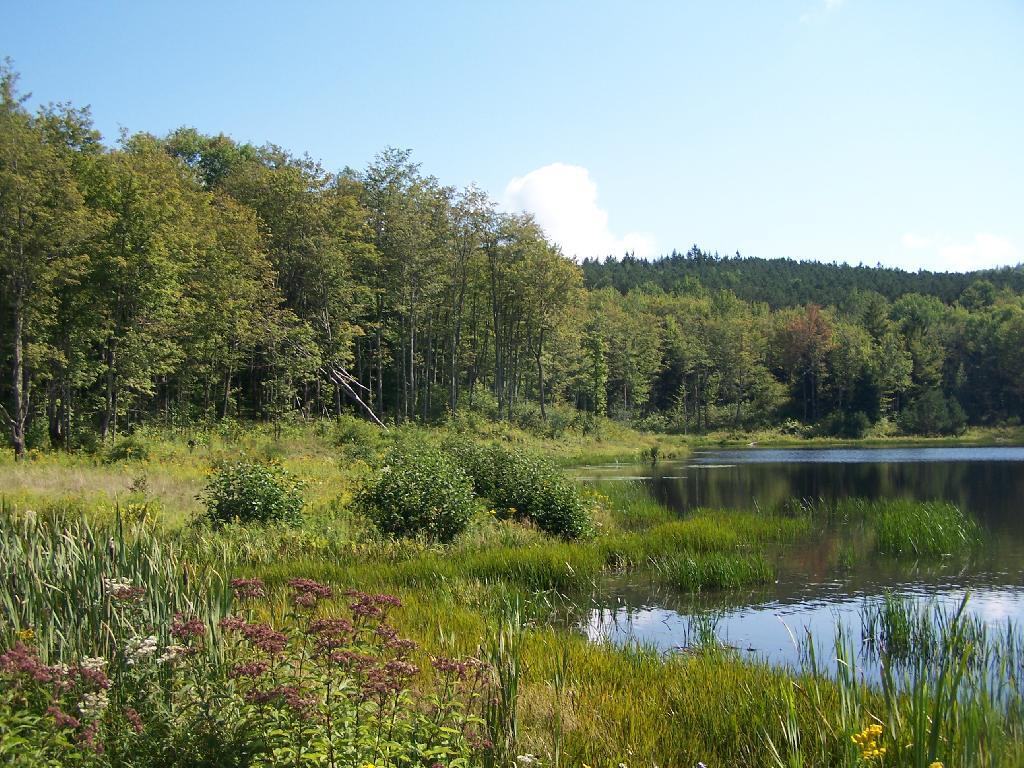
Balsam Swamp is a sprawling state forest that stretches almost 5.5 miles east-west across 4 towns. The area is very rural, and the landscape surrounding the State Forest is predominantly forested. Balsam Swamp State Forest is comprised of a mix of native hardwood forests, hemlock swamps, and conifer plantations. There are no designated recreational trails on the forest, but there is ample opportunity for self-guided day hikes to explore the diversity of habitats represented on this State Forest. Additionally, the western section of Balsam Swamp State Forest is adjacent to Five Streams State Forest to the south.
The main attraction of this forest is Balsam Pond. The impoundment is approximately 152 acres and is a popular destination for fishing and paddle boat sports. Balsam Pond is a warm water fishery that contains a mix of largemouth bass, smallmouth bass, chain pickerel, yellow perch, brown bullhead and sunfish. Tiger muskellunge have been stocked in the past with the last stocking occurring in 1995. However, there have been very few reports of anglers catching any of the adult tiger muskies. A shallow gravel boat launch is suitable for launching small fishing boats.
A small rustic camp ground is also located at Balsam Pond. Camping spaces are available at no cost on a first-come, first-serve basis and there is no running water or electricity. A fire ring, outhouse, and picnic table are provided for each camping space. A sign on Balsam-Tyler Road in Pharsalia designates the entrance to the boat launch and camping facility. This is a carry-in carry-out facility. Please do not litter.
Lately, I’ve developed a keen interest in ethnic stores. Unlike supermarkets, which tend to inflate prices significantly on essential items like rice, beans, and spices – particularly those that cater to healthier, basic diets, ethnic stores offer a refreshing alternative. Supermarkets often capitalize on the fact that these wholesome foods aren’t in high demand among their typical shoppers, allowing them to raise the prices with the understanding that they won’t move as quickly – much like how convenience stores tend to overprice everyday items such as bread and milk.
Interestingly, Walmart has emerged as a surprising contender, boasting a more extensive selection and more affordable prices on many nutritious staples like dried beans, rice, and specific spices compared to the majority of supermarkets. Moreover, Walmart consistently stocks Greek yogurt, whereas local supermarkets often struggle to keep this section adequately supplied. An amusing anecdote: it seems Hannaford, for instance, barely manages to keep one container of plain Greek yogurt hidden away, only to have it vanish by nine o’clock every morning.
For those seeking even more diverse options, India Market comes to the forefront. Here, you can find ghee, a healthier dairy fat option for cooking and spreading, boasting a nutty flavor. Additionally, they offer kefir, a nutrient-rich fermented dairy product packed with protein and probiotics. Kefir is often regarded as an even more wholesome alternative to Greek yogurt, further enhancing the appeal of these ethnic stores.
Monday, Monday, a fresh start anew,
Back to work with tasks to pursue.
Memories linger of the weekend’s grace,
As August departs with a gentle embrace.
Autumn whispers secrets of gold,
Labor Day Weekend, a story untold.
Soon, students gather with books and zeal,
Traffic and bustle, a familiar ordeal.
Days grow shorter, a cooler embrace,
Nature’s canvas adorned with grace.
Amidst the change that’s in the air,
This week’s beauty, let’s cherish and share.
As the countdown begins towards the conclusion of daylight saving time in ten weeks, a somber reality takes shape. The anticipation of more daylight in the early morning hours is contrasted by the grim prospect of darkened evenings, commutes in dark.
The shift signifies a trade-off: while mornings may offer a temporary reprieve from the encroaching darkness of winter, the trade-off comes in the form of darker evenings that hinder outdoor activities and makes for darker evenings.
I’ve been playing with Chat GPT to come up with a relatively healthy, simple recipe for whole wheat biscuits using baking powder, skim milk and olive oil that I could eat up at camp or whip up at home:
Ingredients:
– 2 cups whole wheat flour
– 1 tablespoon baking powder
– 1/2 teaspoon salt
– 1/3 cup olive oil
– 3/4 cup skim milk
Instructions:
1. Preheat your oven to 425°F (220°C).
2. In a mixing bowl, whisk together the whole wheat flour, baking powder, and salt.
3. Add the olive oil to the dry ingredients and use a fork or pastry cutter to combine until the mixture resembles coarse crumbs.
4. Gradually add the skim milk and stir until the dough comes together. Be careful not to overmix; just mix until the dough forms.
5. Turn the dough out onto a lightly floured surface and gently knead it a few times until it’s smooth.
6. Pat the dough to about 1/2 inch (1.25 cm) thickness.
7. Use a biscuit cutter to cut out rounds from the dough. Press straight down without twisting the cutter to ensure the biscuits rise evenly.
8. Place the biscuits on a baking sheet, leaving a little space between them.
9. Bake in the preheated oven for about 10-12 minutes, or until the biscuits are golden brown on top.
10. Remove from the oven and let the biscuits cool slightly before serving.
Here’s an approximate breakdown of the nutrition facts for one biscuit, along with the percent of the daily value (DV) based on a 2,000-calorie diet:
In recent times, an unexpected apprehension has taken hold of me—the unwarranted fear of placing my new mountain bike onto the CDTA bike rack and embracing the convenience of utilizing the bikable bus option. It’s noteworthy that all CDTA buses are equipped with bike racks; however, uncertainty loomed over whether my mountain bike, with its broader tires, would securely fit the rack. My doubts were quickly dispelled, and a delightful revelation unfolded when I embarked on the Nature Bus journey last Saturday.
Amid my concerns, a nagging worry persisted—that my prized bicycle might meet an untimely fate during transit, whether falling off the bus or succumbing to potential damage. Yet, upon closer examination, this fear seems rather irrational. While one can stumble upon online horror stories, employing common sense and ensuring a secure attachment of the bike to the rack renders such concerns negligible. Admittedly, the improbable could occur: the bike rack might fail, the bus might collide with another vehicle, or other unforeseen mishaps could transpire. Nevertheless, when evaluated against the backdrop of its benefits, the associated risks appear relatively minor. Despite my affection for my bicycle, its replaceability and the odds of misfortune seem to place my concerns in perspective.
The amalgamation of the bus and the bike, a seemingly simple concept, presents an extraordinary combination of advantages. This symbiotic relationship permits me to commute to work without apprehension, even on days plagued by impending rain or sweltering humidity later in the day. Furthermore, it empowers me to embark on a two-part journey—part cycling and part bus ride—crucial especially as my workplace relocates to a suburban setting, necessitating shuttle or bus transfers. The bicycle emerges as a rapid solution to such transfers, rendering the transition seamless. Moreover, as daylight diminishes come November, and evenings are cloaked in darkness, this dynamic duo continues to prove invaluable. Cycling to work in the morning remains an option, with the convenience of taking the bus during dark evenings, knowing my bicycle is safely ensconced upfront.
In conclusion, my unfounded anxieties surrounding the integration of my mountain bike and the CDTA bus system have been replaced with a newfound appreciation for their harmonious synergy. The initial fears were eclipsed by the realization of the system’s practicality, coupled with the insignificance of the associated risks. The bike-bus combination not only defies the elements and geographic constraints but also offers an optimal solution for various commuting scenarios. It encapsulates the idea that embracing innovation, even in mundane aspects of life, can lead to unforeseen conveniences and freedoms.
Returning to the art of breadmaking, my interest has been piqued by the idea of occasionally indulging in whole wheat bread without the additions of sugar or oil, and keeping salt to a minimum. It’s a delightful companion to both olive oil dipping and homemade soups. The monotony of constant brown rice and lentil dishes has left me a tad fatigued, making soup a comforting option to utilize a plethora of winter vegetables, while offering warmth.
My dietary choices have led me to abstain from added sugars, save for a couple of exceptions during special occasions such as indulging in ice cream on summer getaways or partaking in a rare slice of homemade pie during birthdays. I also steer clear of refined carbs, although I occasionally allow myself to savor cream of wheat coupled with zesty lemon, chia seeds, Greek yogurt, and fresh fruit. Similarly, a modest serving of couscous accompanied by edamame or chicken, and generously augmented with vegetables—predominantly spinach—makes its way into my repertoire.
The decision was made yesterday to refurbish my Dutch Oven. Swiftly biking to the store, I acquired King Arthur whole wheat flour and yeast. Employing a no-knead approach, I combined whole wheat flour, yeast, water, and a pinch of salt for flavor. The dough rested for approximately 20 hours on the countertop before being baked tonight. Although the resulting bread was commendable, the dough’s excessive moisture posed challenges in shaping it. While the crust turned out excellent, I do ponder the possibility of reducing water and slightly augmenting yeast for a fluffier consistency. One slice was enjoyed, dipped in olive oil and balsamic vinegar, while the remainder found its place in the freezer.
For the next attempt, I intend to employ slightly less water and a greater amount of yeast to conduct a further experiment. Contemplating back-to-back preparation of two loaves not only conserves energy by utilizing the high-temperature Dutch Oven but also ensures a month-long supply of superior bread for dipping and accompanying soups.
I mean I probably should have with the summer we’ve had expect rain. Going to clear out later but will be cool for the family clam bake.
Good morning! Happy Sunday. Rain showers and 65 degrees at the Five Rivers Environmental Education Center. ☔ There is a north-northwest breeze at 6 mph. 🍃. The dew point is 60 degrees. The skies will clear around noontime.
Woke up early 🌅 and to run to the bathroom 🚽 and decided not to go back to sleep. Milled oatmeal down to a fine powder in the food processor and then added one of the fresh apples 🍏 that I got at Yonder Farms and ultimately a banana 🍌 for sweetness and consistency and a bit of water for pancakes 🥞. Black coffee ☕ and frozen fruit with sugar free syrup made for a good breakfast.
Rode Blackie 🚵 out to Five Rivers Environmental Education Center 🐸 for some nature observation and to get away a bit this morning, though I wasn’t expecting the rain. ☔ Not super wet but unexpected in my mind, I’m hiding our under the pavilion for now. I’ll go for a short walk 🚶 and then head home. Then shower 🚿, get a few groceries at Walmart and clams 🦪 at Market 32 🛒 then head out to the folks house by later midday. 🕛
Today will have isolated showers before 9am. Partly sunny 🌞, with a high of 76 degrees at 3pm. Five degrees below normal, which is similar to a typical day around September 11th. Maximum dew point of 62 at 11am. North wind around 7 mph. Chance of precipitation is 20%. A year ago, we had cloudy skies in the morning with more sun in the afternoon. It was somewhat humid. The high last year was 81 degrees. The record high of 97 was set in 1948.
Yesterday afternoon at Thacher Park 🏞 was nice, though some of those trails were rougher on the bike 🚲 then expected but I try to be super gentle with Blackie not wanting to break shit but I’m also not afraid to now ride somewhat rougher trails with Blackie but I still prefer gravel. Super muddy after the summer that was. Still want to get to Charles Baker State Forest to ride before the snow 🌨 comes. Not that I probably have much of a worry this winter with El Niño and I’m not planning on doing much trail riding which closes October 31st, just road riding.
John Wolcott’s funeral is over ⛪ that chapter is closed. The whole wheat bread I made last night came out pretty good, most of it is now frozen. Last night’s dinner was commercial protein pasta you find in the supermarket with a bunch of spinach and the remaining kale I had plus mackerel for a good boost in the omega 3, healthy fats to help absorb the vitamins that make up the spinach and kale. The fats, protein and fiber fill you up quickly. 🍲
Solar noon 🌞 is at 12:58 pm with sun having an altitude of 57.5° from the due south horizon (-13.3° vs. 6/21). A six foot person will cast a 3.8 foot shadow today compared to 2.2 feet on the first day of summer. The golden hour 🏅 starts at 7:03 pm with the sun in the west (278°). 📸 The sunset is in the west-northwest (285°) with the sun dropping below the horizon at 7:41 pm after setting for 2 minutes and 59 seconds with dusk around 8:08 pm, which is one minute and 39 seconds earlier than yesterday. 🌇 At dusk you’ll see the Waxing Gibbous 🌔 Moon in the south-southeast (151°) at an altitude of 15° from the horizon, 228,020 miles away. 🚀 The best time to look at the stars is after 8:45 pm. At sunset, look for mostly clear skies 🌄 and temperatures around 71 degrees. The dew point will be 59 degrees. There will be a north breeze at 6 mph. Today will have 13 hours and 26 minutes of daytime, a decrease of 2 minutes and 44 seconds over yesterday.
Tonight will be partly cloudy 🌃 with a low of 56 degrees at 6am. Three degrees below normal, which is similar to a typical night around September 6th. Maximum dew point of 60 at 6pm. North wind around 5 mph becoming calm in the evening. In 2022, we had clear skies in the evening, which became cloudy by the early hours of the morning. It became humid as the night progressed. It got down to 59 degrees. The record low of 42 occurred back in 1982.
Now that I made bread with yeast 🍞, I’m interested in doing baking using baking powder or baking soda for those times I don’t want to mess with kneading or waiting 24 hours for the bread to rise. That’s more kind of for making biscuits but they can be a source of healthy carbs too if you limit the unhealthy fats by using olive oil or ghee and don’t use sugar. Also I was playing with my food processor this morning and will just dry oatmeal seems to do a decent job of milling whole grain oatmeal down to oat flour – and not just pancakes. 🍪
Today in 1859, Petroleum is discovered in Titusville, Pennsylvania leading to the world’s first commercially successful oil well. 🛢 To this day, that town still smells like petroleum, and it floats in the creeks, but they produce much less oil today then at the peak around the turn of the century. Exploring the Oil Creek State Park is fun as is Pithole abandoned oil town but do expect a strong petroleum smell. 👃 But then again, Western PA smells like petroleum like the Black River Valley smells like cattle and manure. Just part of the country.
Looking ahead but maybe not forward to dark mornings walked or risen, there are 2 weeks until 6:30 Sunrise 🌇 when the sun will be setting at 7:16 pm with dusk at 7:43 pm. On that day in 2022, we had mostly sunny, patches of fog and temperatures between 83 and 56 degrees. Typically, the high temperature is 77 degrees. We hit a record high of 96 back in 1931.