The Rattlesnake Hill Wildlife Management Area is a 5,100 acre upland tract, situated approximately eight miles west of Dansville, New York. Roughly two-thirds of the area lies in southern Livingston County, while the remaining third lies in northern Allegany County. The tract was purchased in the 1930’s under the Federal Resettlement Administration and is one of several such areas turned over to DEC for development as a wildlife management area.
The area is appropriately named after the Timber Rattlesnake, which may be occasionally found in the more remote sections of the “Hill”.
The area offers an interesting blend of upland habitats such as mature woodland, overgrown fields, conifer plantations, old growth apple orchards and open meadows.
The area is inhabited by a variety of game species and is open to public hunting. The white-tailed deer, wild turkey, ruffed grouse, grey squirrel, cottontail rabbit and woodcock are found on the area. An occasional snowshoe hare may be observed adjacent to thick creek bottom brush or conifer plantation habitats.
A number of small marsh units have been developed and provide limited hunting for waterfowl. Some of the area’s furbearing species such as mink, beaver and raccoon may be occasionally viewed at these marsh units.
2024 will be an election year. So will 2026 and 2028. Either Joe Biden or Donald Trump will win in 2024 most likely, and either the Democrats or Republicans will control the US House and Senate. An election will determine that this year, and another election will determine that in 2026 and 2028. Both Biden and Trump are term limited in 2028, and even if they somehow could get away with ignoring the constitution, their advance age will send them packing not long beyond that.
Do I have faith in the politicians to not try to tweak the rules so their favored party wins extraordinarily close election? Of course, not. I’ve been around Albany along enough to not be that stupid. But extraordinarily close elections are as much a coin toss as anything else. Storm clouds, a car with a dead battery, a phone call to one’s niece can often determine close elections. Or a clever intrepration of election law, or how the existing law puts a finger on the scale on who wins the election. Really when the election is that close, it doesn’t matter who ends up winning, because essentially the winning candidate reflects either majority sentiment or close to majority sentiment. The next go-around, things might be different.
While in a pure discussion of fairness, you can say a candidate who has 48% popular support winning over the candidate 52% popular support is anti-Democratic. But regardless of who is chosen, virtually the same the number of people will have backed the winner and loser. It’s a rounding error. If the 52% view can’t win under the enacted rules, then they’ll just have to win over a few more supporters, so they get 54% or maybe 56% so they win the election. And then they can play around with the rules, to tilt the election rules more in their favor.
Usually they aren’t do freaken dumb that when you approach them with a bicycle on the bike trail they move out of this way. But there was a great flock of them, and I think somebody was feeding them or otherwise causing them to be overly comfortable with humans, and I didn’t slow down enough, and clipped one on the wing. I was shocked — I wasn’t going that fast on a bicycle!
I honestly didn’t think that much of my trip up to Cole Hill State Forest over the weekend.
But somebody said to me, I am jealous of your adventure.
It really wasn’t that much of an adventure, just a quick, inexpensive overnight out to Cole Hill. I was going out to my parents house on Sunday, so it was only a little out of way, and I figured it would be a nice adventure. Maybe I should cherish the little things in life, but I really don’t because it’s not a particularly noteworthy trip, just a quick night in the hammock, decided mostly while I was at Thacher Park earlier in the day.
Jealousy is something I think about a lot these days. While one shouldn’t covert what others have, it’s hard not to compare yourself to others. It seems like other people always have all the nice toys, go on the nice adventures. Mine are relatively simple, I have that run-down apartment, that old jacked up truck, a mountain bike, and a lot of equipment that is wearing out or is junk. A lot of people have kids and families, go exotic places, see great things. I do relatively simple trips, things often not that far from home. I wish I owned my own land, had acreage, ATVs and other toys. But I don’t.
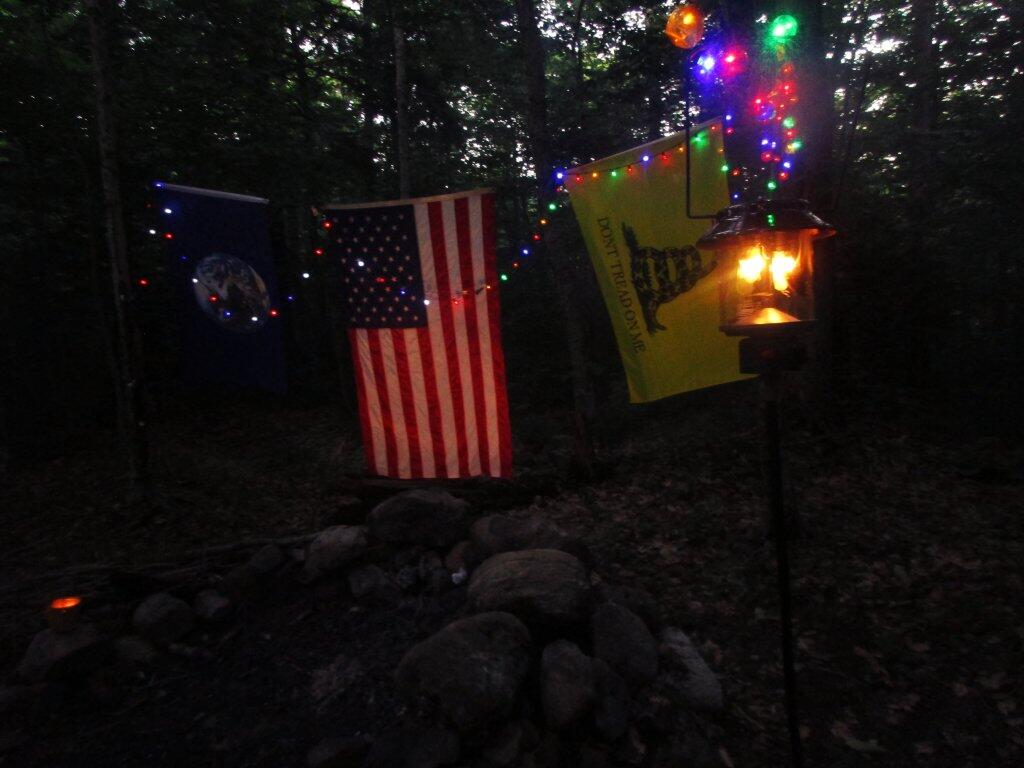
Increasingly on clear nights I’ve been killing the lights earlier after dusk then the past in favor of being able to see the stars better and enjoying the laser lightening bug light show that I have that puts pretty ever shifting green dots on the trees.
The truth is when I got the laser lightening bug show I was concerned about pointing it up towards the tree branches with all those sensational news stories about the laser Christmas lights blinding pilots. So I did some of my own fact based research on the topic and also tried shining the lights at distant hill tops and I found very little light traveled beyond 500 feet. Maybe problematic next to an airport but not to a plane thousands of feet in the air. I also tend to angle things no more than 30 to 40 degrees.
With the stars up above and the lights elegantly illuminating the tree branches it really is nice. Both the natural beauty above and the artificial beauty looking ahead. It makes for some nice quiet time in the wilderness.
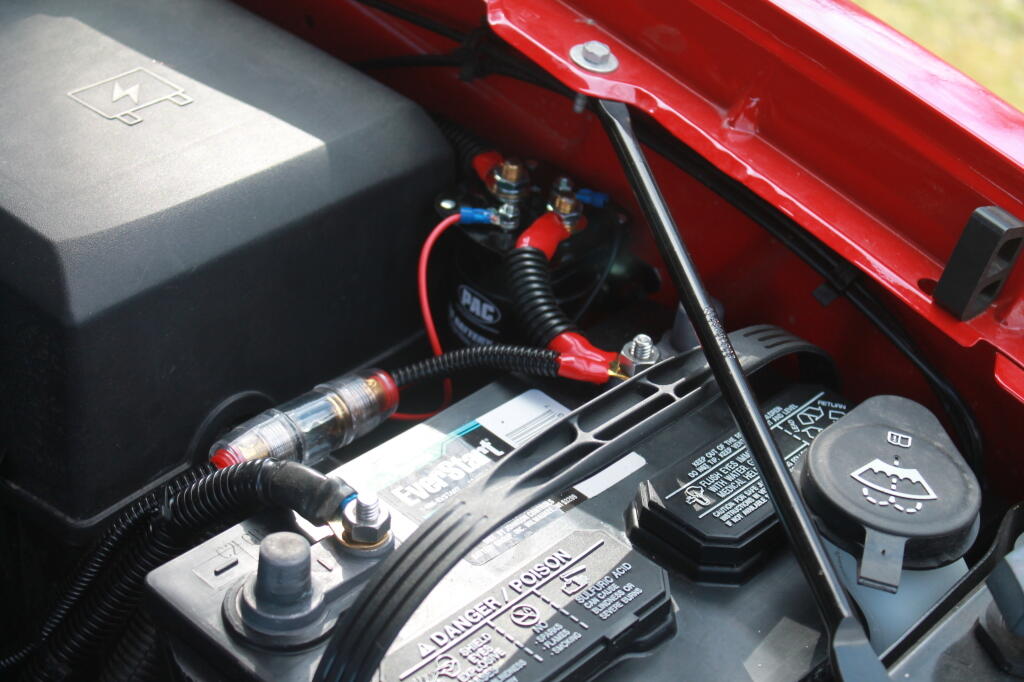
I’ve discovered that adding the low voltage battery disconnect (LVD) is key for maintaining a happy and healthy accessory battery in my truck. Previously, the accessory battery was electrically isolated from the starting battery, which allowed me to run down the battery without worrying about getting started, but nothing protected the accessory battery from overdischarge. Dropping a rechargeable battery’s levels down too low means the chemistry is irreversibly changed and the plates have sulfur collecting on them, which limits the ability to recharge. The alternator also has work much harder and longer to recharge a totally dead battery compared to one that is discharged to a safe level of only 50% charge. Battery life is much longer when you don’t overdischarge the battery, so that 50% consumed, actually can be longer then 80-90% consumed after a few deep discharges. A good deep cycle battery should be able to go into the 75% range safely, but why risk damage when one can disconnect it at a higher voltage? Moreover, you have to leave a bit of battery voltage above the danger range, to keep the low voltage disconnect powered, even though it only uses about 70 milliamp (which can add up over time).
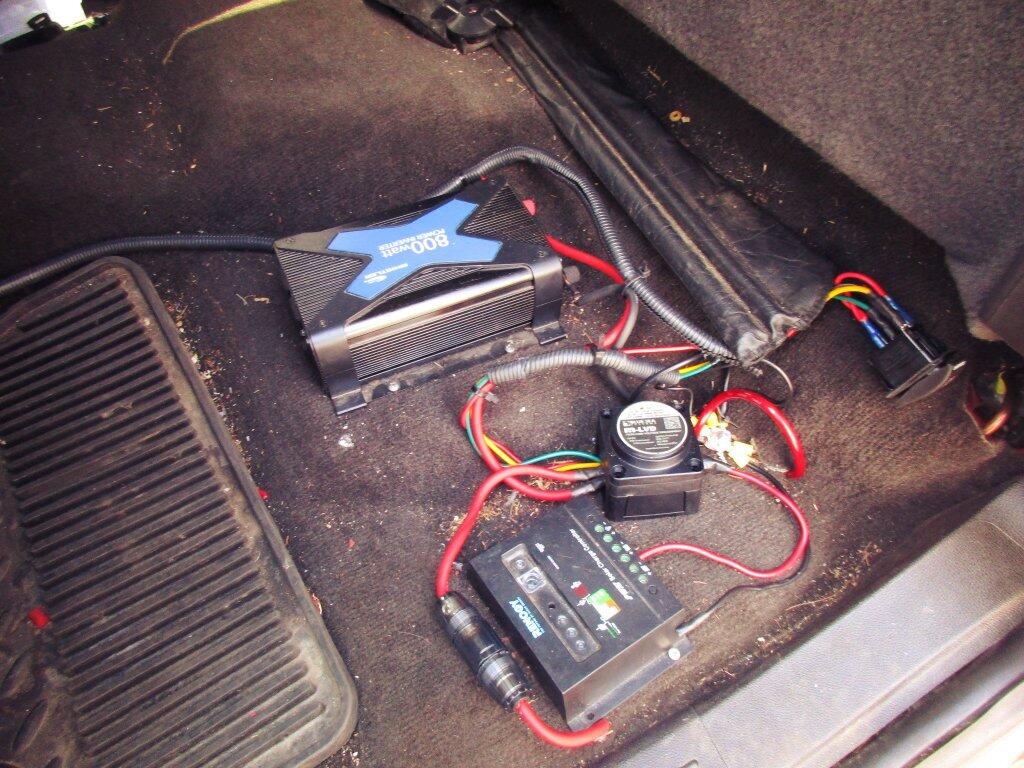
A low voltage disconnect is a combination of a electronic device and electro-mechanical relay that monitors system voltage, and if voltage drops below a certain level for a period of time, the relay opens to disconnect the load from the battery. This keeps the battery from overdischarging. On my truck, I use a BlueSeas 60-amp LVD ($50 on Amazon), which was a nice integrated unit that has both the voltage monitoring circuitry and a 60-amp relay built into the unit, and come with a wired remote for overriding the system or changing the targeted voltage. Read the instructions carefully on wiring the remote – they are a bit confusing. I have the remote hooked up, but I have yet to use it. There are other models out there, but most of them have a separate disconnect controller and relay, and aren’t as elegant.
The low voltage disconnect on my truck is always monitoring the voltage of the accessory battery. As long as the voltage is at 12.1 volts or higher, the relay (switch) inside it remains closed and supplies power to my truck cap lights, inverter, CB radio, dash camera, and all other accessory loads I have connected to it. When the voltage drops to 12.0 volts for more then 30 seconds (a delay to avoid disconnects on temporary high start-up loads of inductive loads like electric motors or the starting of the inverter), the relay opens, disconnecting the load. This means that the lights in the truck cap, inverter and all accessory loads are disconnected. That can plunge you in the darkness, but it also spares the accessory battery. You can always hit the door unlock button, or hop in the truck, and have interior light to get the truck started again.
The low voltage disconnect is constantly polling the battery voltage. When you start the truck up, after 30 seconds of voltage over 13.5 volts, the load is automatically reconnected to the battery, automatically reseting the inverter, turning back on the lights, and other load you have connected. The delay in reconnecting the load is good for the alternator, because it gives it a chance to start recharging the low voltage – a high amperage drain – before you put even more load on it from the accessories.
Prior to the installation of the low voltage disconnect, I relied on both the inverter faulting out for low voltage, and keeping an eye on the battery voltage to know when I should recharge things. But that was a hardly a perfect solution. The inverter wouldn’t raise a fault until 11.8 volts or so, which is closer to 75-80% discharge, and would beep but allow the battery voltage to fall well into the danger range for low voltage, before finally disconnecting. Other loads wouldn’t be disconnected at all. The inverter would chirp and beep when the battery voltage was low – a rather annoying alarm – and require a full reset by reaching down and turning the power switch on an off. Left parked for an extended period of time, sometimes predatory loads from the various USB ports and other minor electronics would discharge the accessory battery below a safe level. It was far from an ideal situation.
The low voltage disconnect does it’s job, silently. It disconnects the load when the battery voltage is low, without any further prompting or annoying beeps or alarms. It reconnects the load when the engine is powered back up and the battery charge is at a safe level once again. It works without fiddling with it or monitoring the voltage yourself. It’s a good safety measure that I would recommend for any rechargable battery-powered application.
I guess not all government workers are bad people 👨🚒
Maybe it’s the field I work in — political communication — but the impression I get of most government workers is they are in for the money primarily, and that most government jobs are about patronage and unwarranted attention seeking. Maybe government workers fill a needed jobs, and some are competent at what they do, but they hardly are the noble public servants, helping those in need, that they use the mass media to portray themselves as. Maybe a necessary evil, but not as noble as they like to portray themselves.
But my views have softened a bit since the fire recovery efforts at John Wolcott’s house. With some careful negotiations with the fire inspector, and some help from current and former local elected officials, we were able to recover a lot of his files. The fire department was very sympathetic and helpful with the recovery effort, working to haul heavy, stinky, soggy wet boxes of files out of the house and ultimately allowed us to secure even more things from inside. They seemed genuinely caring and helpful, willing to go above the bare minimum of their jobs to help out the community. They took time they could have spent doing other activities, they spent actively assisting in the recovery efforts.
So maybe government workers do care about the communities they serve. There are good people in government, even if the incentive structures of government workers sometimes mislead them — be it campaign contributions, promotions, or other benefits from serving the politicians over the people. It’s good to know people in government sometimes actually serve the people, are willing to lend a helping hand to those in need. Not all government workers are just political hacks out for themselves.
Tonight’s ride home wasn’t nearly as wet 🚲, their wasn’t any rain ☔ and while the southernly breeze on Erie Boulevard was though as usual, it wasn’t so hot and humid at five o’clock that I ever felt too exhausted.
I think I found the loose part of the shaft ⚙ on the food processor and glued it back together. I’m hopeful that this will fix the problem. I’m hoping this is the case but I might also get a mini chopper to use for prepping food up at camp. I just love my shredded carrots 🥕 and oatmeal. Onions too!
Out at Five Rivers Environmental Education Center 🐸 listening to the frogs and doing some reading. 📖 Phone touch screen is working good again. 🖕 📱 Maybe I can put off that expense for a bit longer. Do want to get a bolt 🔩 on kickstand for the bike though in the coming weeks.
![Untitled [Expires June 6 2024]](https://andyarthur.org//data/photo_013762_large.jpg)