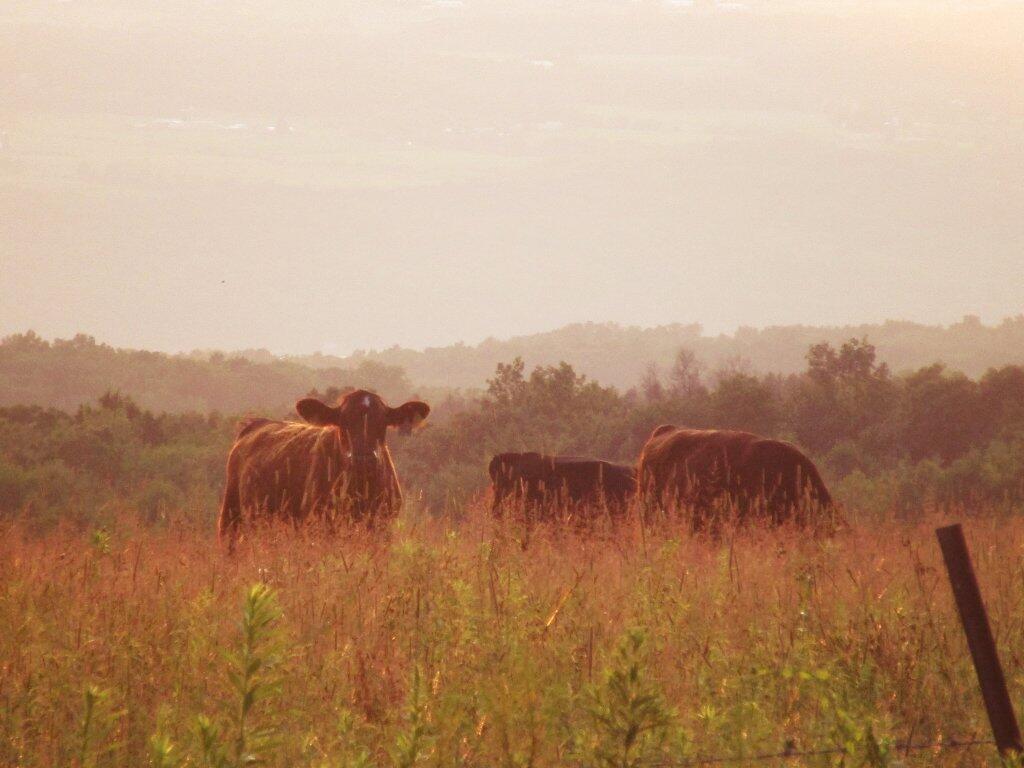
Yesterday at the Green Energy Fair 🔌 I listened to Woodstock Farm Sanctuary’s lecture on animal agriculture 🐮 and climate change 🌎 …
Honestly, I was quite curious to hear what they had to say, even though I knew it hardly would be positive and probably downright misleading. And it did not disappoint me, reflecting all the typical stereotypes of people who know nothing about agriculture or animals, have spent little time in the country and have a pretty poor grasp of science, facts or reality. Here’s my thoughts on some of the things said ….
Farms sometimes are pungent but that doesn’t mean their bad for the earth
Farms raise crops and livestock. Crops like silage are constantly being attacked by bacteria, as is animal manure. It rots, it produces hydrogen sulfide which are noses are very sensitive to. Just because it stinks, doesn’t mean it pollutes. Most farmers are highly educated on soil science, animal health and the environment. They want their often multi-generational farm business to survive, and the way to do that is to be highly contingent of the natural world around them. There is a lot that goes into building healthy soils that yield quality, profitable crops. Manure and fertilizer that washes off fields not only impacts streams, it also is a loss of nutrients from farms, which is a loss of potential crop yield. Nutrient management plans, based on science and created by people who have had years of training in managing natural resources are the basis of most mid-size and large farms. 💩
Burping cows and anaerobic biodegration in silage and manure pits produces methane
So that’s not shocking to anyone. Even if you take the worse-case scenarios, climate emissions from farming, especially in America were forests are not actively being taken down for new farm fields, are if anything declining rather then increasing as farms upgrade to more modern technology and techniques — and they’re a small part of the nation’s total carbon footprint. Farms cover millions of acres, but their carbon footprint is tiny compared to the big cities with the millions of automobiles. Deforestation in the rain-forest, by often desperate people in the third world is a totally different but related issue, but eating meat and partaking in animal agriculture in America isn’t necessarily causing it. 👣
Livestock are not treated badly on farms
Most farmers nowadays have a college degrees in agriculture and related sciences. They subscribe to and read the latest agriculture news and what products and practices are being promoted today. They are in frequent consultation with their veterinarians, and work hard to treat their animals humanely and with respect. Livestock are expensive, they require a lot of feed and care to raise to market weight or to produce milk and wool. High livestock morality, from stressed or sick animals means low profitability and the eventual failure of a farm business. 🐷
Farming keeps the land green, absorbing carbon
Farms by definition raise crops, and lots of them. Crops are plants, they absorb carbon dioxide from the air, turning them into carbohydrates that are eaten by humans or livestock. Even dairies, hog farms, chicken farms, and other livestock businesses are big crop growers, they actually produce and consume the bulk of crops grown on farm land today. All those crop fields are keeping the land open for wildlife, free of development, home for a wide variety of wildlife species. Some of the biggest “crops” of deer and turkey are found in agriculture areas that have quality soil, built up from years of careful management by farm families who not only feed themselves and the nation, but also wildlife.🌽
World-renowned activist, advocate, speaker, and author Dr. Temple Grandin will deliver a lecture at SUNY Cobleskill on Wednesday, November 20, sharing her thoughts and experiences about working with peers who are on the autism spectrum, and discussing methods she has used to be successful in her career. The lecture will begin at 1 pm in Bouck Theater, with a book signing to follow. The visit is part of a multi-campus partnership which includes the presentation “Connecting Animal Science and Autism” at SUNY Oneonta. The appearance at SUNY Cobleskill is limited to SUNY Cobleskill students, faculty, and staff.
On a Friday afternoon in late September, Kalamazoo County Health Officer Jim Rutherford announced that aircraft would mist much of the county with an insecticidal spray. Intended to kill mosquitoes, the emergency plan quickly turned into a public relations battle. Hundreds of calls and emails — and even some threats — streamed into Rutherford’s office in southwest Michigan, many expressing concern about the spray.
In the United States, an average of seven human cases of eastern equine encephalitis (EEE) are reported annually, according to the Centers for Disease Control and Prevention. But 2019 has been an especially bad year for the mosquito-borne virus, with at least 35 cases and 13 deaths reported nationwide. In Kalamazoo County, when Rutherford made his decision, EEE had killed a 64-year-old man and sent a 14-year-old girl into intensive care. Faced with the prospect of several more weeks of mosquito-friendly weather, Michigan state officials had offered 15 counties the option of spraying. All of them accepted.
I like spending time out in the country but a daily commute out to Rural America would really be a drag I have to say. Having driven out to my parents house after work for a week house sitting, I really miss the ease of just being able to catch the bus to and from work, not having to worry about the traffic or the weather. When I’m home and can take the bus, I can be tired, I can be distracted or drunk but I don’t have to worry about getting to my destination safely.
Eventually when I own my own land, automobile commuting will be an inevitable part of the trip. Maybe I can car pool part of the time or use a bus to access the center city. Maybe I won’t live near such a big city where traffic is such a problem or choose a more sothernly climate were icy roads aren’t such a problem. Or maybe I’ll find work in the small town I choose to live in and I won’t have to drive far away to the city. Or develop a business that lets me work from home. There are many options.
I just don’t want to spend my days, every day stuck in traffic going back and forth to work with long drives out to the country. But it seems like I have options.