A few weeks ago, in Pasadena, Calif., I waited in a line that snaked all the way down the hot, sunny block for a cheesesteak the length of my forearm.
At first glance, it was a totally straightforward sandwich, but one that happened to cost $24, built with eight ounces of intensely beefy Wagyu rib-eye and sirloin. It had developed a cult following in Los Angeles after debuting as a lunch special at Matū, a steakhouse in Beverly Hills.
The meat was finely sliced, sizzled on the flattop with diced onion that went golden in the rendering beef fat, then tucked into an airy sesame roll along with some sticky cheese and a single, crinkly hot pepper. It was excellent, though it was also the kind of lunch that invited me to clear my schedule and take a little nap.
House Pond, located about seven miles north of Stratford on Piseco-Powley Road serves as a quiet monument to the vanished industry and transient settlements of the southern Adirondacks. While often overshadowed by Ferris Lake, the Potholers, and other destinations along the road, this pond’s history is deeply intertwined with the development of the Piseco-Powley Road and the early 19th-century logging and tanning era.
The Industrial Roots: Oregon and the Tanning Era
The history of House Pond is inextricably linked to a defunct settlement known as “Oregon,” which once existed near the southern end of the Piseco-Powley Road.
The Tannery Settlement: During the mid-to-late 1800s, this area was a bustling industrial outpost. The settlement of Oregon was centered around a large tannery that utilized the abundant hemlock trees in the surrounding forest. Hemlock bark was a critical ingredient for the tanning process, and the remote location allowed for direct access to these vast timber stands.
The “House” in House Pond: The pond’s name is derived from the structures that once stood on its shores during this period. It is locally understood that the name refers to a “boarding house” or a cluster of dwellings built to house the woodsmen and tannery workers who labored in the Oregon settlement. While these buildings have long since succumbed to time or were removed by the state, the name remains as a phantom of that era.
Logging and Abandonment
Like many early Adirondack settlements, the community near House Pond was temporary.
Resource Depletion: Once the accessible hemlock and spruce stands were exhausted, the economic viability of the Oregon tannery vanished.
Reclamation by Nature: By the early 20th century, the settlement was largely abandoned. When New York State established the Forest Preserve and the Ferris Lake Wild Forest, the land was designated “Forever Wild”. Under this mandate, any remaining structures from the old boarding house era were either demolished or allowed to decay, returning the site to its natural state.
Transformed to A Secluded Wilderness Site
Today, House Pond is a prime example of the Adirondacks’ “reclaimed” wilderness. It is accessible via an unmarked but well-traveled trail located behind Campsite 2 on Piseco-Powley Road.
Hiking and Camping: The hike to the pond is a short, half-mile trek with a modest elevation gain of about 100 feet starting at Piseco-Powley Roadside Campsite 2.
Seclusion: Because it is not a primary tourist destination and lacks official signage, it remains a bit of a “locals’ secret,” offering a primitive campsite on the shore where the historic boarding houses once stood.
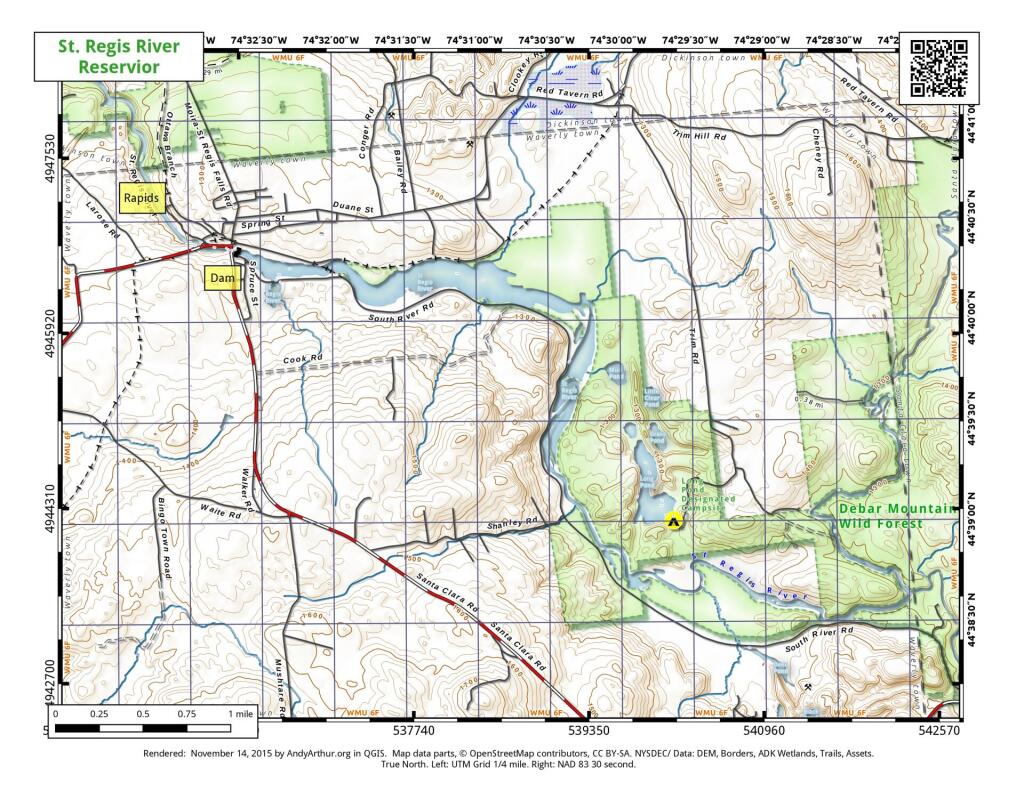
The St. Regis Canoe route consists of several navigable stretches of the St. Regis River, including the reservoir just east of the hamlet of St. Regis Falls. Parking to access this reservoir and a boat launch is located downtown and is found off of South River Road via a large sign on NY 458 aka Santa Clara Road.