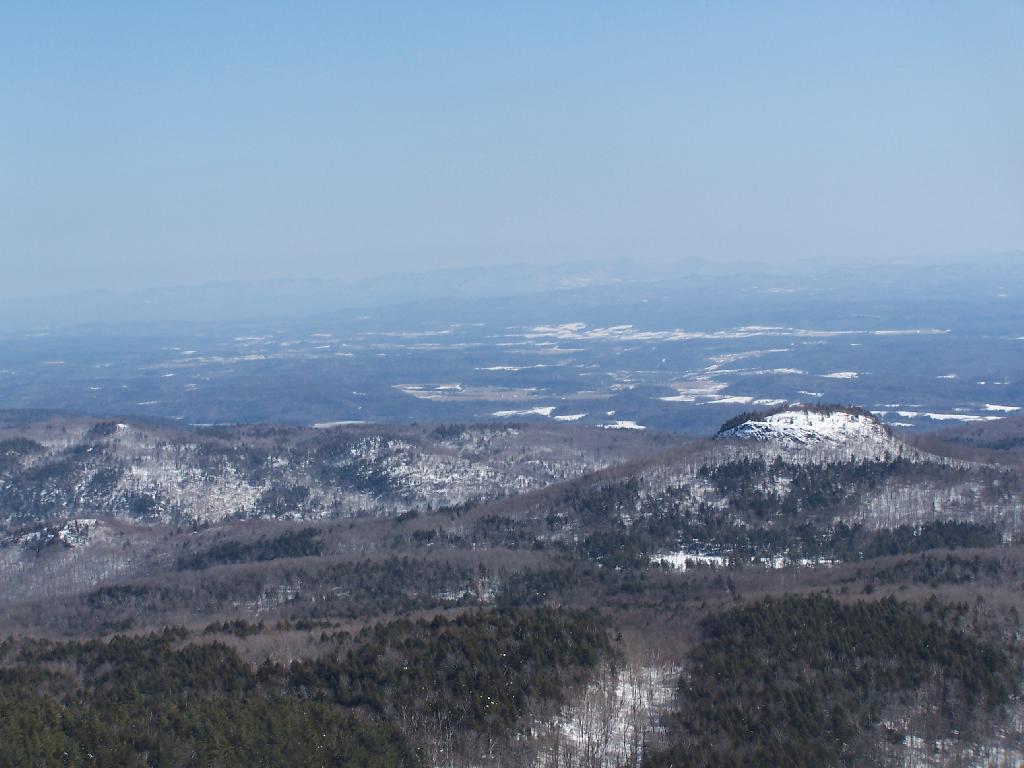
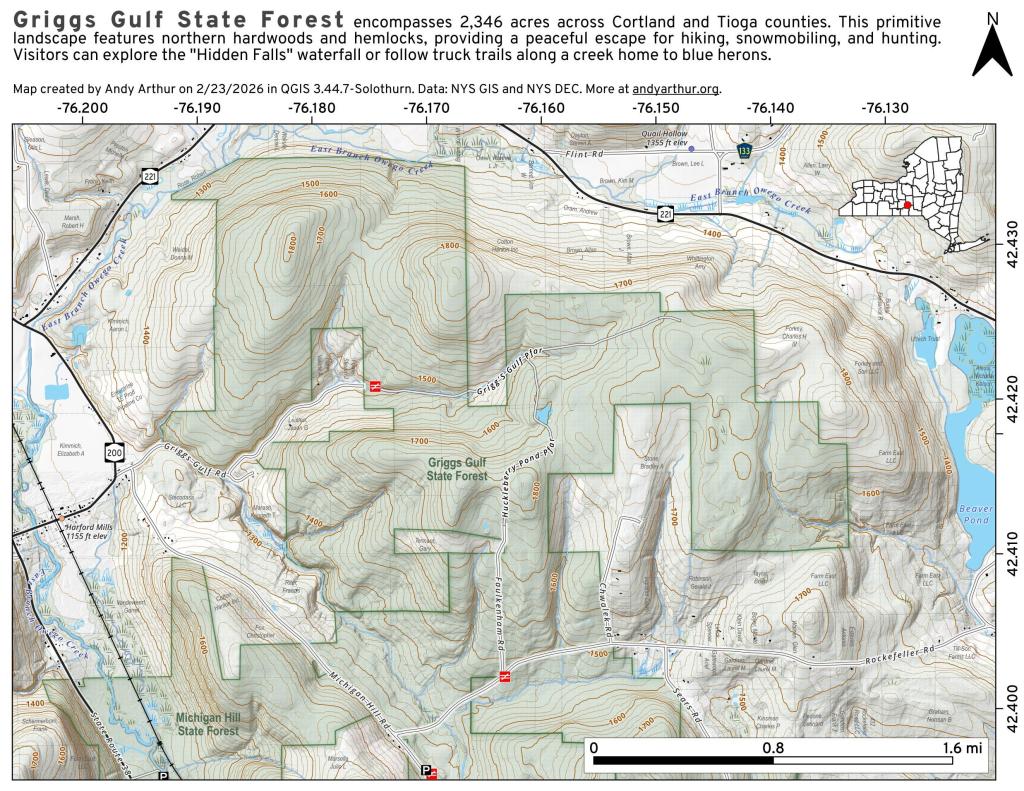
Along Prospect Mountain Road aka National Forest Road 273 (NFR 273), you’ll find a series of primitive, dispersed campsites that serve as a quiet basecamp for exploring the southern Green Mountain National Forest.
Campsite Overview
These sites are “dispersed,” meaning they are free, first-come-first-served, and offer no facilities like water or toilets.
Site Features: There are approximately 12 pull-off spots along the road. Many are large enough for 2–3 vehicles or a medium-sized RV.
Amenities: Most established spots include fire rings.
Road Conditions: NFR 273 is a dirt road generally accessible by most cars and SUVs, though higher clearance is recommended after heavy rain.
Key Regulations: You must camp in designated pull-offs or at least 200 feet from roads, trails, and water. Stays are limited to 14 days.
Nearby Trails
NFR 273 provides convenient access to several notable hiking opportunities:
The Long Trail (LT) & Appalachian Trail (AT): The road provides a gateway to these famous long-distance paths. You can hike from the end of NFR 273 toward the Congdon Shelter via connecting paths like Stage Coach Road.
Bald Mountain: A popular, challenging 8-mile hike with significant elevation gain and viewpoints of the Bennington area.
Prospect Rock Trail: A moderate 3.1-mile hike following an old road to a rocky overlook with views of Manchester Center.
Stratton Pond Loop: Accessible via nearby Forest Road 71, this 15.1-mile loop is one of the most popular backpacking destinations in the region.
Outdoor Activities
Stargazing: Due to the remote, wooded location, the area has very low light pollution, making it excellent for night sky viewing along the road.
Fishing & Paddling: The Somerset Reservoir is located a short drive away, offering extensive opportunities for fishing, kayaking, and canoeing.
Wildlife Viewing: The forest is home to moose, beaver, and various bird species, particularly near wetlands and brooks like Castle Brook.
Winter Recreation: In winter, the forest roads (including NFR 273) typically close to vehicles and transform into routes for snowmobiling, cross-country skiing, and snowshoeing.
Be sure to pack out all trash and check for seasonal road closures before you go, especially during “mud season” in the spring. Be aware some of the sites may have road noise from VT 9 (Molly Stark Trail) as trucks climb out of the valley.
1995 - Before the closure and demolition of GM's North Tarrytown Assembly
2020 - North Tarrytown Assembly Demolished, environmental remediation underway, to be re-developed
The North Tarrytown Assembly plant, located in what is now Sleepy Hollow, New York, was one of General Motors' most historic and longest-running facilities,operating for nearly a century from 1900 to 1996.
Early History & Maxwell-Briscoe (1900–1914)
The Walker Steamer: The facility opened in 1900 on the shores of the Hudson River to produce the "Mobile" steam carriage for the Mobile Company of America.
Transition to Gas: By 1903, steam power had lost its appeal, and the plant was leased to Maxwell-Briscoe. For a time, it was one of the largest and most advanced automobile factories in the world, designed by the famous architectural firm McKim, Mead & White.
The Chevrolet and GM Era (1914–1996)
Chevrolet Acquisition: Following Maxwell-Briscoe’s bankruptcy, the Chevrolet Motor Company acquired portions of the site in 1914 and 1915.
General Motors Merger: When Chevrolet merged with General Motors in 1918, the plant became the GM Assembly Division, Tarrytown. It would eventually become the largest GM assembly plant east of the Mississippi.
World War II: During the war, production shifted to military aircraft. As part of the Eastern Aircraft Division, the plant built wing assemblies and other components for the Grumman TBF Avenger torpedo bomber, employing roughly 10,000 workers, including 2,900 women.
Post-War Prosperity: In 1963, the plant celebrated a major milestone by producing the 50 millionth Chevrolet, a gold-colored Impala SS. At its peak, the plant provided nearly 50% of the village's tax revenue.
Closure and Redevelopment
Plant Shut Down: The facility closed in June 1996. Its age was a primary factor; the multistory, land-constrained site could not be efficiently modernized for new production methods. The final vehicles produced were the "APV" minivans: the Chevrolet Lumina APV, Pontiac Trans Sport, and Oldsmobile Silhouette.
Demolition: The massive complex was demolished in 1999.
Edge-on-Hudson: Today, the 96-acre site is being transformed into a mixed-use development called Edge-on-Hudson, featuring residential units, retail space, and a waterfront park.