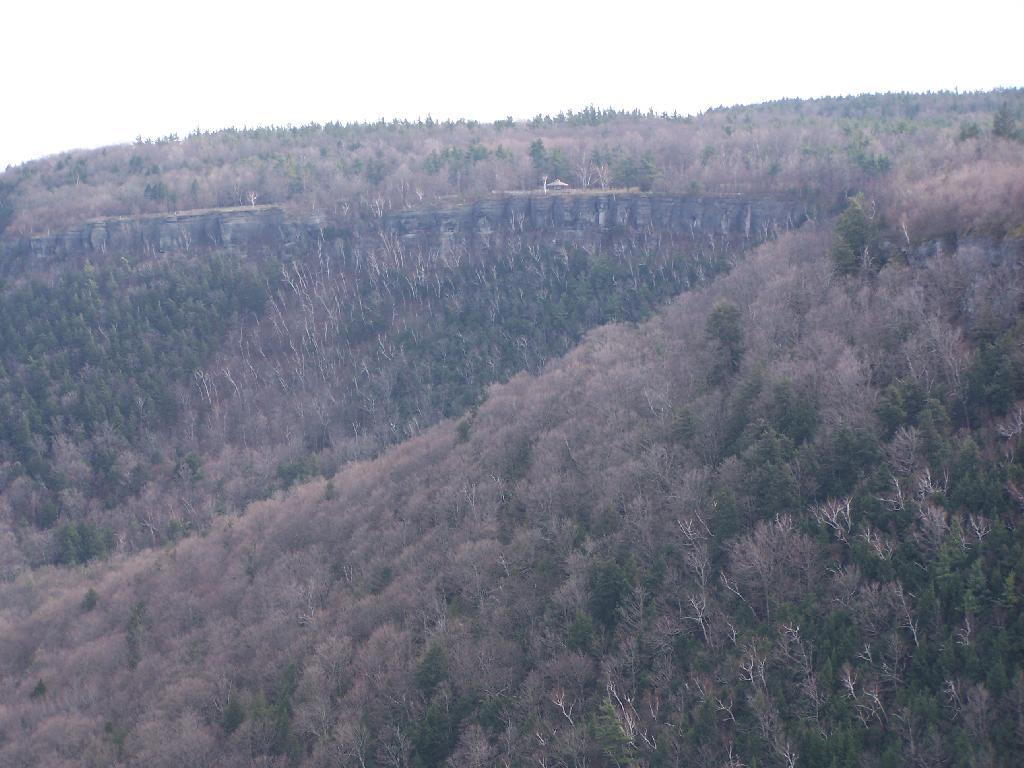
James Morrison, who moved with his family to Warren County about 1800, is believed to have been the first permanent settler of Kinzua Township. Previously, Morrison had rendered active service during the Revolutionary War, having engaged in combat at Staten Island in 1776 and in the crucial victory at Trenton on the day after Christmas. In recognition of the firesight, courage and independence of this early Pennsylvania pioneer, the General Assembly hereby recognizes his achievements by affixing his name to a bridge in his adopted Warren County.
Located on the Allegheny River in Warren County, the concrete and earth embankment dam stands 179 feet tall, 1877 feet long, and 1245 feet wide. The lake created by the dam has a normal elevation of 1328 feet and is 24.2 miles in length with a total of 12,080 acres in area in Warren and McKean Counties in Pennsylvania and into New York State.
Built 1966, the Kinzua Dam was authorized under the Flood Control Acts of 1936 and 1938. The dam was constructed to protect Pittsburgh and reduce flood levels in the Ohio River Valley after a series of floods devastated Pittsburgh, Johnstown, and other cities downstream the Allegheny River.
In a cemetery high on a promontory overlooking the broad waters of the new Allegheny Reservoir in northwestern Pennsylvania stands a stone monument to a once powerful and celebrated Seneca Indian war chief, The Cornplanter, who fought with the British against the Americans during the Revolution, and then became a loyal friend of the United States and a steadfast protector of American families settling in the wilderness of the upper Ohio River basin. The monument has not been at its present site long. In 1964, amid controversy, anger, and the protests of many Seneca Indians, the United States Army Corps of Engineers moved the memorial shaft, together with what was left of the earthly remains of The Cornplanter and more than 300 of his followers and descendants, from an Indian cemetery (“our Arlington,” pleaded a Seneca woman) that was about to be inundated by rising waters behind the engineers’ new Kinzua Dam on the Allegheny River.
I like listening to Bread 🥪, which is the maximum soppyiness of music 🎶 that they play ▶ on the oldies station not that anybody listens to the radio 📻 anymore.
Kinzua County is often spoken of as a beautiful place and attractive to tourist. Nearby, to the north, was a little town that had its attractions too, now swallowed up with water and seldom spoken of. The name Corydon.
We do not know how Corydon got its name. It was located on the Allegheny Plateau in a fertile valley through which the Allegheny River flows. It was situated between two Indian reservations, Seneca to the North and Cornplanter to the south. Along the shore were many interesting plant, cattails, willows, thorn-like plant, and fragrant blossoms. Here and there towering trees grew. People enjoyed boating and fishing on the Allegheny, gathering bluebells on Brown's Island, gathering wild crabapple blossoms, getting arbutus, lady slippers, marsh marigolds, wintergreen-berries and, in the autumn, bittersweet which was prized for the winter bouquets. Chestnuts were plentiful then as well as wild plums.
A Californian who visited Corydon, years ago had this to say: "The Corydon, Warren and Bradford area of Pennsylvania is as lovely in natural beauty, residential appeal and genuine hospitality as any spot I have yet seen. Through the Allegheny Valley I have seen the fundamentals of real living and unblemished works of nature at its best. The Pennsylvanians of this area are blessed with a setting for the unexcelled".
The Pfizer vaccine involves two shots taken three weeks apart. Casanova says the first shot, which is merely an introduction that allows the body to get used to the messenger so the immune system can start developing antibodies, had nearly no impact. He said there was some soreness where the injection happened, but other than that, he thought he had received the placebo; he had no symptoms.
Three weeks later, when he received the second shot, he was sure that it was the vaccine. The second shot is a booster, which allows the immune system to kick into action, creating antibodies. The response was noticeable but didn’t last long. He experienced flu-like symptoms, with some chills as he went to bed. By 3 a.m., the symptoms were gone.
It should be noted, the vaccine is not introducing the virus to the system, and the symptoms are just the immune system doing what it is supposed to do.