Today’s essay is from the Bulletin of the Atomic Scientists in December 1969, penned by Mayor Erastus Corning in 1969. I share this simply for the convenience of reading it online, I can claim no copyright except to point out it should be in the public domain due to being a speech given by a public figure to a public body.
When city officials meet with highway engineers, there is a familiar theme. Where is the automobile leading us? Here is the way one official of a metropolitan center looks at the problem of autos and more autos. Mr. Corning is the mayor of Albany, New York. His comments are adapted from an address to New York Highway Department engineers, April 17, 1969.
For something over half a century, few people gave even the slight thought to the question: Is the automobile here to stay? In the sixties, however there have more and more haunting doubts–more and more question raises. Have we the necessary space for all the automobiles we are buying, using and discarding so freely? Have we the space for the great scotch-tape kind of ribbons of concrete and blacktop that we are pasting on the land? Have we the space to congest and clog up our city streets so that they can neither be cleaned properly in the summer nor have the snow removed in the winter? Have we the space for monumental parking garages and vast parking lots of in prime areas in our cities?
While I have used the word “space” and not spoken of the cost or economics, the relationship between space and economics and becomes and more intimate each year that our earth becomes more and more crowded. When one can reflect that total number of people on the earth today is greater than the number of all members of human race that have walked the earth before us since the dawn of history, we can see dramatically that we are getting pretty crowded.
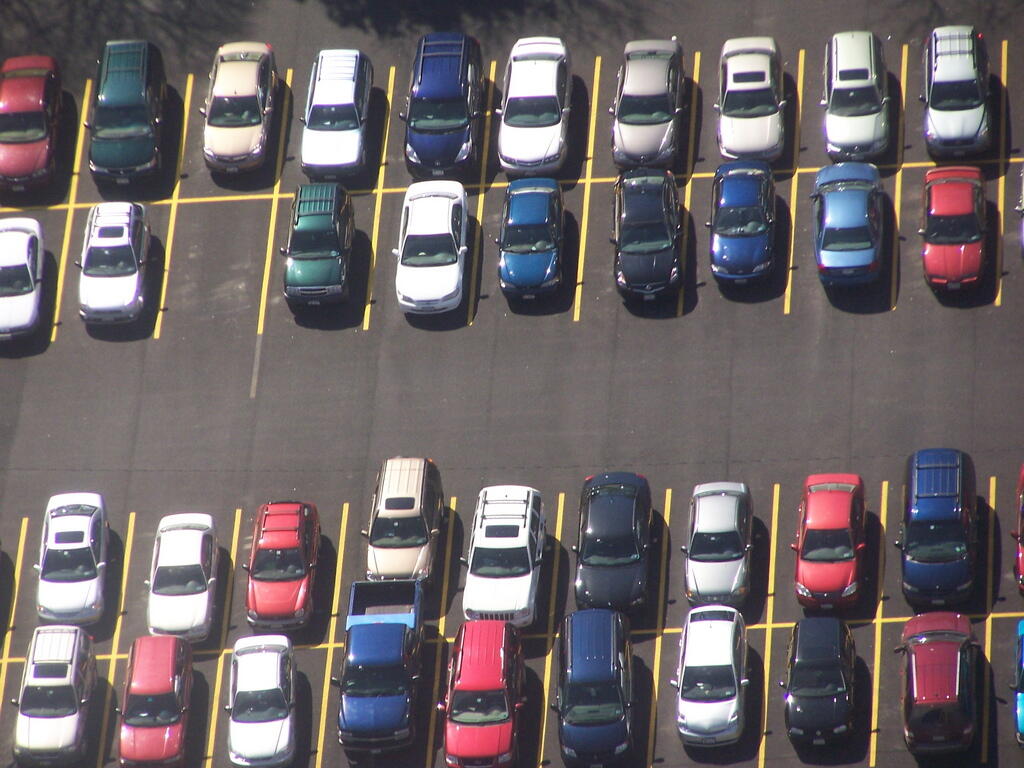
Speaking of being crowded — brings to mind a number of pretty dramatic statistics. The vastness of the oceans of the world is no longer limitless. Pesticides, hydrocarbons, lead, to mention but a few, are becoming cause for serious alarm as to the universal polluting affect they are already having on our oceans. On a more local scale two-thirds of downtown Los Angeles is devoted to either — highways, arterials, or parking lots. One-half of all the air pollution that exists in the entire world comes from automobiles, carbon monoxide amounting in just the United States alone to some 230,000 tons each and every day.
It sad thing to have to take comfort from the fact while the amount of carbon dioxide that is going into the atmosphere increases the tendency of the atmosphere to act as an a greenhouse trapping the heat of the sunlight and raising the world’s temperature, this balanced by other forms of air pollution that come between us and the sun, cutting down on the amount of actual solar heat that reaches the earth and reducing the temperature to back where it was.
While the medical advances in the last quarter of a century are greater than all such advances that have occurred throughout human history, a less pleasant fact is that in the last 30 years we have used up more minerals and fuels than in all of history, and that use will double again in the next 25 years. It is another sad fact that in half a century we will have increased our per capita use of water in this country twenty-five fold.
In addition to the population explosion, everything else is exploding too. Our use of water, minerals, and fuels has increased even more than our population. Our manufacture of automobiles, packaging materials, bottles, tin cans — these too have increased by geometric proportions.
We are getting crowded; air and water and land becoming more and more at a premium.
You may very well wonder what in the world all this has to do with highways and highway engineering. The plain fact is that we are in a competitive race for space and land and haven’t come even remotely close to realizing it as yet. The hue and cry that we hear on all sides on the disposal of solid wastes is an indication of the start of that realization. The almost complete about-face on the question of thermal pollution resulting from the operation of atomic power plants is but a few months old. The popular appeal of bond issues and vast spending program to combat air and water pollution is a further step along the road realization of the conditions around us.
The day of laying out the basis of pure engineering and plain economics is gone. Today your problems are infinitely more complex than they were ten years ago. I do not know much of what is in store for us in the future, but I do know this for certain. If our population continues to climb at its present rate we are not going to have room for both people and automobiles as we know them today. Looking at the State Campus office complex in Albany, one is overwhelmed by the vast sea of automobiles covering a far greater area then all the office buildings. When you come from the Thruway and the Northway to go to this same State office complex, the amount of land covered and surrounded by curliques and cloverleafs seems greater again than all the campus office buildings. There just isn’t going to be enough space for this kind of a thing to continue. The competition is going to be too great, and the automobile, I hope and believe, is going to lose the fight to just plain people.
What can be done about? What can you who are so closely associated with the automobile and where it goes and where it sits quietly most of the time, what can you do? I don’t know but I do have a few suggestions.
The amount of space that automobiles take up just waiting to be used is tremendously wasteful. In our cities, waiting automobiles make it impossible to clean our streets of dirt in the summer and snow and ice in the winter. Perhaps private ownerships of automobiles will become a thing of the past in our cities. We may end up with a fleet of mini-autos, self-driven taxis, owned by the city, autos without keys that can be driven by anyone to anywhere he wants to go and then left for the next person who wants to go someplace else. This would eliminate much of the waste of autos just sitting in one at least 90 per cent of the time.
Certainly mass transportation is going to become more and more important. Our passenger carrying railroads to contrary notwithstanding, the possibilities of innovations and great break-thoughts in mass transportation are infinite and must be found, monorails, moving sidewalks, mini-buses, high speed trains. These are all with us now, but we cannot stop there. We must have a great variety of new ideas in the field of mass transportation. Our locations for bus stations, and what services are provided in these bus stations must be new, must be treated both with imagination and that we have a long, long, way to go in this field.
Multiple uses of our highway properties, particularly in and around our cities are already with us, but here again it must be expanded. Every highway planned from now on must be designed with multiple uses in mind. The use of air rights will become more and commonplace, and highways will have all the features built into them at the outset that will make it easy to use the air rights. Every cloverleaf eventually will be designed so that its interior land can be used for surface parking and, to go one step further, will be designed for two- and three-deck parking garages either over or under, and perhaps both.
Chemical engineering is going to be more and more important. The air over our highways our highways can no longer continue to be filled to suffocation with the wastes from our automobiles.
Note: The rest of the speech was not printed in the article.

