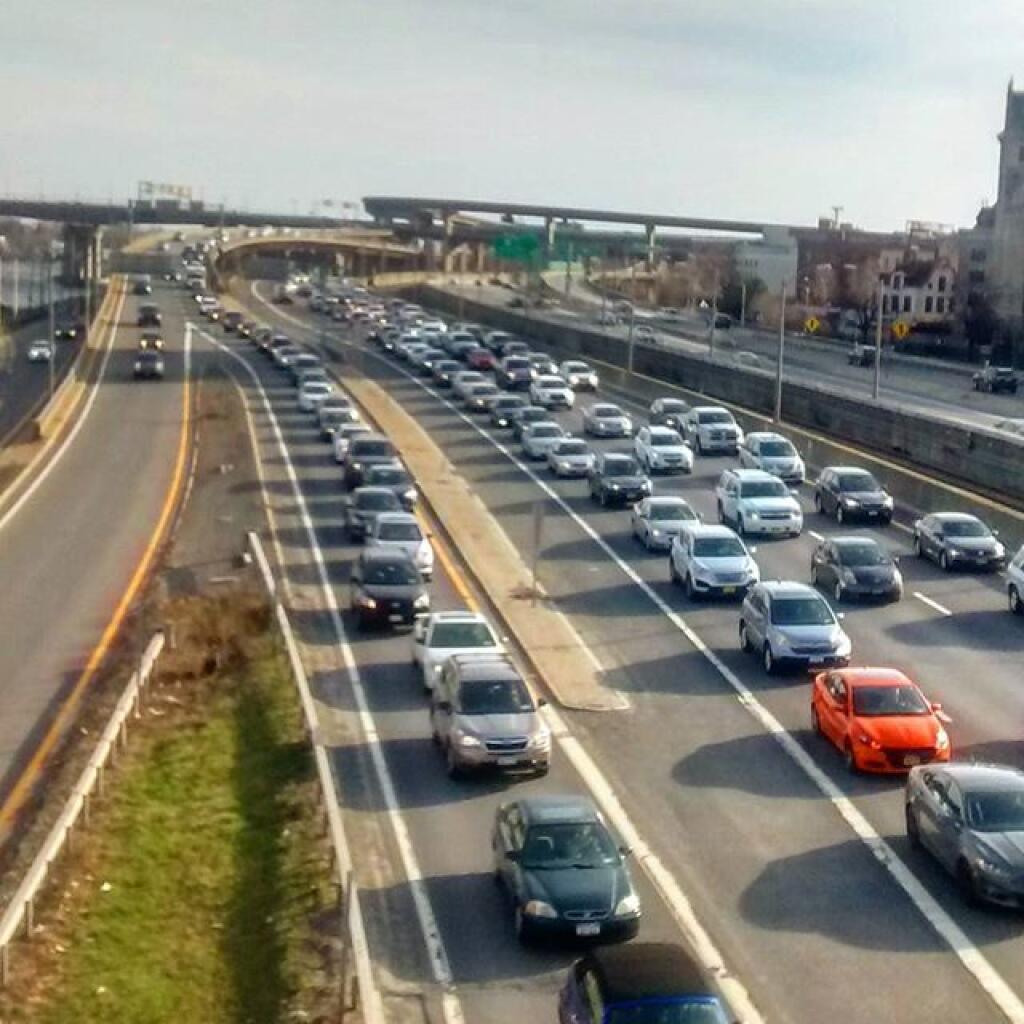
I’ve continued to think about country living and building my off grid homestead. Commuting sucks especially in the big city, as I’ve determined in the past two days when I drove to work – one day for the Pine Bush Hike and the other for heading out to Schoharie to camp.
Traffic jams, traffic speeds up and slows down, you have to pay constant attention.
So many broke down cars and crashes necessitating difficult lane changes due to Move Over Law.
Cops everywhere – checking your speed, if all your tail lights are working, not using your cellphone, following the Move Over Law.
A complete time suck – on the bus you can read and on the bike you get exercise but time driving is wasted.
Expensive automobile maintenance and fuels.
And that was only one trip out of town and a trip up to the Pine Bush!
It’s nice to get out of town, but I’ve come to realize that much of the nice of the really nice land is beyond sensible commuting distance. There is no reason to live in a suburban subdivision surrounded by corn fields that smells like cow shit. Commutes aren’t certainly a good reason to live out in the country.
Maybe for as long as I have to live in big city, focusing on making money, I should continue to live in the city where I can bike to work. Continue to research and plan my dream homestead, but realize it’s not compatible with living in New York or being within commuting distance of my work. It just isn’t possible to put together to incompatible views of my future.
I have lately gotten this idea of the parameters of my homestead that I’m putting together.
20 acres
Less then 30 miles, 45 minutes to work each way
Total of $250k for the build
Up to $300k if necessarily with cost-over runs
$100k for land
$100k for house
$50k for infrastructure (road, leach field/septic, water well, possibly solar)
Having these parameters is fine, but in many ways I am pulling these numbers fairly arbitrarily based on some preconceived notions I have i my head that isn’t based on hard data. As a podcast on building an off-grid cabin notes, anchoring oneself to a series of numbers is dangerous because it risks you spending too much or thinking your vision is impossible.
Moreover, I’ve realized many of these numbers might as well be pulled out of thin air and my own biases. But I needed somewhere to start, and as cost and availability data come to be clearer, I will adjust my plan appropriately.
I am thinking I would go all in for the rustic, early 1900s look when electrification was a new thing and buildings were often lit by a single bright light bulb hung from the ceiling with a wire with no fixture surrounding it, hung in the center part of the cabin near the wood-stove. There are so many great retro-LED bulbs, and it would so much like a poor cabin from that era when people had only a few electric lights. Plus very energy efficient to spread out the light over the majority of building, with only separate fixtures in the bathroom, kitchen, and then task lighting like table lamps by the rocking chair or next to the bed.
I was thinking I would do wood-plank style flooring, either over a post and beam floor or poured concrete slab foundation, to keep that rustic look, along with wooden shiplap and/or tongue and groove inside walls with the use of congregated steel in the bathroom and kitchen, and in front of the firewall where the wood stove would be located. I could certainly install those materials myself, and it would not only save money, but also put more sweat equity into the whole project. Plus, while I don’t hate drywall quite as much vinyl siding, plain drywall walls are so ugly, and far less sustainable then pine or even cedar shiplap or tongue and groove. Plus drywall is hard to keep from getting dingy with mud and muck I’m likely to track in from barnyard and hauling wood into the cabin, or the occasional smoke and ash from back-drafts and chimney cleaning. Plus then I could keep the scraps either for heat or bonfires out back. Burning hunks of shiplap in a bonfire out back with a cold beer is probably a hell of lot more fun then paying to landfill hunks of drywall. I guess you can chip and compost gypsum board, but they use fly ash in it which contains heavy metals. Yuck!
Fire safety people probably wouldn’t like the lack of walls in the center part of the cabin, and when I consult with the architect and town building inspector, I would have to figure out what the code requirements would be. Walls are good should a room flash over in a fire, as your bedroom could be closed off from the main section of the building. That said, having good smoke detectors and a nearby window for escape might be sufficient. I really like the idea of minimizing walls, outside of the bathroom, to ease heat dispersion from the wood-stove, simplify building, and be able to light more of the building using that single central light bulb. I want be warm in bed, even in the coldest nights. I don’t have privacy concerns, as I live alone and aren’t real interested in marrying anytime soon.
After watching that video I was thinking about all the tools I have for land research with public data and GIS tools 🗺
Most counties and states now publicly post tax maps and rolls. If I can connect to those REST Services then I can have fairly good idea of property lines, assessed value and taxes. Using R Studio I can easily calculate the assessed value per acre in an area or for similar properties.
Then then there is a lot I can find out about a property without ever even stepping foot on it. Aerial photography, especially the most-common leaf-less type taken either in April or November before the snow can show a lot about what conditions are like on the ground. It can give on an idea of what buildings exist there, what trees and pasture exist. What kind of logging practices have taken past in the recent past. In addition, most places now have a wide variety of historical aerial photos available. For most areas, you can easily get aerial photos from the 1950s and early 1960s, which can give you insight on whether or not the land was farmed in the recent past.
But maybe the next most interesting is the information one can obtain from LIDAR elevation data. In most cases, LIDAR survey data can show stone wells, gullies, potential wetlands and swamps, and old trash dumps above grade. Basically anything that is ground cover, that is not trees. If you download the full-point cloud data, you can get things like building and tree heights, which can give you more ideas on what trees are on the property and what is salable.
It’s actually quite remarkable what you can do with modern databases, some R code and GIS data to discover a lot about land that might in a few years back be unknowable without a detailed, on the ground property survey. I am fortunate to have so many resources available at my finger tips these days — recognizing though that other people also have access to data, though maybe others aren’t quite as talented when it comes to working with big data or sifting through GIS data.