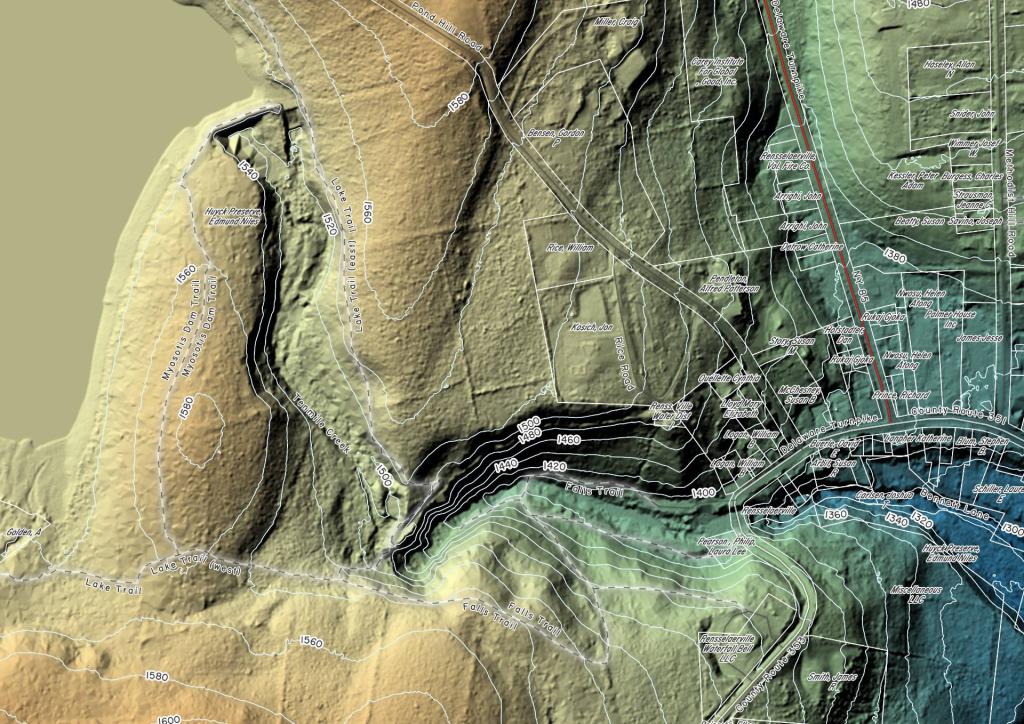
I took a bus and the walked out to a car dealership in New Jersey, out past some long abandoned factories. Big long abandoned industrial buildings and earthy and smelly, rundown farm land. It’s still winter, quite bleak and gray. I’m looking at these big pickup trucks and then it’s time to go home. Somebody suggests I take state subsidized commuter rail back to New York – it’s only a few bucks as it’s subsidized. I ride a few more stops then expected until I get to this scenic crossing over a river – scenic except you know for lots of electrical lines. I get off at the station there, and there is a scenic viewing platform, but of course the real scenic view of the river is highly blocked off with restricted area signs and chain link fence due to the electrical infrastructure. Big signs put up by State of New Jersey discuss how green the commuter rail is, being powred by the hydro dam right below my feet.
Deciding to walk the rest of the way downtown, I step into this vast underground college campus, officially it’s an affiliate of Rutgers University as I’m still in New Jersey. Vast lecture halls, all underground. I pop into a lecture hall briefly and then head back out needing to get back to the Empire Plaza and downtown. So I follow this tunnel back to the Empire Plaza, running into this long time political activist from a lifetime ago – some left wing group I used to hang out with in my college days. We talk as we walk to the Empire Plaza, the mystery level I’m completely unfamiliar with. I arrive after going what seems like miles to what appears to be the Empire Plaza but an unfamiliar level. Looks like the Concourse but this is a different, lower level. There are some signage but it’s confusing. White walls, brass, concrete I beams.
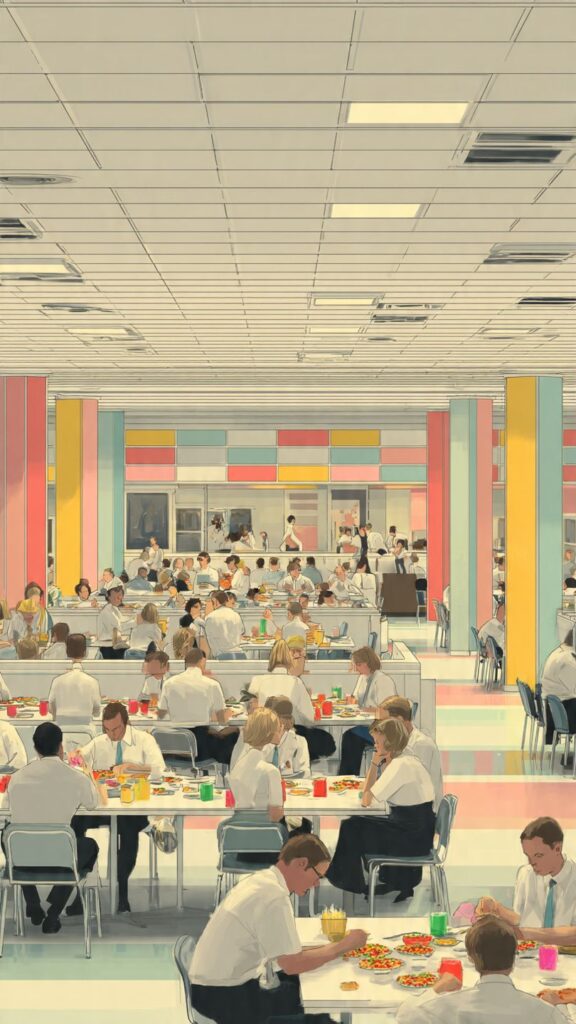
What would you know by now I need to go to the bathroom. There is a sign to the bathroom, down the stairs to an even deeper more obscure level of Plaza. At first I walk through an abandoned cafeteria, tables roped off in caution tape and a hastely posted “Posted No Tresspassing” sign like you might find on a farm. Then I find another bathroom sign that directs me through another hallway, a set of stairs to another cafeteria, this one a knock off of Pizza Hut from the 1970s, full of state workers in pin stripe shirts eating what appears to be thin microwave pizza and round plates of colored flat jello, each quarter of the plate a different brightly colored jello, red, yellow, blue and green. I am at a loss, the next bathroom signs appear to point a broom closet.
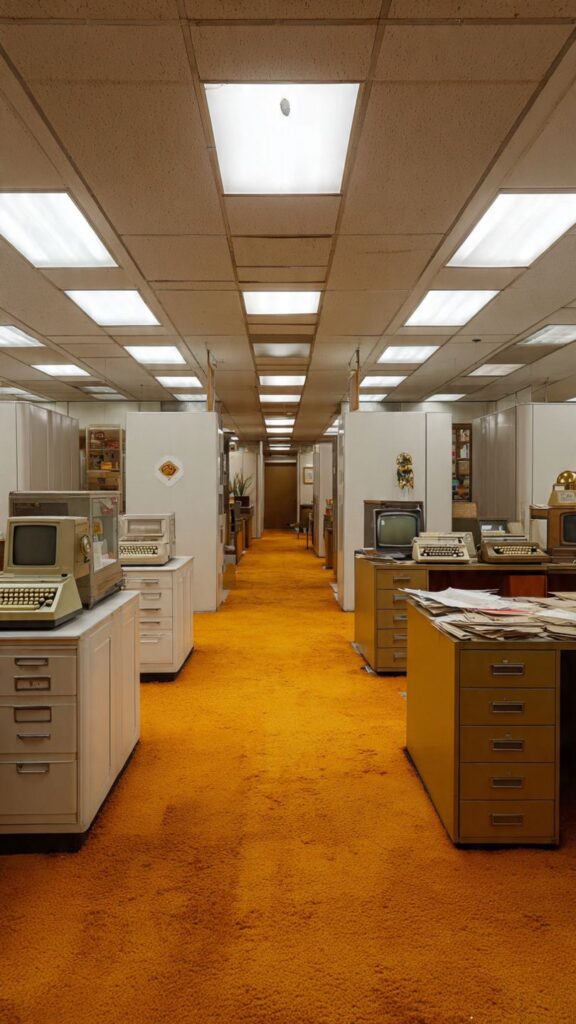
I ask one of workers and he looks up from his plate of flat colored jello and he points me down another corridor. I walk past the Office of State Purchasing from Women Owned Alpaca Farms. Who knew the state had an agency that only purchased from women owned Alpaca Farms? I guess fiber for state agency uniforms? Down another hall, set of a stairs. I see a even more state offices, the hallway narrows further, as this part of the building is very old and not accessible to people with disabilities. Apparently this part of the building was never updated to accommodate persons with wheelchairs. Past more filing cabinets and cubicles. This is a very old and dated interior, so deep in the Plaza few people ever see it. And I keep following that signs promising me the bathroom, deeper, and deeper into lower and lower levels of the Empire Plaza I never knew existed.
A few weeks back I joined a few Facebook groups on Ford SuperDuty trucks, one of them is the 7.3L Godzilla enthusiasts forum. Unfortunately most of the posts lately have been reasons that you really don’t want to buy the ginormous engine – lifter failures, bad transmissions, and people getting far more horrendous gas milage then even I estimated.
Truth is it’s one of the most produced commercial truck gas engines produced in America, and many people use them to pull heavy loads over mountains, idle all day, and otherwise work them hard. Far harder then I would, and it’s good to see the other side and no potential risks and downsides of the enormous trucks. Any mass produced vehicle, no matter how good quality control is, there will be some lemons. But I also take in context – I won’t likely ever run a lift kit on a HD truck and probably will be happy enough even with close to stock tires. With factory parts, and simple engine, it will be much easier to get repairs done unlike my old lifted truck.
And then there is the issue of cost and complexity of LED headlights and taillights with all of the sensors. I was reading the Ford taillights are upwards of $4,000 to replace the broken part. That said, the XL models – like the XL Off-Road still have the halogen bulb lights which are certainly much cheaper to replace. Maybe that’s the case for staying away from the appearance package and not having the fancier headlights and taillights. That said, solid state units are certainly quite reliable and in a few years it’s certain you’ll be able to find junkyard parts much cheaper. And maybe there are Chinese-knock off parts that would work, especially if STX I get doesn’t have the fancy cameras or sensors. And is the 6.8L and 10R100 that much worse then the 7.3L 10R140? I don’t really need the extra umph for towing, and the destroked Minizilla is said to be nearly as powerful or maybe even better then it’s up sized version and the 10R100 shifts smoother. I guess it depends what is avaliable and for what out the door price.
Truth is I am probably over-analyzing it, and whatever I get for a truck will serve me well over the next 15 years. Even limiting yourself to F-250/F-350 gassers, the options seem numerous. And the big Fords are relatively simple engine designs with lots of space under the hood for repairs compared to a lot of cars these days. You can’t prevent all tragedies or loss, insuraning against every rare case quickly gets expensive and is not financially wise even if sometimes you do have to bite the bullet, cut a checkand deal with whatever life throws at you.
I’ve been considering the pros and cons of the Godzilla engine vs the Minizilla and how much priority I should give to trucks with the bigger gasser engine. I want something really reliable and I worry the downscaled engine might be less reliable even though I plan mostly light duty driving. I am in this Godzilla Facebook group and I keep hearing issues people have with this otherwise said to be highly reliable engine. I did some research and also checked out what Google AI had to say about the options.
Both the 7.3L Godzilla and 6.8L Minizilla (also known as the “Baby-zilla”) are considered highly reliable, heavy-duty gas engines built on nearly identical architectures. Introduced to replace the aging 6.2L V8, these pushrod engines prioritize simplicity over the complexity found in smaller, turbocharged, or direct-injected engines.
Engine Comparison & Reliability Factors
Shared DNA: The 6.8L is essentially a destroked version of the 7.3L, sharing approximately 95% of its components, including the cast-iron block and cylinder heads. This means parts availability and serviceability are excellent for both.
Simplicity Wins: Both engines use port injection and a pushrod (overhead valve) design. This avoids common issues found in other modern engines, such as carbon buildup on valves (from direct injection) or complex timing chain failures (from dual overhead cam designs).
Key Differences:
Internal Strength: While the 7.3L features a forged steel crankshaft for maximum durability under heavy loads, the 6.8L uses a cast iron crankshaft. This makes the 7.3L objectively tougher for extreme, continuous towing.
Transmission Pairing: The 6.8L is typically paired with the 10R100 transmission, whereas the 7.3L usually comes with the heavier-duty 10R140 TorqShift, which is designed to handle more torque.
Known Issues:
Lifter Concerns: The 7.3L has had reported instances of lifter failure, often attributed to low oil pressure during extended idling periods.
Early Recalls: Some early Godzilla models (2020-2021) faced minor issues, but most have been addressed in newer model years.
Which is right for you?
Feature
6.8L Minizilla
7.3L Godzilla
Horsepower
405 hp
430 hp
Torque
445 lb-ft
475 lb-ft
Best For
Light-to-moderate hauling, daily fleet use
Heavy towing, long-term durability under load
Primary Advantage
Lower upfront cost; smoother low-end feel
Forged internals; higher resale value
Both engines are viewed as “forever engines” by many owners, often preferred over modern diesels for those who want to avoid the high maintenance costs of complex emissions systems.
For a general-purpose vehicle, both engines are reliable choices, but they cater to slightly different ownership styles. Since you aren’t planning on extreme, heavy-duty towing every day, the decision often comes down to upfront cost versus long-term resale value.
6.8L “Minizilla” (The Efficient Workhorse)
The 6.8L is widely considered the better “value” play for general daily use and fleet-style work.
Better Daily Manners: Some drivers report the 6.8L feels smoother and more responsive at low speeds. It delivers its torque in a way that many find more refined for city driving or unladen highway cruising.
Cost Savings: It is typically the standard engine in lower trims (XL), making the initial purchase price significantly lower.
Fuel Efficiency: While both are thirsty V8s, the 6.8L generally edges out the 7.3L by about 0.5 to 1.5 MPG in mixed driving. It is also E85 compatible, providing more flexibility at the pump.
7.3L “Godzilla” (The High-Value Choice)
The 7.3L is the premium option, offering more “headroom” for whatever you might throw at it.
Overbuilt for Longevity: Because the 7.3L uses a forged steel crankshaft (compared to the 6.8L’s cast iron unit), it is technically more “overbuilt” for its power level. This translates to high confidence for owners planning to keep the truck for 200,000+ miles.
Superior Resale Value: In the used market, the 7.3L is much more desirable. Buyers often view the 6.8L as a “base” or “fleet” engine, while the 7.3L is the engine of choice for enthusiasts and private owners, which helps it hold its value better over time.
Heavy-Duty Transmission: It is paired with the 10R140 TorqShift, a beefier transmission shared with the high-torque diesel models, offering an extra layer of mechanical insurance.
Maintenance Comparison
Maintenance costs are virtually identical because they share the same architecture. Both use port fuel injection, avoiding the carbon buildup issues seen in direct-injected engines, and both utilize a simple pushrod design that is easy for any mechanic to service.
Recommendation: If you want the lowest entry price and a slightly smoother daily ride, go with the 6.8L. If you want the best resale value and the toughest possible internals for peace of mind, the 7.3L is worth the roughly $1,500 upgrade.