The new inverter which doesn't run the fan at low heat conditions, and has a quieter fan at high-heat conditions is quite nice.
I did not budget for purchasing a new inverter when my old one finally quit. Probably running the electric drill on it when installing the CB radio didn’t help it much, but for a while it had been suggesting the the end was near for it – and I kind of had planned on replacing it when it died this summer. At least it didn’t quit during camping, leaving me in the dark.
I bought a $50 Whistler 800-watt inverter to replace my existing $75 Vector 800-watt inverter. The new inverter lacks a built-in voltage meter, but the 800-watt inverter’s voltage meter was on it’s way out for a while now, so it gave me pretty invalid readings. To deal with the lack of a built-in voltage meter, I purchased and installed a voltage meter in the truck cap, so I can easily keep the track of the battery’s charge while camping.
I bought the Vector inverter the day of Barack Obama’s Democratic National Convention speech during the summer of 2008. I remember that. It got a fair amount of use, for an inexpensive inverter, operating in the often dusty and dirty truck cab. I think the dust along with just the inexpensive design eventually caused the fan to start to wear out and eventually die, causing the inverter to die.
Last summer, the inverter would “suddenly” have a voltage drop, without explanation. The fan was getting noisier, and at least once this winter, the fan did not start up until I tapped it, and I could smell the insides of the inverter starting frying.
The new inverter is nice. It does have a fan, but the fan only comes on when thermal conditions demand in it. The fan is much quieter too. No grinding noises or hum from this inverter. At first camping, I probably will have trouble sleeping not hearing the soothing hum of the inverter. That’s fine, I appreciate the quiet.
Making progress, slowly. Didn't help I left the radio mounting kit home and blew a fuse, and have a grounding problem leading to a high SWR, but I am hopeful to get this wrapped up soon.
On Sunday I got the solar controller and CB radio mostly wired up. The solar controller powers the CB radio on it’s load terminals, so it will disconnect the CB radio from the battery, when the battery level drops below a certain point.
Got the antenna mount bent in, so it wasn’t bent out too far — risking get hit by trees. The following weekend, me and dad used some vise-grips, and bent the mount inwards. It was too far inwards then, but I was able to bend the metal gently outwards, until perfectly straight. It still leans a bit forward (the opposite of the truck below), but there is nothing I can do about that as the hood rail leans forward. At speed, the antenna stands up perfectly straight due to wind resistance and spring. But in general, it’s pretty straight, and doesn’t look bent.
On Sunday, I was finishing up my install and removed the antenna connection to tighten it up, and solder the connector. I checked one last time for a ground fault with an ohm meter, and I was good. Of course, I forgot to unplug the radio first, and the poor connection caused the inline fuse to blow. I was afraid I could have fried the radio. Picked up a new fuse on Autozone, plugged it back in, and now we are up and going again.
Still need to tune the radio as the SWR reading is unacceptably high — 3.4 on Channel 19. Last night was dark and rainy, so that didn’t happen. I think I may have a problem with grounding the ground plate, to the hood rail, something dad warned me about. But I didn’t really want to pull the paint off the hood rail in fear of exposed metal rusting. There is an extra hole in the mount for a ground screw, and I may just run a wire from the ground plate to a grounding post under the hood. I probably should have tested this first.
I still also have to mount the radio. But I am making progress one step at a time, at a painfully slow speed. Pictures once it’s all up and running.
A 100-watt solar panel which operates all day when the sun is it on will produce more energy than an alternator running only occasionally.
A 100-watt solar panel in theory can put 7.35 amps at 13.6 volts. In contrast, an 150 amp alternator, run at highway speeds can in theory put out 150 amps at 13.6 volts. Except that 150 amp alternator will put out nearly half as much electricity at idle or maybe 70 amps due to the engine running at half it’s highway speed, and that’s before the regular electrical loads of an engine’s computer and headlights take their bite out of power supply.
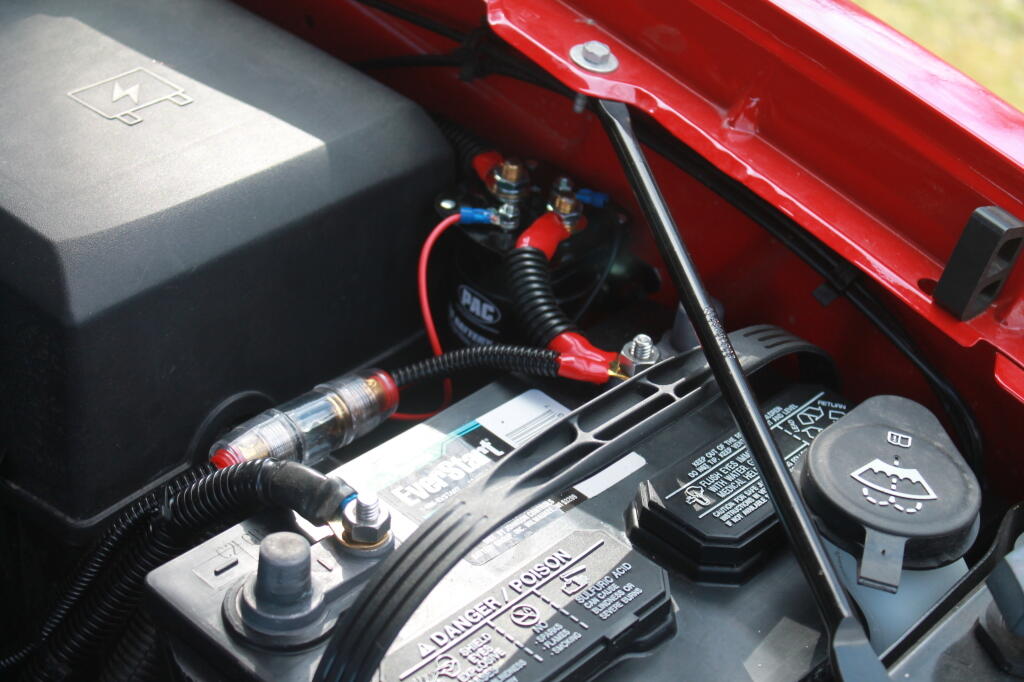
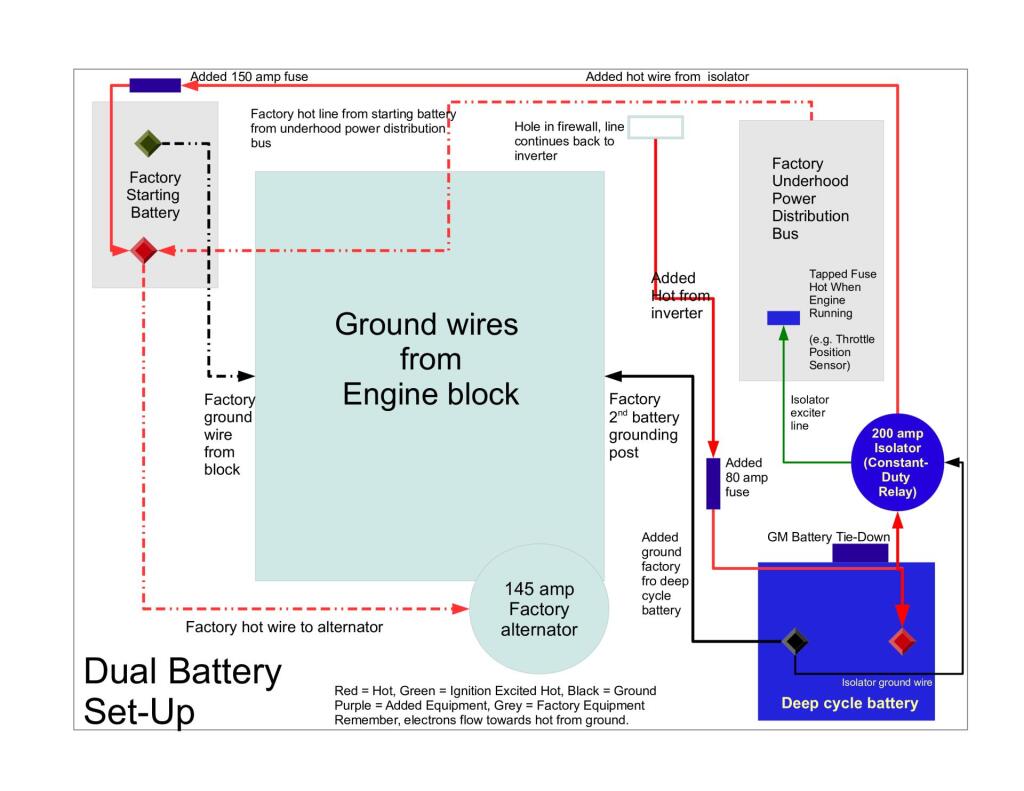
When I camp, I usually use my deep cycle battery mounted under my truck’s hood to power my campsite, radio, and other equipment. It works fairly well, but after a while, it becomes discharged and I need to start the truck’s engine to charge it back up for 10 minutes when I hear the low battery alarm or the truck’s computer notices a low battery. I probably have to do this once every 1.5 to 2 hours. This keeps the battery fairly healthy, but it’s still not as strong as when I first arrived at the campsite, after often hours of charging at the maximum necessary charge provided by the alternator.
Energy Math
Amps are the amount of current Voltage is with how much force the current is moving, e.g. 13.6 watts Wattage is amount of work consumed, e.g. 12 watt LED bulb Amp Hours are the number of amps consumed per hour Watt Hours are the number of watts consumed per hour Amp = Wattage / Voltage
The Truck’s Charging At Idle
Alternator Peak Output – 150 amp Typical Output at Idle (possibly lower after predatory loads) – 70 amp Voltage – 13.6 volts Charging Hours – 10 minutes every 1.5 hours = 0.11 hour charging Amp Hours Charged (over 1.5 hours) – 7.7 amp/hr Watt Hours Charged (over 1.5 hours) – 105 watt/hr Watt Hour Charged per 10 hour day (assuming I start the truck every 1.5 hours during 10 hours) – 0.7 kW/hr
100 watt solar cell
Solar Cell Output – 7.35 amp Realistic Solar Output – 5.1 amp (70% of maximum on sunny day) Voltage – 13.6 volts Charging Hours – 1.5 hour Amp Hours Charged (over 1.5 hours) – 7.7 amp/hr Watt Hours Charged (over 1.5 hours) – 105 watt/hr Watt Hour Charged per 10 hour day – 0.7 kW/hr
I currently have a deep-cycle, second battery under the hood of my truck. It is connected to an 800-watt inverter under the back-seat of my truck.
For days when I expect to be camping at a campsite for multiple days without moving the truck, I want to be able to provide the truck with solar power to charge the deep-cycle battery during the daytime and operate low-wattage appliances like an alarm clock, an AM/FM radio, and a CB Radio – and not have to start up the truck every couple of hours. If I plan to go out hiking, hunting, or fishing in the evening, it would be nice to be able to leave a light on campsite and know my battery wouldn’t start to discharge until close to dark.
I think a realistic estimate to power produced would be:
50-70 watt/hour on a sunny day
0.5-0.7 kW/hr for a 10-hour day
20-40 watt/hour on a cloudy/drizzle day or with moderate shade
0.2-0.4 kW/hr for a 10-hour day
Compared to the 2.2-3.2 kW/hr daily that I use in my apartment that is not a lot of electricity. But I am not planning running a refrigerator, electric hot water heater, or a electric stove on it. I also can just crank the truck up when I need more power from the alternator at night when I need more juice to keep the lights on.

 The new inverter is nice. It does have a fan, but the fan only comes on when thermal conditions demand in it. The fan is much quieter too. No grinding noises or hum from this inverter. At first camping, I probably will have trouble sleeping not hearing the soothing hum of the inverter. That’s fine, I appreciate the quiet.


 Fastener Mart: Understanding Tapping Screws.