NEW YORK (AP) — The U.S. stock market is holding near its records Thursday as oil prices keep dropping on hopes that a deal may be nearing to allow tankers to carry crude once again from the Persian Gulf to customers.
The price for a barrel of Brent crude oil, the international standard, fell another 4.5% to $96.70, down from more than $115 early this week. It and gasoline are still much more expensive than they were before the war with Iran began, but hope is rising in financial markets as Iran said it was reviewing the latest U.S. proposals on ending their war.
On Wall Street, the S&P 500 added 0.1% to its all-time high set the day before after a spokesperson for Pakistan’s Foreign Ministry said, “We expect an agreement sooner rather than later.” Pakistan has been acting as a mediator between the United States and Iran. The hope is that an end to the war will reopen the Strait of Hormuz, whose closure has kept oil tankers pent up in the Persian Gulf and sent prices higher for crude and all kinds of products worldwide.
With the world’s most important fossil fuel supply route at a near-standstill, many advocates for wind and solar say the transition to renewable energy is about to shift to a much higher speed. The United Nations climate chief, Simon Stiell, recently described an “immense irony” in which leaders who have “fought to keep the world hooked on fossil fuels are inadvertently supercharging the global renewables boom.” He didn’t name President Trump, but the United States is aggressively promoting petroleum and natural gas, and its attack on Iran has led to the effective closure of the Strait of Hormuz, the route for about one-fifth of global oil trade. It will take time to see how fully Mr. Stiell’s prediction plays out. But a report on Wednesday underlines one reason for the sentiment: At a time when oil and gas supply is faltering, the cost of wind and solar energy keeps declining. And, when paired with battery systems for storage, renewables can often provide steady electricity more cheaply than fossil fuels, even when the sun doesn’t shine or the wind doesn’t blow.
When people think of “development,” they usually think of things that change the land forever:
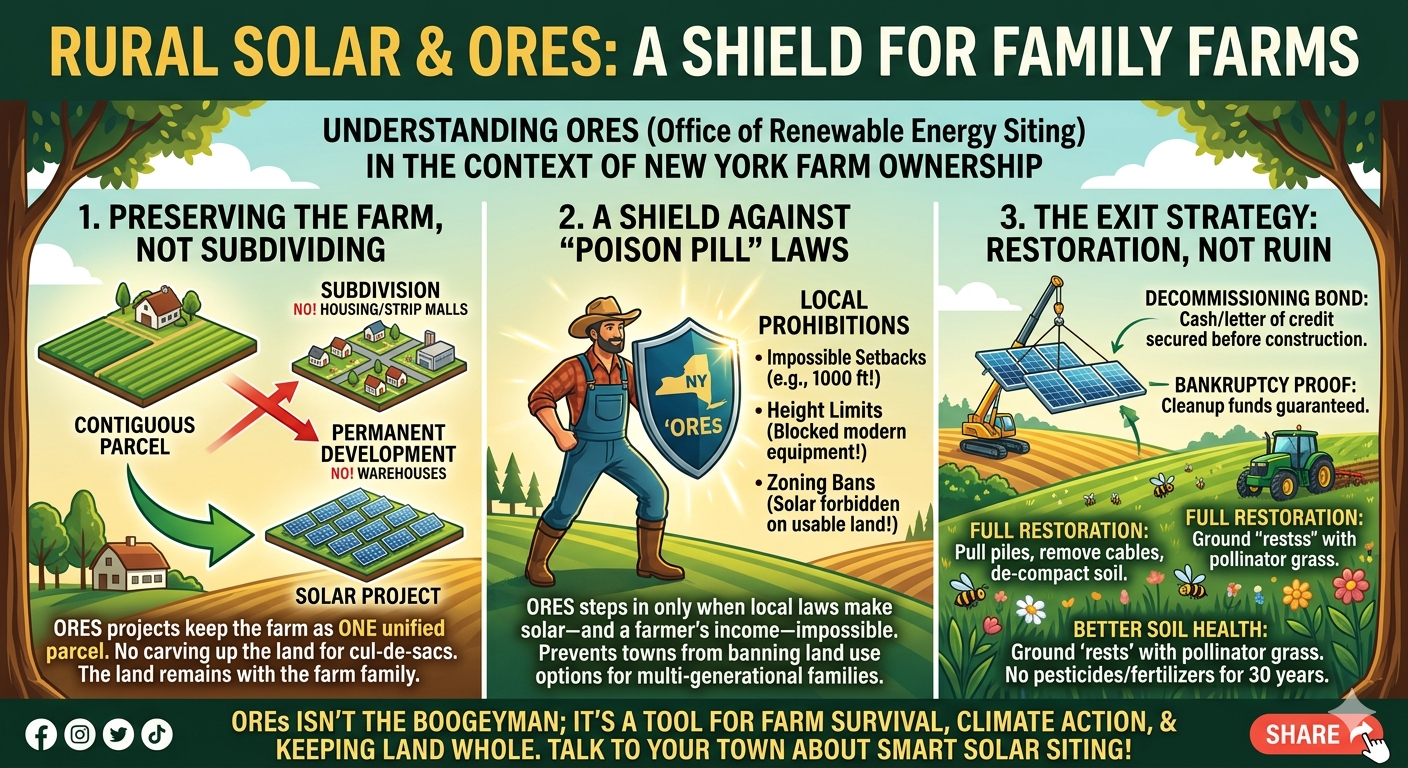
Subdivisions: Cutting a 200-acre farm into 50 tiny tax parcels.
Permanent Infrastructure: Paving over fields for strip malls or warehouses.
Heavy Industrial Use: Permanent structures that mean the land will never be a farm again.
Solar is fundamentally different. Under solar and remains a single, contiguous parcel. It isn’t being carved up or sold off to build a cul-de-sac. It stays in the family, and at the end of the lease, the panels come off and the dirt is still there.
The “Land Resting” Perspective
When a farmer signs a 30-year lease for solar, that land is essentially being “fallowed” or rested.
No Chemicals: Most solar agreements state there are no pesticides or heavy fertilizers being sprayed on that soil for three decades.
Pollinator Habitats: Many solar sites now require “pollinator-friendly” seed mixes under the panels, which can actually improve the soil quality and help local bee populations.
Future Farming: Once the 30 years are up and the panels are removed via the bond money, the soil might actually be in better shape for the next generation of farmers than it was after decades of intensive mono-cropping.
Returning Solar Farms to “Greenfield” Status
The goal of the state’s solar restoration standards is to ensure the land is reversible. Unlike a shopping mall or a housing development, solar is considered a “temporary” use of land (usually 25–40 years).
The restoration requirements typically include:
Total Removal: Taking out every panel, racking system, and—most importantly—the steel piles driven into the ground.
Underground Cleanup: Removing all underground cabling to a depth of at least 3 or 4 feet so it doesn’t interfere with future plowing.
Soil Health: De-compacting the soil in areas where heavy equipment drove and replacing any topsoil that was moved during construction.
Road Removal: Digging up gravel access roads and returning those strips to farmable soil.
The Decommissioning Bond: A Financial Guarantee
Before a developer can even break ground, they must put up a letter of credit or a surety bond.
Not a Promise, but Cash: This isn’t just a signed paper. It is a financial instrument held by the state or town.
Bankruptcy Proof: If the solar company disappears or goes out of business, the money is already there. The town or state can pull those funds to hire a crew to remove the panels.
Regular Updates: These bonds are usually re-evaluated every 5 to 10 years to account for inflation, ensuring the “cleanup fund” stays large enough to cover the actual costs in the future.
The Big Picture
We are in a climate crisis. We have to reduce carbon emissions in the next few years to avoid the worst impacts of extreme weather and drought—things that hit farmers harder than anyone else.