
Power Plants 📍

📽️ Videos

Edison Wins!

If thyristors, IGBTs, MOSFETS existed in 1890s, I bet Edison would have won the war of currents.

Power Lines

Generating plants would still use turbo alternators that produce AC power, but rectified to high voltage DC, for impedance free transmission of power — similar to in your car. I expect they would output around 400 Hz power prior to rectification, for maximum efficiency. You’d boost the voltage up for high voltage transmission, buck it when it got to household for safety.

Household electric motors would be driven by transistors producing high frequency (400 Hz or above) 3-phase alternating current, for maximum efficiency. Other DC-based electronics would use buck converters to further reduce voltage down to safe, usable levels. Every outlet and switch though would have to have heavier contacts due to the lack of zero point to withstand arching or use a MOSFET/IGBT to break connections rather then a mechanical switch.

Such a system would be more efficient, and use a lot less copper for transformer windings, but arching would be concern when contacts or wires broke. Might be more of a fire risk, and certainly a much greater shock risk, as you can’t let go of a high voltage DC wire easily due to lack of a zero point.

Such systems sort of exist in the world today — High Voltage Direct Current power transmission. But all existing HVDC systems are inverted back to AC power when connecting back to local substation — nobody uses DC down to the household level. But as more renewables come online, more people are switching power supplies and inverter-driven AC motors, this is a technology whose future might eventually come to the entire power grid.
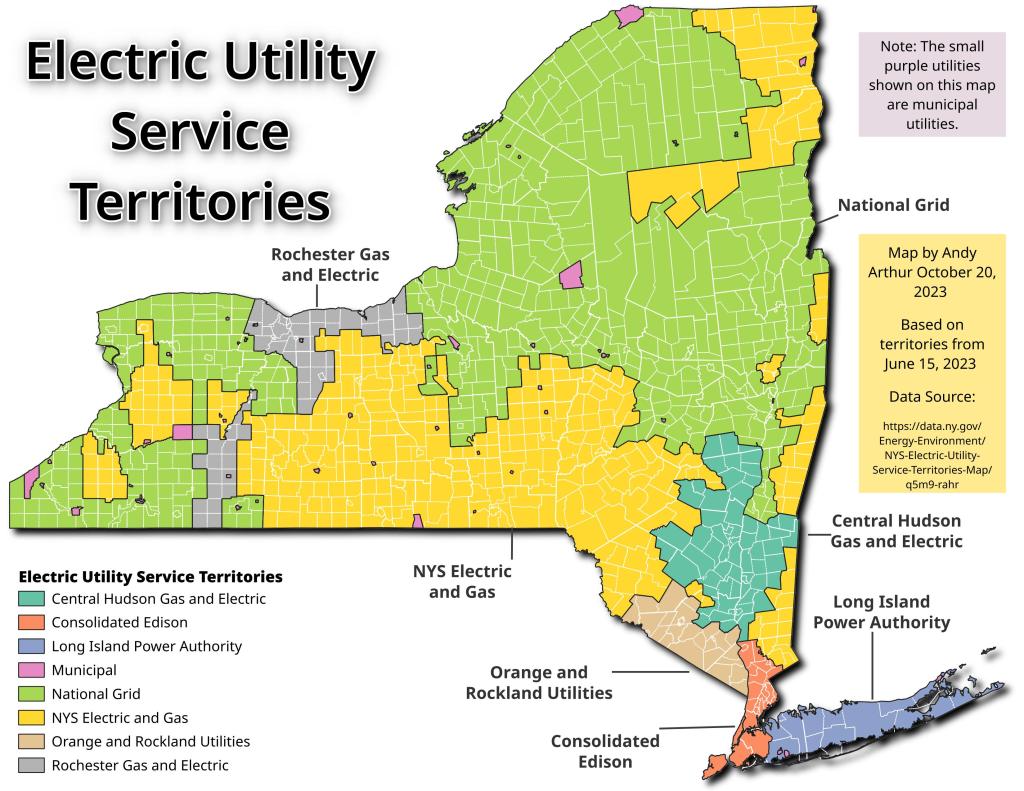
NYS Electric Utility Service Territories Map

This interactive map shows the Utility Service Territories in New York State, including that of National Grid,
Rochester Gas and Electric, NYS Electric and Gas, Central Hudson Gas and Electric, Orange and Rockland Utilities, Long Island Power Authority, Consolidated Edison and municipal utilities.

For more detail, please see interactive KML Maps: NYS Electric Utility Service Territories Map

Data Source: NYS Department of Public Service. https://data.ny.gov/Energy-Environment/NYS-Electric-Utility-Service-Territories/q5m9-rahr

Electric Generating Utilities

Terrain Map: Mahanoy Mountain
Map: North Lake Reservior

New Legislation Would Advance ‘Virtual Power Plants’… | New York Focus

New Legislation Would Advance ‘Virtual Power Plants’… | New York Focus

Assemblymember Anna Kelles, of Ithaca, introduced legislation last week that would require the state’s major electric utilities to create “virtual power plants” — networks of home batteries, smart thermostats, electric vehicles, and other devices that companies can draw on to keep the lights on at peak times. It aims to rapidly scale up the programs by creating new incentives for customers to participate.

The idea behind the bill is gaining traction among energy experts as states contend with rising electricity demand and soaring energy bills, as New York Focus recently reported. How a More Flexible Grid Could Save New York Billions Jack Carroll and Colin Kinniburgh

Flexible grid programs could help New Yorkers save money and cut pollution, a highly sought-after combination amid a bruising fight over the costs of achieving the state’s climate targets. A mammoth report published last fall by the state energy authority NYSERDA found that virtual power plants will be one of the key tools to achieve a reliable, zero-emissions grid, as the state’s climate law requires — and that they are cheaper and quicker to deploy than some of the other technologies the state envisions, like hydrogen or next-generation nuclear.