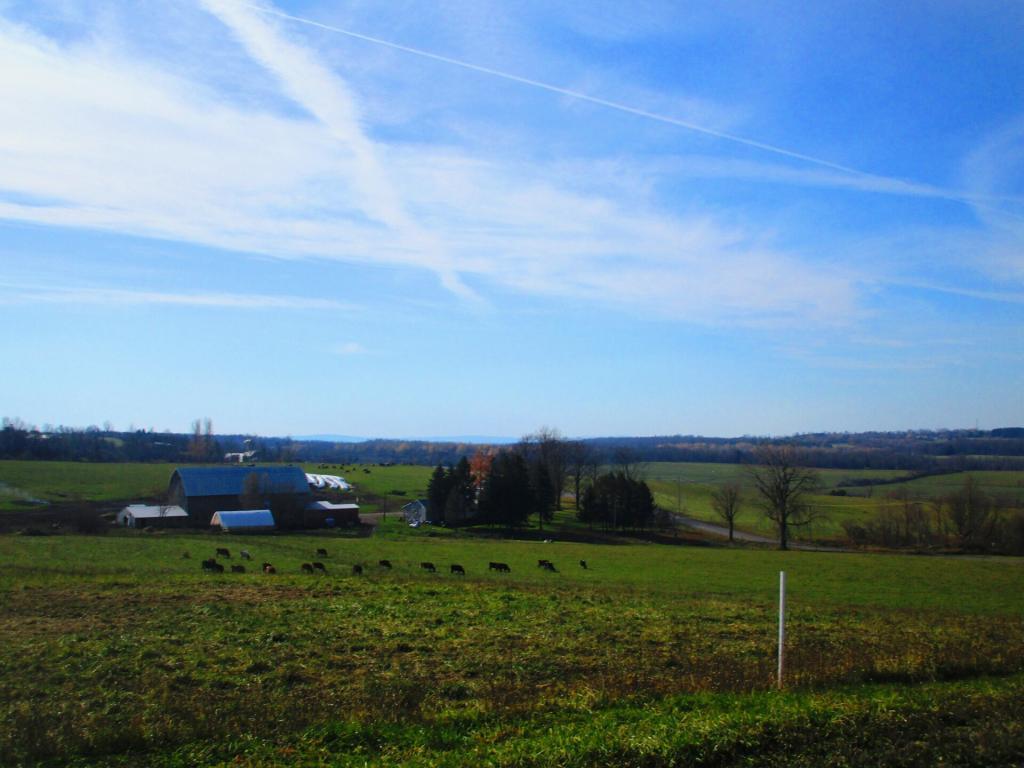
Walking around the Rodgers Center, or basically any rural dairy country in Upstate NY you can’t help but notice the smell of silage, the mud and manure, the rundown barns and old and decrepit farm homes. Good ol dairy country can be pungent depending on the time of year.
With work, I’ve also had the opportunity to travel to New York City and Coney Island and canvassed public housing buildings in the city. They’re often quite diapilated and in rough shape, dirty grimy buildings with enormous piles of garbage.
Suburbia likes to hide the mud and manure that makes the world go round. It’s a plastic world, the suburbs buy food wrapped in plastic far away from the smells of the farm and buried in a distant garbage dump. Let the working folk deal with the smells and dirt of the real world. But denialism doesn’t make it disappear.
Poverty and the debris that makes up our world is often seen as something to look down at, almost sub human. Those dirty tenements and farms. But it’s a lot closer to reality than the suburbanite would want to admit. Cows and diesel tractors, are real life. As the piles of garbage that sit outside of the blighted buildings in the city. We all consume natural resources and we all generate waste – it’s all part of who we are as a species. Even though the suburbanite is in denial.
Stigma is a Greek word that in its origins referred to a type of marking or the tattoo that was cut or burned into the skin of criminals, slaves, or traitors in order to visibly identify them as blemished or morally polluted persons. These individuals were to be avoided particularly in public places.
When Aaron Hinton walked through the housing project in Brownsville on a recent summer afternoon, he voiced love and pride for this tightknit, but troubled working-class neighborhood in New York City where he grew up.
He pointed to a community garden, the lush plots of vegetables and flowers tended by volunteers, and to the library where he has led after-school programs for kids.
But he also expressed deep rage and sorrow over the scars left by the nation's 50-year-long War on Drugs. "What good is it doing for us?" Hinton asked.
As the United States' harsh approach to drug use and addiction hits the half-century milestone, this question is being asked by a growing number of lawmakers, public health experts and community leaders.
In many parts of the U.S., some of the most severe policies implemented during the drug war are being scaled back or scrapped altogether.
In philosophy, moral responsibility is the status of morally deserving praise, blame, reward, or punishment for an act or omission in accordance with one's moral obligations. Deciding what (if anything) counts as "morally obligatory" is a principal concern of ethics.
Philosophers refer to people who have moral responsibility for an action as moral agents. Agents have the capability to reflect upon their situation, to form intentions about how they will act, and then to carry out that action. The notion of free will has become an important issue in the debate on whether individuals are ever morally responsible for their actions and, if so, in what sense. Incompatibilists regard determinism as at odds with free will, whereas compatibilists think the two can coexist.
Moral responsibility does not necessarily equate to legal responsibility. A person is legally responsible for an event when a legal system is liable to penalise that person for that event. Although it may often be the case that when a person is morally responsible for an act, they are also legally responsible for it, the two states do not always coincide.
An indulgence is the full or partial remission of temporal punishment for sins after the sinner confesses and receives absolution. Under Catholic teaching, every sin must be purified either here on earth or after death in a state called purgatory.
2. How did the practice of dispensing indulgences begin?
The first known use of plenary indulgences was in 1095 when Pope Urban II remitted all penance of persons who participated in the crusades and who confessed their sins. Later, the indulgences were also offered to those who couldn't go on the Crusades but offered cash contributions to the effort instead. In the early 1200s, the Church began claiming that it had a "treasury" of indulgences (consisting of the merits of Christ and the saints) that it could dispense in ways that promoted the Church and its mission. In a decretal issued in 1343, Pope Clement VI declared, "The merits of Christ are a treasure of indulgences."
William Moore was born in Binghamton, N.Y., but he was not just another "Yankee" sticking his nose where many Southerners believed it didn't belong. Moore had roots in the South. Moore was raised in Russell, Miss., after going to live with his grandparents at the age of 2. As an adult, Moore returned to Binghamton and began organizing demonstrations for civil rights. He also became a member of the Congress of Racial Equality (CORE), a vital arm of activism at the time.
If you drove down Highway 11 five decades ago, you might have spotted a middle-aged white man in rumpled clothes and coiffed hair, sporting a gap-toothed grin. You might have thought little of it and kept driving. But when you glanced back, you would have wondered why this guy was pulling a little red wagon, handing letters to people he passed and pushing a grocery cart plastered with a "Wanted" poster featuring an image of Jesus. William Moore definitely stuck out.
But there were people along his route who did more than wonder about strangers like William Moore. Mary Stanton, author of Freedom Walk, a book about Moore and others who continued his effort after his death, describes people who confronted him. The polite individuals interrogated him about his intentions; the rude threatened him.
Ultimately, Moore was shot twice in the head at point-blank range near Attalla, Ala. He was left on the side of the road at a picnic area approximately 300 miles short of Jackson. In her book, Stanton describes a frightened Willis Elrod, who stumbled over Moore's body when he pulled over to use the restroom.