politics

Should We As A Society Plan for the Future?

If you want to make god laugh, tell him your plans.
— Van Zandt, Help Somebody

It seems like there is a lot of talk about planning these days. People are constantly urging us to make retirement plans on the radio, especially for the young. Cities are told they have to make 20 year solid waste plans, along with Comprehensive Plans through 2030.

Paint Mine Creek

What’s the obsession with plans? Why can not we as a society simply learn to live in sustainable ways today, and not spend so much effort focusing on tommorow? There is a difference between planning and sustainability:

Planning is…

  • Abstract plans
  • Based on a view of tomorrow by today’s ziegist
  • Educated guess based on today’s technology
  • Excuse for not doing things right today

Sustainability is…

  • Taking sensible steps today that are right for today and tomorrow
  • Not consuming more resources then we currently have access to
  • Avoiding debt unless it shows short-term benefit, and can be shown also to have a long-term benefit equal to payback time

There is a lot of talk about short-term pain for long-term gain these days. Yet, what should be the threshold for pain? While it would be irresponsible for us as a society and individuals, to ignore long-term consequences of our actions, it’s just as bad to scrimp today on false beliefs on what tommorow would look like.

Thru a Tree

Planners of all stripes are bound to take issue of prioritising sustainability over planning. They say, without a plan, how can you really know if your actions will lead you where you want? I disagree. Do what’s right for today, but also don’t destroy your world for tomorrow.

Agreeing with Tea Party Sentiment; But Not Really Their Politics

I agree almost 100% with the message of the Tea Party protesters. Too often our elected officials are not serving the public interest, but only their own narrow special interests. Politicians are unwilling to confront both wealthy donors, much less any sector of their demographic that they represent. Too many politicians have spent too much time in office, and have grown too distant from the people they are supposed to represent.

It’s not just a problem with the Democratic Party. Indeed, it’s a problem with both political parties. Many Republicans are too friendly to big business based on their ideological predisposition. Republicans often exploit government for the special interests that they are involved in. Republicans are too willing to oppose taxes on behalf of the rich, while either depriving the public of much needed services or leading to higher user fees on the rest of non-rich populous.

100,000 Iraqis Dead

Both political parties need to have a tea party revolt that kicks out the bums their respective parties. There needs to be fresh blood, corrupt and evil practices should not be tolerated. Legislators need to have term-limits and primaries that force the old out and the new in. Legislative sessions need to be shortened, and legislative bodies made unprofessional, so that new elected officials have a connection with the people they represent are elected into office.

The Tea Party folk are right. It’s time for a new politics, a new generation of thinking and caring politicians. The old must come and go, the new blood must come in. The beloved old politician of yesteryear is the problem of today, holding us back into a politics of yesteryear. We as a society must move forward and not backwards. And for that, my hat’s off to all reformers of politics be it the Democracy for America and MoveOn folks of the left or the Tea Party folk on the right.

Socialism

A common rallying cry these days from the Republicans is that the Democrat’s programs are socialism. They fear government-imposed equality that will deprive individual choice and the freedom to live one’s life as one chooses. The reality is that logic is faulty in a modern-era with big businesses staffed with lawyers that abuse the most basic principles enshrined in our laws.

Good government policy does not impose socialism or deprive choice. Instead, it protects and enhances the individual’s ability to make choices. People are allowed to make good choices based on accurate information thanks to government regulation. Government ensures that there is a basic level of quality or safety in the products they buy and use. It also protects sellers of products to ensure that they receive the compensation they are due, and labourers their pay.

Delaware Avenue After A Fresh Snow

Neither of the major political parties is advocating forced equality. What most Democrats want is to provide accurate and truthful information to consumers, and ensure that they get ensured a basic quality of life. Democrats don’t want to force people to one equal standard of living, but they do want to ensure that nobody is deprived basic healthcare or the ability to make ends should a terrible life event happen such as a job loss.

I don’t want the government telling me how to live my life any more then the next guy. Yet, I believe government can regulate businesses to ensure fairness without infringing on my personal choices. What one does to make money is fundamentally different then what one choose to do on their leasure time.

Wanting A Bigger Truck

Notes on the Re-Run for Monday, August 22nd.

I do like my Ford Ranger. It’s big enough and powerful enough for me needs right now, but I would love to have a little bit more space for camping, and in a year or so I think it will reach it’s end of cost-effective life at 13 years of age. Maybe not, but I’ve been saving for three years and the reality is full-size trucks now have fuel economy in the range of compact trucks of a decade ago.

— Andy

It’s probably no secret to anybody who reads my blog that I’ve been coveting a bigger pickup truck, with an extended cab, bigger bed, and a better off-road capacity. As I’ve also noted, I’ve been saving a big chunk of every paycheck to have enough money next year or the year after to buy that truck.

Yet, I realize it’s kind of silly. I still have a decent 1998 Ford Ranger regular cab short-bed, with only 95,000 miles on it. Driving only for pleasure, I probably will have less then 5,000 miles on it before the year’s end. It might be a bit old and rusty, but it still runs well with minimal problems. But I still want a bigger truck.

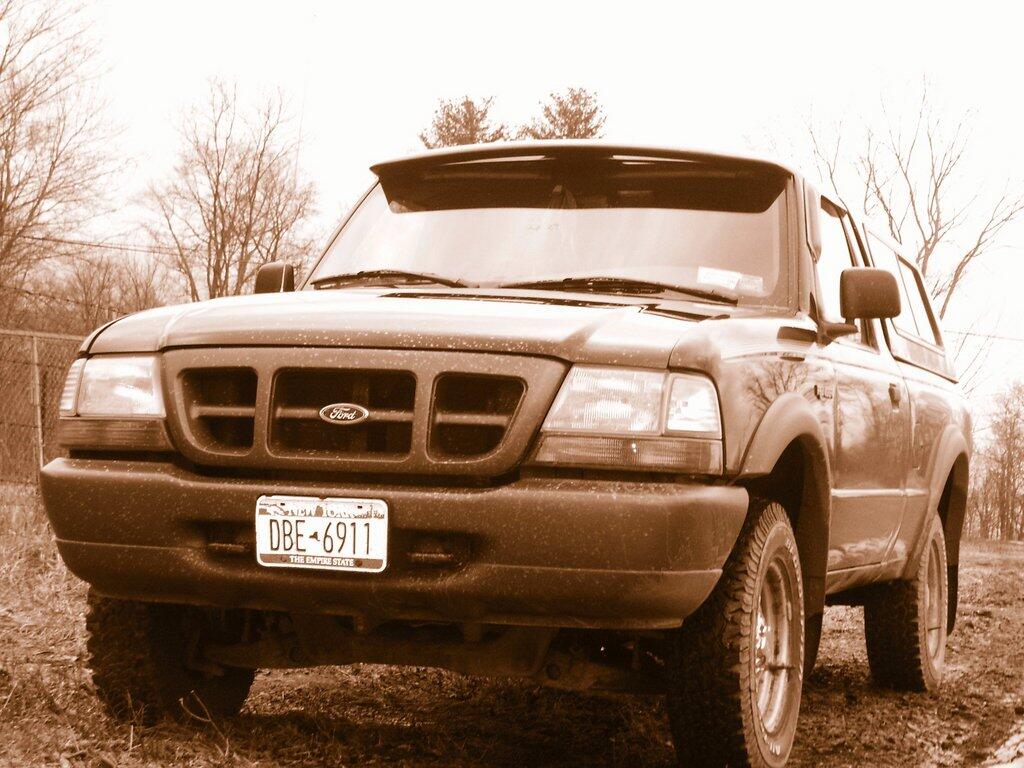
 My Truck

It’s not totally rational. I know I am buying into the consumerist mindset that I one level I supposedly reject as being vapid. But it would be so much more fun then my current Ford Ranger. Who wants to put money to upkeep a truck that I don’t really like that much, when I could be putting towards getting a new one?

It’s probably not a good attitude to have. I probably will drive more carelessly with my Ford Ranger and not maintain it as well as I should, secretly hoping that it will die, so I have to buy a new pickup. I need to avoid that attitude, as the truck is something I want to keep working,I also want to avoid financing as much as possible.

The World is Flat (?)

A colleague of mine recommended I take a look at Thomas Friedman’s book on globalization called, The World is Flat. Admittedly, reading the first few chapters of his book I was quite cynical. I felt that Friedman was overly obsessed with the promise of high technology, and ignorant of the hard material realities of our lives made out of silage, corn, cattle, concrete, steel, coal, and oil.

Friedman didn’t even mention such things until later chapters of his book in passing. His version of globalization entirely focused on information as being the ultimate resource that people cared about. The quick and innovative ways of moving information is what is flattening the world and making it more equal. Friedman attributes more and more of our lives to the quick movement of information across our globe, and the ability collaborate on information intensive tasks.

Friedman is right in noting how information technology is changing our lives and the way products are moved around our country. There is little guess work on how much of a product is needed any more nor where any product is at any one time. This means less wastage and more predictability. Supply chains can be globalized and efficient in cases where this makes sense such as limited resources of certain natural resources in certain areas. It also means outsourcing and global collaboration.

There is no reason why certain tasks that can be easily put into electronic format must be done in house or down the street anymore. As Friedman notes, with the Internet there is no difference between data transmitted from across the street or information transmitted from across the world. And unbeknown to many Americans, millions of Chinese and Indians are coming to age, and getting the knowledge needed to preform these tasks. There literally will be hundreds of millions of Chinese and Indians who have grown up in the Internet age and will be able to do many of the tasks Americans might otherwise do.

Global collaboration is an exciting possibility. We should be tapping into the knowledge and unique experience of all of what the world has to offer to us. With inexpensive fiber optic technology being able to transmit information worldwide at minimal cost, it can bring a lot of information to us virtually for free. This is much different then just a generation ago when making a long distance phone call across the United States was an expensive luxury. There is a lot fewer limitations on the movement on information but not necessarily product, especially in an era of high oil prices.

At the same time, those hundreds of millions of Chinese and Indians will be able to tap into American products and services that might otherwise unavailable in their country. Specialties that Americans develop and refine, and take advantage of our unique culture, that can be transmitted over the Internet may someday be very valuable in an increasingly globalized world. Friedman argues that our culture and education must be changed to adopt the folkways of globalization.

I disagree. People should learn to embrace other cultures and understand their differences. Societies that choose to engage or partake in a specific activity should not be penalized for being uneconomic. There are many reasons why peoples are across do things differently from belief to compatibility with varying environmental factors where people live. There need not be any forced culture.

As a whole Friedman makes some interesting points but puts too much faith in technology. Technology is not energy and technology does not feed or cloth us. The best computer program in the world won’t fix the worlds problems and our lives can not be digitized and sent over a fiber-optic cable. Energy comes from coal or oil, and is a finite resource that comes under increased demand as China and India comes to age.


Blogging Tool

Map: Severence Hill Trail
Map: Gilman Lake