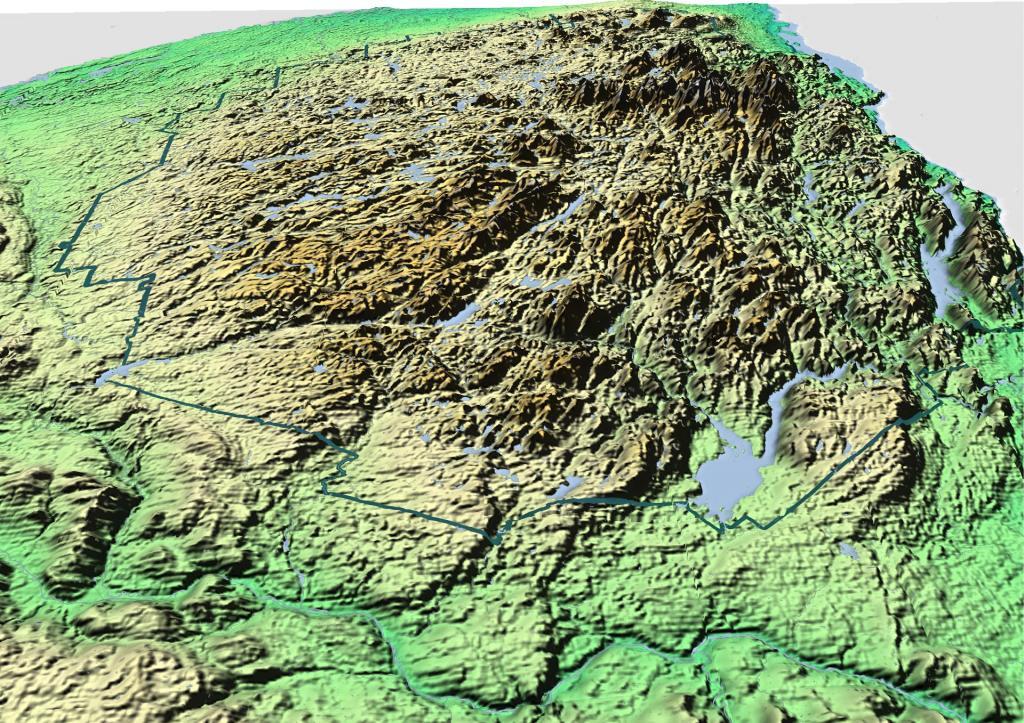
Adirondack Park of New York
A 3D Rendering of the Adirondack Park.

A 3D Rendering of the Adirondack Park.

"They say that all good things must end some day, autumn leaves must fall."

I was reading Walden, by Henry David Thoreau and this passage, written in 1854 — 166 years ago — seem capture the world we live in overflowing with crap churned out by the factories, at least in redneck land where you can still burn things. I tell you, when I own my own land, purges will be fiery ….
My furniture, part of which I made myself, and the rest cost me nothing of which I have not rendered an account, consisted of a bed, a table, a desk, three chairs, a looking-glass three inches in diameter, a pair of tongs and andirons, a kettle, a skillet, and a frying-pan, a dipper, a wash-bowl, two knives and forks, three plates, one cup, one spoon, a jug for oil, a jug for molasses, and a japanned lamp. None is so poor that he need sit on a pumpkin. That is shiftlessness. There is a plenty of such chairs as I like best in the village garrets to be had for taking them away. Furniture! Thank God, I can sit and I can stand without the aid of a furniture warehouse. What man but a philosopher would not be ashamed to see his furniture packed in a cart and going up country exposed to the light of heaven and the eyes of men, a beggarly account of empty boxes? That is Spaulding’s furniture. I could never tell from inspecting such a load whether it belonged to a so called rich man or a poor one; the owner always seemed poverty-stricken. Indeed, the more you have of such things the poorer you are. Each load looks as if it contained the contents of a dozen shanties; and if one shanty is poor, this is a dozen times as poor. Pray, for what do we move ever but to get rid of our furniture, our exuvi?; at last to go from this world to another newly furnished, and leave this to be burned? It is the same as if all these traps were buckled to a man’s belt, and he could not move over the rough country where our lines are cast without dragging them,—dragging his trap. He was a lucky fox that left his tail in the trap. The muskrat will gnaw his third leg off to be free. No wonder man has lost his elasticity. How often he is at a dead set! “Sir, if I may be so bold, what do you mean by a dead set?” If you are a seer, whenever you meet a man you will see all that he owns, ay, and much that he pretends to disown, behind him, even to his kitchen furniture and all the trumpery which he saves and will not burn, and he will appear to be harnessed to it and making what headway he can. I think that the man is at a dead set who has got through a knot hole or gateway where his sledge load of furniture cannot follow him. I cannot but feel compassion when I hear some trig, compact-looking man, seemingly free, all girded and ready, speak of his “furniture,” as whether it is insured or not. “But what shall I do with my furniture?” My gay butterfly is entangled in a spider’s web then. Even those who seem for a long while not to have any, if you inquire more narrowly you will find have some stored in somebody’s barn. I look upon England to-day as an old gentleman who is travelling with a great deal of baggage, trumpery which has accumulated from long housekeeping, which he has not the courage to burn; great trunk, little trunk, bandbox and bundle. Throw away the first three at least. It would surpass the powers of a well man nowadays to take up his bed and walk, and I should certainly advise a sick one to lay down his bed and run. When I have met an immigrant tottering under a bundle which contained his all—looking like an enormous wen which had grown out of the nape of his neck—I have pitied him, not because that was his all, but because he had all that to carry. If I have got to drag my trap, I will take care that it be a light one and do not nip me in a vital part. But perchance it would be wisest never to put one’s paw into it.
I would observe, by the way, that it costs me nothing for curtains, for I have no gazers to shut out but the sun and moon, and I am willing that they should look in. The moon will not sour milk nor taint meat of mine, nor will the sun injure my furniture or fade my carpet, and if he is sometimes too warm a friend, I find it still better economy to retreat behind some curtain which nature has provided, than to add a single item to the details of housekeeping. A lady once offered me a mat, but as I had no room to spare within the house, nor time to spare within or without to shake it, I declined it, preferring to wipe my feet on the sod before my door. It is best to avoid the beginnings of evil.
Not long since I was present at the auction of a deacon’s effects, for his life had not been ineffectual:—
“The evil that men do lives after them.”
As usual, a great proportion was trumpery which had begun to accumulate in his father’s day. Among the rest was a dried tapeworm. And now, after lying half a century in his garret and other dust holes, these things were not burned; instead of a bonfire, or purifying destruction of them, there was an auction, or increasing of them. The neighbors eagerly collected to view them, bought them all, and carefully transported them to their garrets and dust holes, to lie there till their estates are settled, when they will start again. When a man dies he kicks the dust.
The customs of some savage nations might, perchance, be profitably imitated by us, for they at least go through the semblance of casting their slough annually; they have the idea of the thing, whether they have the reality or not. Would it not be well if we were to celebrate such a “busk,” or “feast of first fruits,” as Bartram describes to have been the custom of the Mucclasse Indians? “When a town celebrates the busk,” says he, “having previously provided themselves with new clothes, new pots, pans, and other household utensils and furniture, they collect all their worn out clothes and other despicable things, sweep and cleanse their houses, squares, and the whole town of their filth, which with all the remaining grain and other old provisions they cast together into one common heap, and consume it with fire. After having taken medicine, and fasted for three days, all the fire in the town is extinguished. During this fast they abstain from the gratification of every appetite and passion whatever. A general amnesty is proclaimed; all malefactors may return to their town.—”
“On the fourth morning, the high priest, by rubbing dry wood together, produces new fire in the public square, from whence every habitation in the town is supplied with the new and pure flame.”
They then feast on the new corn and fruits, and dance and sing for three days, “and the four following days they receive visits and rejoice with their friends from neighboring towns who have in like manner purified and prepared themselves.”
The Mexicans also practised a similar purification at the end of every fifty-two years, in the belief that it was time for the world to come to an end.
I have scarcely heard of a truer sacrament, that is, as the dictionary defines it, “outward and visible sign of an inward and spiritual grace,” than this, and I have no doubt that they were originally inspired directly from Heaven to do thus, though they have no biblical record of the revelation.


That’s what the radar is promising as a front pushes through. Good soaker of a rain to keep the fire danger now, though things are still pretty green with It being mid to late August. But like always happens this time of year, many of wildflowers are quickly fading.
Summer is rapidly drawing to a close 🌇 and I feel kind of bad for not doing more yesterday, not getting out of time but the SuperDuty needed a rest and it still needs an oil change to get the contaminates out from the initial run. I will schedule that this week. And maybe a physical too with my doctor. Also need to decide on what oil undercoating service to do – something to have sprayed onto the truck come September. 🧑🔧 Not cheap, but after the frame rotting out on the old truck, I think it will help keep things less rusty on the undercarriage of the SuperDuty. Should I have done that last week? It was usch a busy week, I really kind of treasured a quiet day, spent at Five Rivers, then napping at home, then heading out to Pine Hollow Arboretum in the evening. While I didn’t fire up the SuperDuty, I did have a relaxing day and got out a bit.
I don’t think I can afford to take Friday off with all that is going on with work, 🏕️ but I am inclined to head up to the Potholers/House Pond/Piseco-Powley on Thursday and then just drive down to Dolgeville and remote work on Friday. 🧑💻 Not quite as much free time to spend floating in East Canada Creek but what’s the alternative? ⚖️ Go to the office and work all day in person? Stay home? I Schoharie is a good fall back plan. ⛈️ Maybe thunderstorms on Friday but Saturday and Sunday next week look good, cool but nothing can be done about that. I’ll bone up, smoke some weed and float in the East Canada Creek. Even Friday I could go for a quick swim before heading down to Dolgeville and maybe head back a little before 5 PM to camp, and still have some daylight to either float in East Canada Creek or ride up to Potholers and cool off there. A lot could change in the forecast before then. Ideally I’d change the oil on SuperDuty before then but I’m just at 3,000 miles though I wanted to do it early as the truck still has the break in oil, not that I ever drive the truck real rough.
Other then that I’ve been doing a lot of reading and trying to understand AI, 🤖 and not the hype. I am a big fan of learning new ways to do things, gather information, process and refine it. I am skeptical about most of the hype and fears over AI, though I do see it’s limitations and problems – especially as a research and thought provoking tool. Self-reflection loops from it’s desire to please and keep people using it, things it obviously gets wrong, are concern. 🪩 And some of energy and environmental impacts, though a lot of that is hype and not put into context – just because somebody is putting money up and their getting permits or starting construction doesn’t mean every AI data center is going to be built. 🏭 And yet, I do find it a useful tool for many purposes – exploring ideas, helping with code snippets, noting all those limitations. I try to seek a variety of sources and opinions, I am not strictly anti-AI.
With the rain today, it’s a good chance to spend some time listening to audio books and podcasts, 🎧


