The Lake Erie “Crack” on Sunday February 8, 2026
The Lake Erie "Crack" as captured on February 8, 2026 on NASA/NOAA Suomi NPP. Don't you know it's not nice to throw rocks at people's Great Lakes?

The Lake Erie "Crack" as captured on February 8, 2026 on NASA/NOAA Suomi NPP. Don't you know it's not nice to throw rocks at people's Great Lakes?
Maybe hell won't freeze over this weekend, but Lake Erie might freeze over for the first time in 30 years.
Lake Erie ice coverage has increased to ~95%, placing the lake very close to a complete freeze over — an event that has occurred only three times since the 1970s (1978, 1979, 1996). Persistent Arctic air intrusions and a prolonged period of 10–20° below-average temperatures since mid-January have driven rapid ice growth. Ice coverage expanded from ~2% to over 85% in approximately one week, with coverage holding near 95% since late January. At this stage, further ice growth is becoming increasingly sensitive to wind forcing rather than temperature alone. Strong synoptic-scale wind events can induce ice divergence, fracturing, and redistribution, temporarily reopening areas of open water even under sustained subfreezing conditions. The remaining window for a 100% freeze is narrowing. Model guidance suggests a potential mid-February moderation, which would increase ice mobility and inhibit complete consolidation if full coverage is not achieved within the next several days.

The National Hydrological Database lists nine lakes in New York State that are named Round Lake. This interactive map shows the location of the lakes, the towns and counties where the lakes exist. Zoom in to see the lakes and topography around each Round Lake.
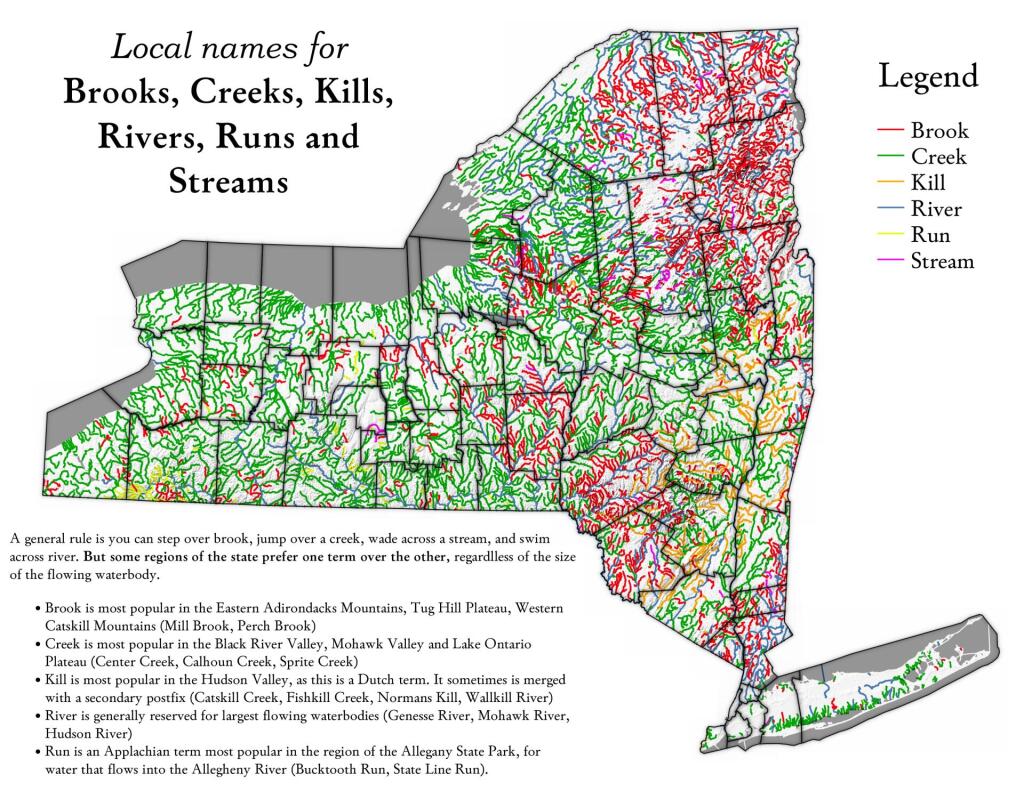
A general rule is you can step over brook, jump over a creek, wade across a stream, and swim across a river. But some regions of the state prefer one term over the other, regardless of the size of the waterbody.

I was unfamiliar with what a gut was until I googled it. A gut is a narrow passage or strait in a waterway.
