The Ford F-250 vs F-350
The primary difference between the Ford F-250 and F-350 is their hauling and towing capacity. While they share the same engines and cabins, the F-350 is built with a reinforced chassis and a stiffer suspension to handle heavier commercial-grade loads.
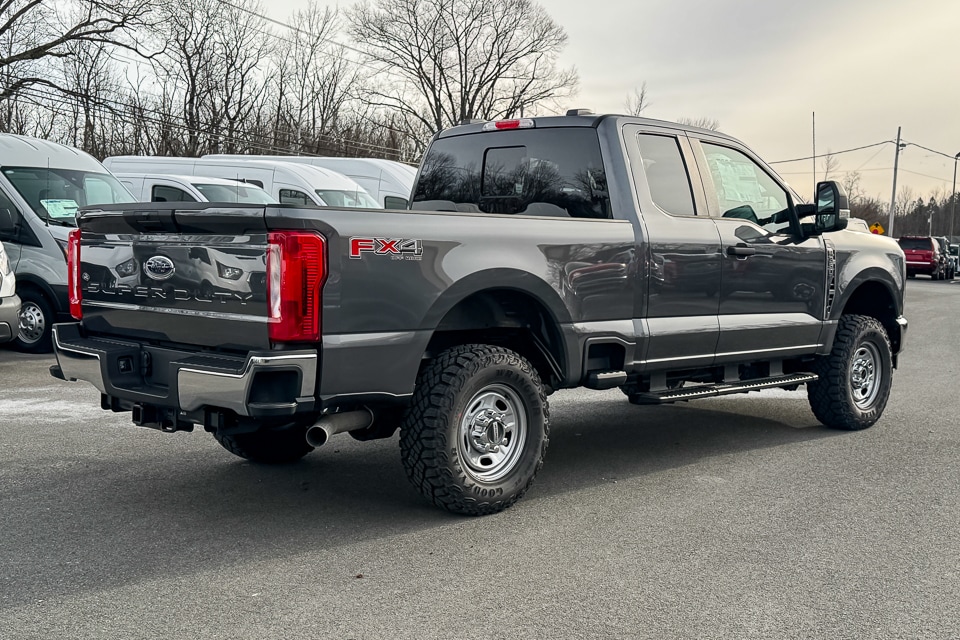
The F-350 significantly outperforms the F-250 in raw strength due to its higher Gross Vehicle Weight Rating (GVWR).
- Max Towing (Gooseneck):
- F-250: Up to 23,000 lbs.
- F-350: Up to 38,000 lbs.
Max Payload:
- F-250: Up to ~4,246 lbs.
- F-350: Up to ~8,000 lbs (when equipped with Dual Rear Wheels).
- Drivetrain: The F-350 offers a Dual Rear Wheel (DRW or “Dually”) configuration for maximum stability, which is not available on the F-250.
Under the hood, these trucks are nearly identical, but the rear hardware sets them apart.
- Suspension: The F-350 typically has more leaf springs (often 4 vs. 3 on the F-250) and a larger rear block to prevent sagging under heavy weight.
- Axles: The F-350 often uses a larger rear axle with a higher gear ratio (3.73 or 4.10) compared to the F-250’s standard 3.55, providing more low-end torque for pulling.
- Ride Quality: Because of the stiffer springs, the F-250 generally offers a smoother ride when the bed is empty.
Price and Practicality
- MSRP: The F-350 generally starts about $1,300 to $2,000 higher than the F-250 for equivalent trims.
- Daily Driving: The F-250 is often considered more “practical” for daily use due to slightly better fuel efficiency and easier maneuverability in tight spaces.
- Registration: In some states, the higher GVWR of an F-350 may lead to higher registration fees or require a commercial driver’s license (CDL) depending on local laws and trailer weight.
Both trucks share these core options:
- Engines: Standard 6.8L V8 gas, 7.3L “Godzilla” V8 gas, and 6.7L Power Stroke Turbo Diesel.
- Trims: XL, XLT, Lariat, King Ranch, and Platinum.
- Technology: Both offer 12-inch touchscreens, 360-degree cameras, and advanced towing aids like Pro Trailer Hitch Assist.