If you spend any time in rural New York Facebook groups or the “Internets” lately, you’ve seen it: a wave of posts warning about faceless state agency (Office of Renewable Energy Siting and Electric Transmission) is steamrolling local rights to blanket our farmland in solar panels. It might be one of the most misunderstood pieces of the energy puzzle in New York right now.
To understand ORES, you got to look at the law that created it.
Why ORES Exists: The need to build large-scale solar to address climate change and energy needs 
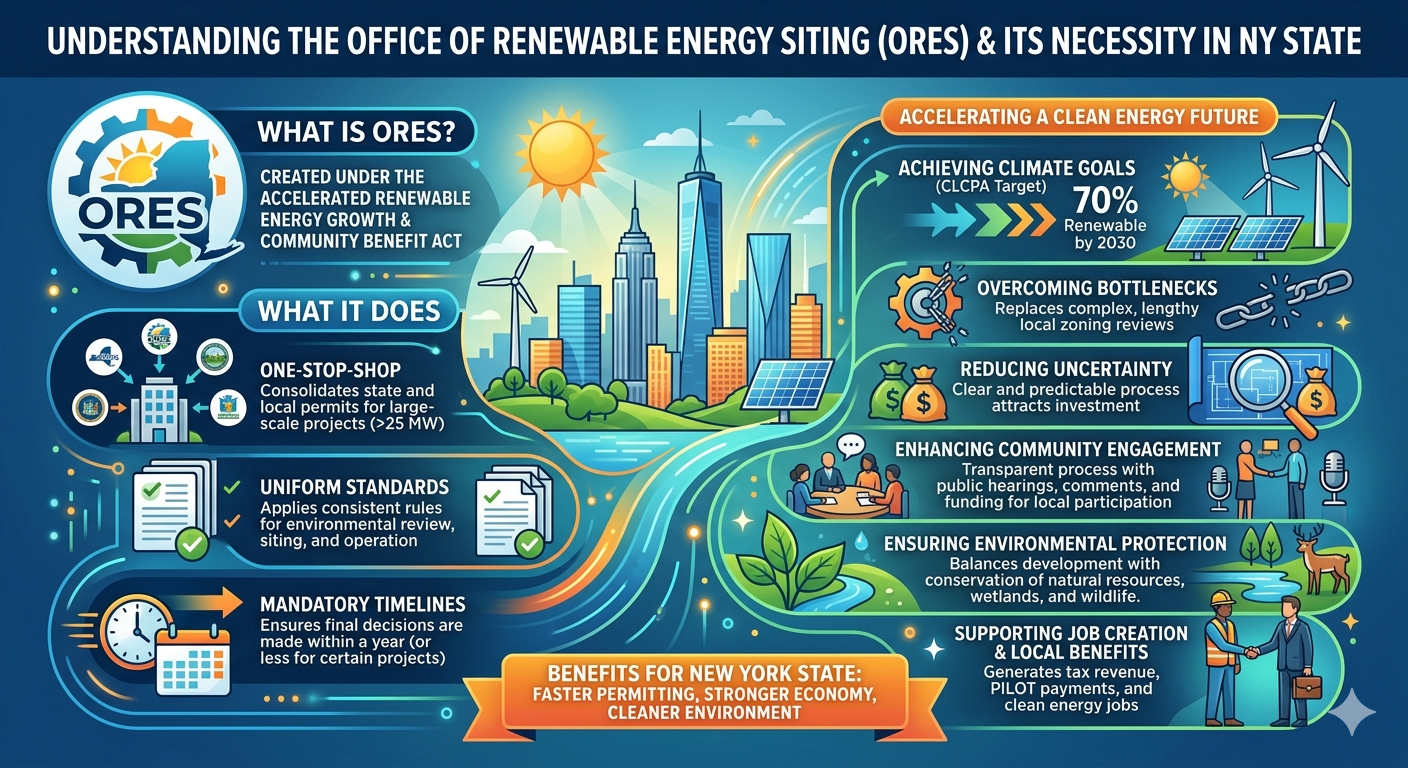
ORES stands for the Office of Renewable Energy Siting and Electric Transmission. It wasn’t created for making solar developers rich or to titillate the woke mind; it exists because of the Climate Leadership and Community Protection Act (CLCPA) and the need to develop new carbon-free sources of electricity as we stare down the climate crisis.
State law requires minimization of future carbon emissions by mandating:
- 70% renewable electricity by 2030.
- Zero-emission electricity (without fossil fuels) by 2040.
The state is under a legal mandate to build infrastructure—fast. Solar is currently the fastest, most scalable way to hit those targets.
Why We Need Solar Now: Every Year Matters Right Now 
Scientists warn that we must significantly reduce emissions in the next few years to avoid the most catastrophic impacts.
- Tipping Points: We are approaching “tipping points” where changes become irreversible (like the melting of Arctic permafrost or the collapse of major ice sheets).
- Extreme Weather: Rapid warming is already fueling more intense hurricanes, prolonged droughts, and more destructive wildfires.
- The 1.5°C Goal: International agreements aim to limit warming to 1.5°C above pre-industrial levels. Exceeding this increases the risk of global food shortages and mass displacement.
- Compound Interest: Carbon stays in the atmosphere for centuries. Every ton we emit now makes the future goal harder to reach; reducing emissions today is far more effective than trying to “clean up” tomorrow.
This urgency is why New York passed the CLCPA and created ORES to get solar farms approved, over local opposition. The state views large-scale solar and the ORES process as a fast-track emergency response to these immediate environmental threats.
ORES Handles Environmental Reviews 
Under ORES, every large-scale solar project must undergo a rigorous environmental “vets” process before a single panel is installed.
- Impact Mapping: Developers must submit detailed studies on wetlands, threatened species, and forest fragmentation.
- The “Net Conservation Benefit”: If a project impacts a protected species (like the Short-eared Owl or Northern Harrier), the developer is legally required to implement a plan that results in a net gain for that species elsewhere.
- Public Comment: ORES is required to hold at least one public comment period and a public hearing in the host community to hear environmental concerns from residents.
Key Environmental Protections in the ORES Process 
ORES mandates specific protections that developers cannot ignore:
- Wildlife Protection: Projects must avoid or minimize impacts on grassland birds and other at-risk wildlife. Construction is often restricted during nesting seasons.
- Water Quality: Developers must follow strict stormwater management plans to prevent runoff into local streams and neighbors’ properties.
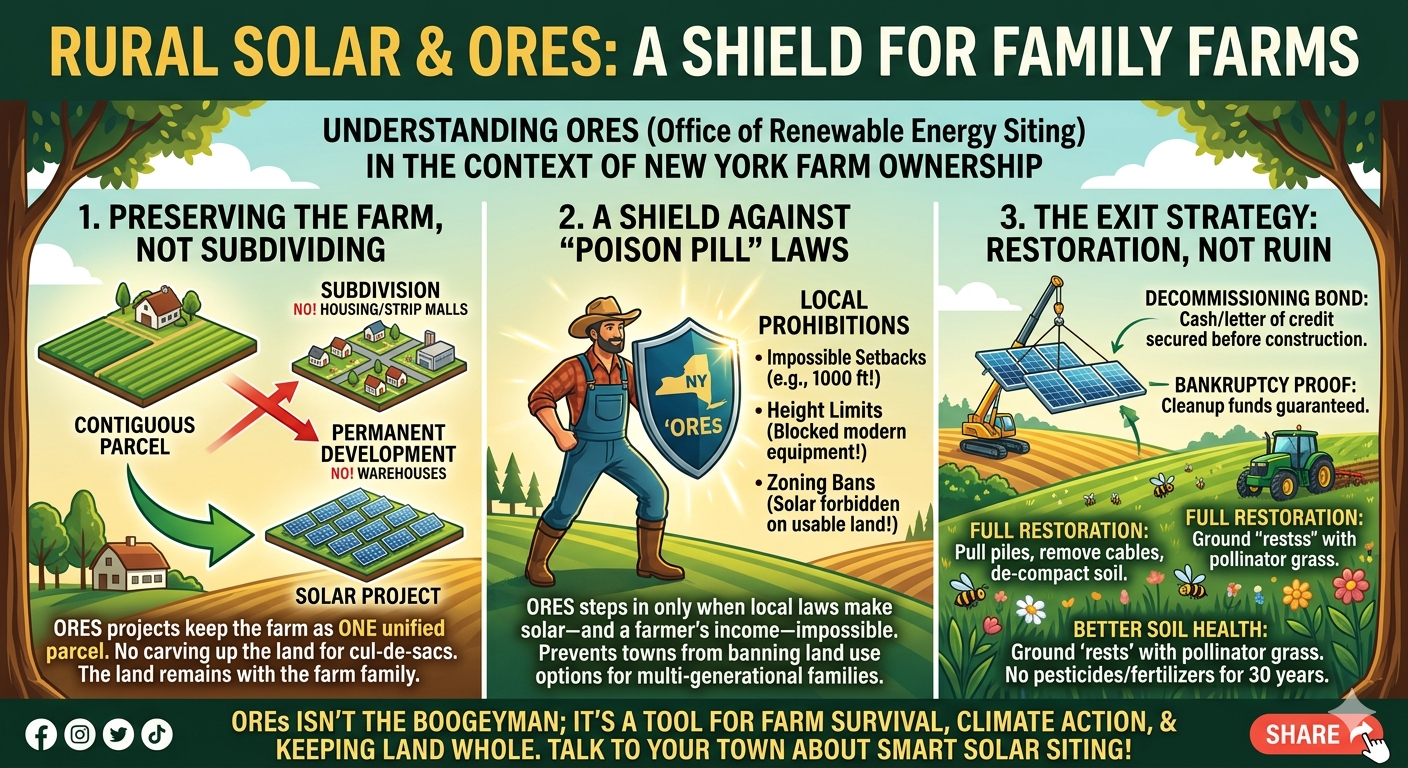
- Decommissioning Funds: To protect the “rural character” long-term, ORES requires developers to post a financial security (bond). This ensures that if the company goes belly-up, there is money set aside to remove the equipment and restore the land to its original state.
- Agricultural Mitigation: If a project uses “Prime Farmland,” the developer often has to pay a fee into a state fund dedicated to supporting permanent farmland protection in other parts of the state.
A Local Government “Steamroller”? 
The biggest misconception is that ORES exists to ignore municipalities. In reality, ORES only steps in on large-scale projects (systems larger than 25MW). ORES only overrides local laws when those laws make a project physically and economically impossible to build.
For example, ORES often intervenes when towns pass “poison pill” ordinances, such as:
- Impossible Setbacks: Requiring panels to be 500–1,000 feet from all property lines, which effectively wipes out the usable space on most parcels.
- Height Restrictions: Setting a maximum height of 6 feet, which doesn’t align with modern, efficient solar racking design.
- Total Zoning Bans: Prohibiting solar on all prime farmland or “active agricultural land,” which essentially bans the technology from the town entirely.
The standard ORES uses isn’t just “build whatever you want.” They look at whether local laws are unreasonably burdensome in light of the state’s climate and energy policy.
What is being approved? 

Over 30 major projects have been granted final siting permits by ORES since its inception. This represents more than 4 gigawatts of clean energy added to the state’s pipeline. There has been only one formal dismissal of a project application by ORES. The reason so few projects are “denied” at the final stage is that ORES uses a “redo” system rather than a “fail” system.
- The “Incomplete” Barrier: ORES has issued over 50 notices of incomplete application. Practically every project that has ever applied to the office has been sent back to the drawing board at least once for missing data or failing to meet standards.
- The Stealth Filter: Many projects never even make it to the official “application” phase. Developers often withdraw or abandon projects during the mandatory pre-application meetings if they realize they cannot meet ORES’s environmental or technical requirements.
- The “Only One” Denial: The single project that was formally dismissed—the Shepherd’s Run Solar project in Copake—wasn’t rejected because of local opposition, but because the developer lost control of the land they intended to build on.
On average, it takes about 3.7 years for a project to move from its first initial filing to receiving a final permit. The state’s legal deadline only starts ticking after the application is declared 100% complete—a status that itself takes an average of three years to reach.