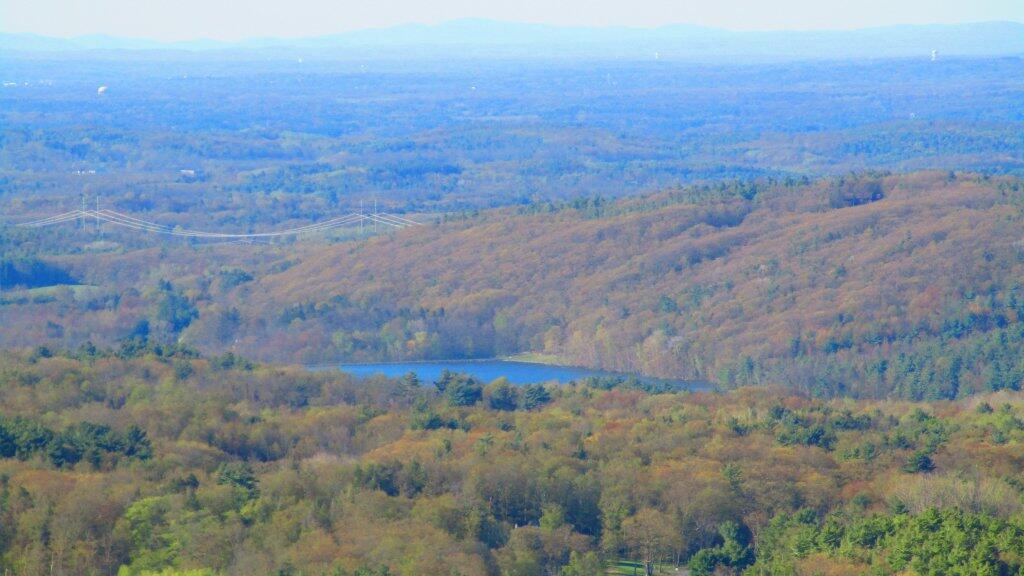
Vly Kill Reservior
Spring does seem to have reached the hills around the Vly Creek Reservior.
Wednesday May 13, 2020 — Bennett Hill Preserve
Spring does seem to have reached the hills around the Vly Creek Reservior.
Wednesday May 13, 2020 — Bennett Hill Preserve

The lone star tick, more common to the Southwest, is slowly pushing its way north and into New York state. They are already abundant on Long Island. Of the 84 ticks sent to his lab from Suffolk County, more than half were lone star ticks.
By contrast, just one of the 554 ticks sent in from Onondaga County was a lone star tick. Nearly all the rest, 523, were deer ticks. Thangamani said the lab also received one lone star tick from each of three other Upstate counties: Broome, Lewis and Monroe.
Lone star ticks don’t transmit Lyme disease, the most common illness caused by the far more abundant deer, or black-legged, tick. The lone star ticks can carry several other serious bacterial and viral diseases, however, and can also cause a bizarre allergy to red meat.
WASHINGTON — The United States is on track to produce more electricity this year from renewable power than from coal for the first time on record, new government projections show, a transformation partly driven by the coronavirus pandemic, with profound implications in the fight against climate change.
It is a milestone that seemed all but unthinkable a decade ago, when coal was so dominant that it provided nearly half the nation’s electricity. And it comes despite the Trump administration’s three-year push to try to revive the ailing industry by weakening pollution rules on coal-burning power plants.
Those efforts, however, failed to halt the powerful economic forces that have led electric utilities to retire hundreds of aging coal plants since 2010 and run their remaining plants less frequently. The cost of building large wind farms has declined more than 40 percent in that time, while solar costs have dropped more than 80 percent. And the price of natural gas, a cleaner-burning alternative to coal, has fallen to historic lows as a result of the fracking boom.
Now the coronavirus outbreak is pushing coal producers into their deepest crisis yet.
Removing map collars from historical topographic maps is easy. Just take the geotiff and then use the 1:24k topo index and run clip raster by vector. There is probably an faster more automated way of doing it, but it works well enough for my purposes.
Water knowledge questions had to do with how many Americans are burdened by the cost of water, how many get their water shut off, and the functions wetlands serve. On average, people answered less than half of those types of knowledge questions correctly.
Trust in Food, a Farm Journal initiative aimed at empowering farmers to adopt conservation practices, conducted a similar survey, gathering responses from over 900 farmers in 43 states, representing production in all nine of the USDA agriculture resource regions. The idea was to see where farmers mirrored the general population of the U.S., and where they might differ.
“Farmers do understand hydrologic cycles,” Kinsie Rayburn, Program Officer at Trust in Food, found. They have a high level of understanding how wetlands function, where rain water goes, and the source of the water they use in their day-to-day lives.