
Solar Project 📍

Researching and eventually putting together a solar electric system for truck camping this summer.

🖼️ Photos 📽️ Videos

Why I decided on a second 100-watt Renology panel for my new rig

I am moving the 100-watt Renology panel from my old truck cap over to the new one. Once I do that I plan to order a second panel of the same specs to mount right behind that one. I believe I have enough room on the truck cap to do that, and the existing panel has served me well that 8 years I have had it mounted to the truck for my needs.

At first I was hesitant to stay with the same set up as frankly those 100-watt Renology panels are overpriced on a per watt basis when some 450 watt residential panels can be had for a similiar prices. But the 100-watt Renology I’ve had has proven to be quite reliable and fits well. A second panel will be easier to mount too, as it will be flatter on the roof bend. And using two panels over one one panel has a major advantage with partial shading, which often is an issue with camping in woods. The new panel only adds 13.1 lbs to the roof is well within the caps’ design capacity with two panels and the kayak on the roof.

Indeed if I had good sunshine, the 100 watt panel would be more then sufficient to almost always be topped off as my lead-acid battery storage is pretty limited – and with remote start the SuperDuty is easy enough to start up to top off the batteries. Plus with the 6.8L engine, I am not worried about excessive idle causing premature wear when plenty of people leave their SuperDuty trucks idling all day – that’s part of the reason why the first generation 7.3L had lifter issues.

Almost tempted to order that second panel and install both at once, but I want to get the cap and measure out first before I start mounting the panels. I might also need to get another aluminum strip for mounting the second panel across. But it’s a summer project. I am also not sure if my existing PWM solar controller can handle two panels at maximum output, but I figure if necessary I’ll swap out for a MPPT controller should I have issues with the old one burning up or failing.
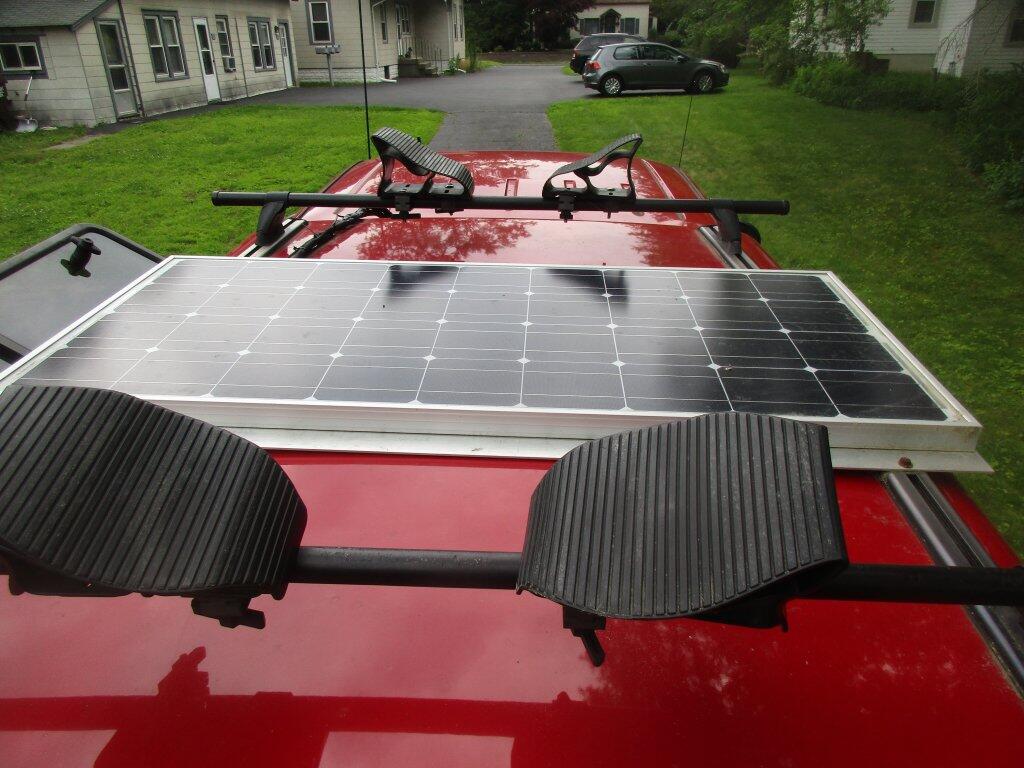
100 Watt Panel

Solar starting

While I do watch the voltage on the starting battery when I camp 🔋 it’s nice to know that solar panel is dumping excess charge into the starting battery ensuring that I can camp multiple days despite opening and closing the doors, using the dome light and other features, and it’s all automatic.

Finally changed the set point on the low voltage disconnect to address greater voltage drop on the accessory battery from the cold

Finally changed the set point on the low voltage disconnect to address greater voltage drop on the accessory battery from the cold. 🔋

It was so easy to do, beats having to either start the truck or hit the reset switch constantly in the cold.

Now I don’t like to abuse my batteries but disconnecting a load at 11.9 volts in the cold rather than 12.1 volts in the summer isn’t the biggest thing ever. Probably it’s still about the same level of discharge as the summer.

It’s easy enough to change that after I’m done winter camping this week I’ll reset it to 12.1 volts. I’ll have to keep this in mind for the future.

God’s alternator is working hard today

God’s alternator is working hard today … 🔋

Cold but sunny! No starting problems for me today when I go out later.

Wednesday, when I last went out to check the truck and knock the snow off it, the accessory battery bank was at 12.4 volts and starting battery at 12.3 volts. It was pretty cold, it was 3 days since I ran the truck, I had the lights on a while while I unpacked my truck on Sunday evening.

Today, with the sun and power flowing from the solar panel, the accessory batteries are at 14.3 volts and the starting battery at 12.8 volts. It looks like starting battery is taking a little longer to charge, but that’s normal as the system is set to charge the accessory batteries first, then once the voltage in system is above 14.1 volts to dump the excess power into the staring battery.

Solar Charger Scam

While lithium batteries are fairly good, I can tell you an advertisement for an 80,000 mAh USB battery bank is a scam. 80 amp hours even at just 5 volts, is 2/5th of a kilowatt hour — which is a lot of electricity to store in a little battery.

The 50 lb lead acid batteries in my truck — each only have about 50 amp hours of usable capacity (to be fair, at 12 volts). Trust me, you’re not going to take a 50 lb battery to the beach to charge your cellphone.

What are they doing to make this claim?
1) First off they’re measuring amp hours at the nominal voltage of the lithium ion batteries at 3.6 volts, ignoring losses in the boost converter, and that 1 amp at 3.6 volts is only 0.72 amp at 5 volts. But discount by the 80% with loses in the boost converter, so you are at .57 amp at 5 volts.

2) A really good 18650 cell — like a pricey one used in an electric car or high end laptop might have 3.5 amp-hour capacity. So the best case scenario if there is three really good 18650 cells in this unit, it could put out 10.5 amp hours or 10,500 mAh if your interested in inflating numbers.

3) But with loses in the boost converter, and the fact that when you increase voltage you decrease amperage, your talking about 5.98 amp hour or 5,980 mA hour if you want to sound impressive. But I doubt the Chinese cheapout 18650 cells in this put anywhere near that capacity.

So yes, these solar chargers are a scam. The solar cells themselves put out maybe 20 – 30 mAh of capacity, so don’t expect much charging unless you have days in the direct sun.