
Solar power is up and running on my truck’s camper shell. Accessory battery is charging at 14.5 volts all while the engine is shut off. Probably the battery will be fully charged soon and the solar controller will just be floating the charge. Everything is nice and tight, no rattles while driving, looks fairly neat. I think I did a nice job. Me happy.
May 17, 2018 8:21 pm Update
Solar panel mounted on my truck, but I still need to run the wires and hook up the fuse. I estimate it will do about 4 amps in bright sun or about 50% output due to lack of a perfect angle. The panel is 100 watt or 8.5 amp but we don’t have that kind of sunshine outside of laboratory.
Unless it’s a bright sunny day, parked in the sun all I probably won’t be able to get the accessory battery to full charge this way, but combined with the alternator running while driving, I should easily be able to get close to 100% most days camping after a 15-30 minute drive plus a few hours parked in the sun.
Can a 100 watt solar panel beat an occasionally run 150 amp alternator ?
A 100-watt solar panel which operates all day when the sun is it on will produce more energy than an alternator running only occasionally.
A 100-watt solar panel in theory can put 7.35 amps at 13.6 volts. In contrast, an 150 amp alternator, run at highway speeds can in theory put out 150 amps at 13.6 volts. Except that 150 amp alternator will put out nearly half as much electricity at idle or maybe 70 amps due to the engine running at half it’s highway speed, and that’s before the regular electrical loads of an engine’s computer and headlights take their bite out of power supply.
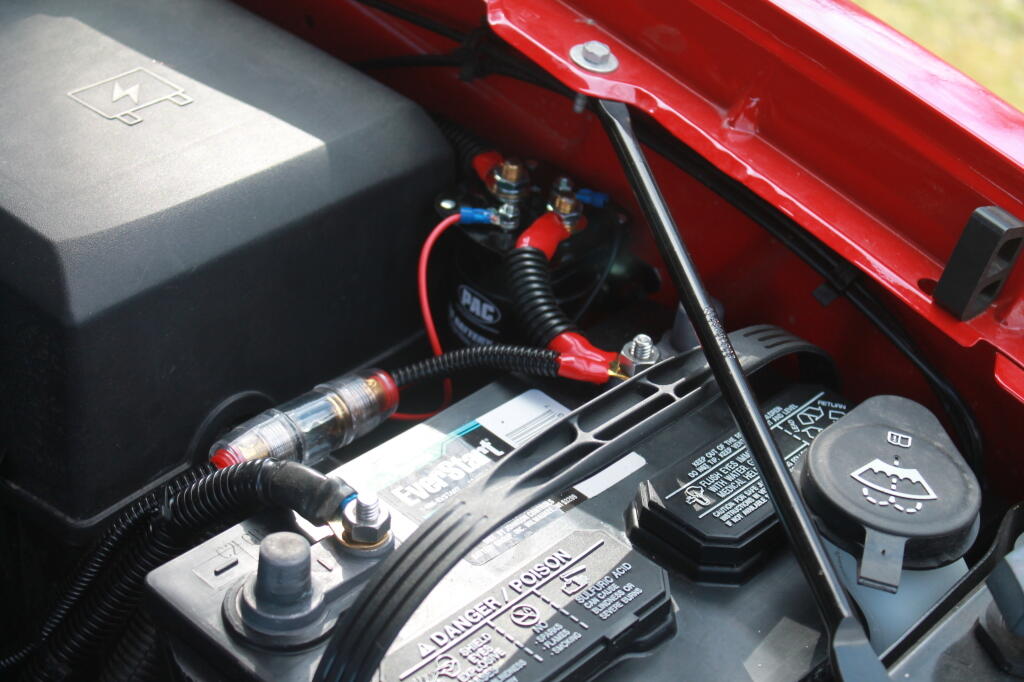
When I camp, I usually use my deep cycle battery mounted under my truck’s hood to power my campsite, radio, and other equipment. It works fairly well, but after a while, it becomes discharged and I need to start the truck’s engine to charge it back up for 10 minutes when I hear the low battery alarm or the truck’s computer notices a low battery. I probably have to do this once every 1.5 to 2 hours. This keeps the battery fairly healthy, but it’s still not as strong as when I first arrived at the campsite, after often hours of charging at the maximum necessary charge provided by the alternator.
Energy Math
Amps are the amount of current Voltage is with how much force the current is moving, e.g. 13.6 watts Wattage is amount of work consumed, e.g. 12 watt LED bulb Amp Hours are the number of amps consumed per hour Watt Hours are the number of watts consumed per hour Amp = Wattage / Voltage
The Truck’s Charging At Idle
Alternator Peak Output – 150 amp Typical Output at Idle (possibly lower after predatory loads) – 70 amp Voltage – 13.6 volts Charging Hours – 10 minutes every 1.5 hours = 0.11 hour charging Amp Hours Charged (over 1.5 hours) – 7.7 amp/hr Watt Hours Charged (over 1.5 hours) – 105 watt/hr Watt Hour Charged per 10 hour day (assuming I start the truck every 1.5 hours during 10 hours) – 0.7 kW/hr
100 watt solar cell
Solar Cell Output – 7.35 amp Realistic Solar Output – 5.1 amp (70% of maximum on sunny day) Voltage – 13.6 volts Charging Hours – 1.5 hour Amp Hours Charged (over 1.5 hours) – 7.7 amp/hr Watt Hours Charged (over 1.5 hours) – 105 watt/hr Watt Hour Charged per 10 hour day – 0.7 kW/hr

Solar camping preliminary graphics
I currently have a deep-cycle, second battery under the hood of my truck. It is connected to an 800-watt inverter under the back-seat of my truck.
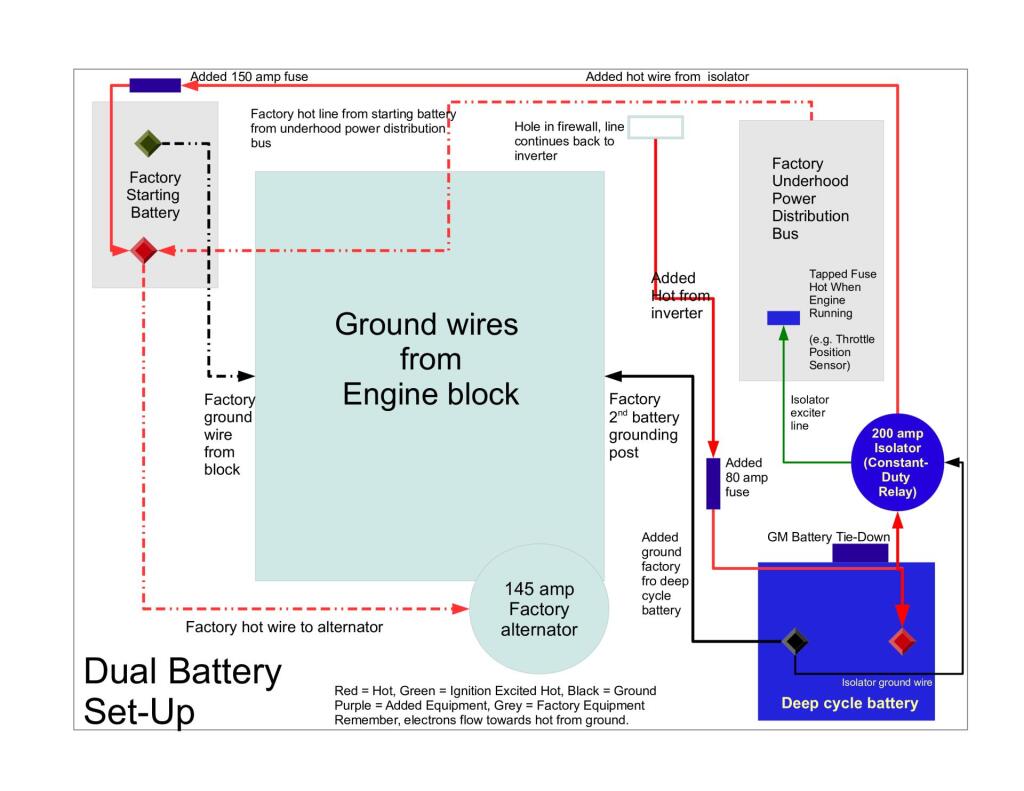
For days when I expect to be camping at a campsite for multiple days without moving the truck, I want to be able to provide the truck with solar power to charge the deep-cycle battery during the daytime and operate low-wattage appliances like an alarm clock, an AM/FM radio, and a CB Radio – and not have to start up the truck every couple of hours. If I plan to go out hiking, hunting, or fishing in the evening, it would be nice to be able to leave a light on campsite and know my battery wouldn’t start to discharge until close to dark.
I think a realistic estimate to power produced would be:
- 50-70 watt/hour on a sunny day
- 0.5-0.7 kW/hr for a 10-hour day
- 20-40 watt/hour on a cloudy/drizzle day or with moderate shade
- 0.2-0.4 kW/hr for a 10-hour day
Compared to the 2.2-3.2 kW/hr daily that I use in my apartment that is not a lot of electricity. But I am not planning running a refrigerator, electric hot water heater, or a electric stove on it. I also can just crank the truck up when I need more power from the alternator at night when I need more juice to keep the lights on.


Add solar power to your truck camper by Jeffrey Yago, P.E., CEM

A nice basic set up, although I don't want to mount my panel to my truck roof as I often park where it's shady and cool when camping in the summer.