More on the History of Burnt-Rossman Hills State Forest
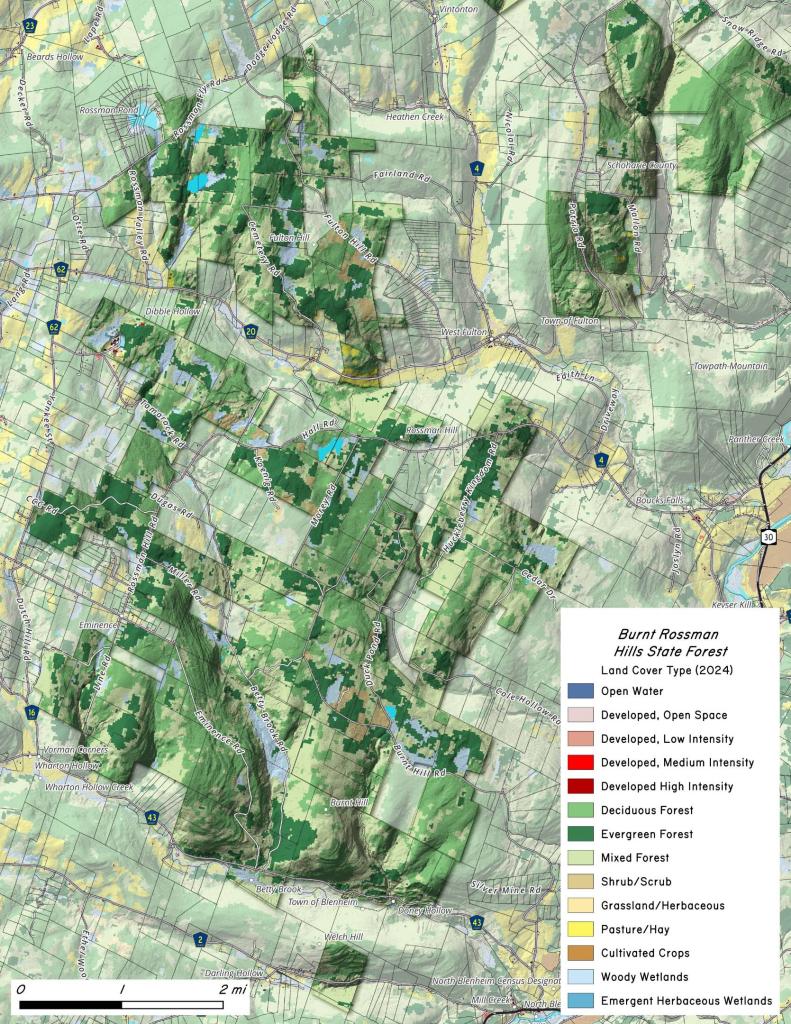
The history of Burnt-Rossman Hills State Forest is a classic American tale of environmental redemption. Spanning over 10,500 acres in Schoharie County, it is the largest state forest in the region—a vast state forest that belies a turbulent past of industrial exploitation, systemic wildfires, and ultimate restoration through Depression-era conservation.
In the 18th and 19th centuries, the landscape looked nothing like the dense woodland seen today. Under the Dutch-inspired “Patroon” system, tenant farmers worked the land without owning it. This lack of ownership fostered an extractive mindset; settlers cleared massive swaths of timber for sawmills, shingle factories, and tool manufacturing. By the late 1800s, the hills were stripped bare, and the thin, rocky soil was exhausted by unsustainable farming.
The forest’s unique name serves as a linguistic map of its geography and scars. “Rossman Hill” refers to one of the area’s primary peaks, but the “Burnt” in Burnt Hill tells a more visceral story. In the early 1900s, the area was frequently scorched by wildfires. Many of these were intentionally set by locals to encourage the growth of huckleberries—a lucrative crop that thrived in charred soil—earning one section of the forest the moniker “Huckleberry Kingdom.”
The turning point for Burnt-Rossman Hills came with the collapse of the local agricultural economy.
Following the Great Depression and the 1931 State Reforestation Law, New York began purchasing abandoned farmsteads for as little as $4.00 per acre. In 1934, the Civilian Conservation Corps (CCC) established a camp at Boucks Falls, located in the Town of Fulton. This “Tree Army” transformed the barren landscape, planting over 6 million tree seedlings across the broader Eminence Management Unit. They also engineered the infrastructure that remains the forest’s backbone today, including the CCC Road and various fire breaks.
In 1961, the Summit Shock Incarceration Camp (originally the Summit Youth Camp) was established nearby in the Town of Summit. Until its closure in 2011, Summit Shock inmates played a vital role in maintaining the forest’s health, performing tasks such as road maintenance, trail construction, and additional tree planting.
Today, hikers on the Long Path can still find the stone foundations of 19th-century water-powered sawmills in Doney Hollow or the weathered headstones at the Old Cemetery Road burial ground. These ruins, alongside the enduring infrastructure built by the CCC and the later contributions of Summit Shock, serve as quiet reminders that the towering pines of Burnt-Rossman Hills are not just a natural feature, but a carefully cultivated legacy of recovery.